Intestinal helminth infections in feral cats and a raccoon dog on Aphaedo Island, Shinan-gun, with a special note on Gymnophalloides seoi infection in cats
- PMID: 19488429
- PMCID: PMC2688804
- DOI: 10.3347/kjp.2009.47.2.189
Intestinal helminth infections in feral cats and a raccoon dog on Aphaedo Island, Shinan-gun, with a special note on Gymnophalloides seoi infection in cats
Abstract
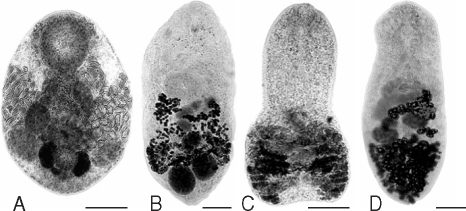
Four feral cats and a raccoon dog purchased from a local collector on Aphaedo Island, Shinan-gun, where human Gymnophalloides seoi infections are known to be prevalent, were examined for their intestinal helminth parasites. From 2 of 4 cats, a total of 310 adult G. seoi specimens were recovered. Other helminths detected in cats included Heterophyes nocens (1,527 specimens), Pygidiopsis summa (131), Stictodora fuscata (4), Acanthotrema felis (2), Spirometra erinacei (15), toxocarids (4), and a hookworm (1). A raccoon dog was found to be infected with a species of echinostome (55), hookworms (7), toxocarids (3), P. summa (3), and S. erinacei (1). No G. seoi was found in the raccoon dog. The results indicate that feral cats and raccoon dogs on Aphaedo are natural definitive hosts for intestinal trematodes and cestodes, including G. seoi, H. nocens, and S. erinacei. It has been first confirmed that cats, a mammalian species other than humans, play the role of a natural definitive host for G. seoi on Aphaedo Island.
Keywords: Gymnophalloides seoi; Heterophyes nocens; Pygidiopsis summa; cat; intestinal helminth; raccoon dog.
Figures
References
-
- Lee SH, Chai JY, Hong ST. Gymnophalloides seoi n. sp. (Digenea: Gymnophallidae), the first report of human infection by a gymnophallid. J Parasitol. 1993;79:677–680. - PubMed
-
- Ryang YS, Yoo JC, Lee SH, Chai JY. The Palearctic oystercatcher Haematopus ostralegus, a natural definitive host for Gymnophalloides seoi. J Parasitol. 2000;86:418–419. - PubMed
-
- Chai JY, Choi MH, Yu JR, Lee SH. Gymnophalloides seoi: a new human intestinal trematode. Trends Parasitol. 2003;19:109–112. - PubMed
-
- Lee SH, Park SK, Seo M, Guk SM, Choi MH, Chai JY. Susceptibility of various species of animals and strains of mice to Gymnophalloides seoi infection and the effects of immunosuppression in C3H/HeN mice. J Parasitol. 1997;83:883–886. - PubMed
Publication types
MeSH terms
LinkOut - more resources
Full Text Sources
Miscellaneous