


Effects of payment changes on trends in post-acute care
- PMID: 19490159
- PMCID: PMC2739024
- DOI: 10.1111/j.1475-6773.2009.00968.x
Effects of payment changes on trends in post-acute care
Abstract
Objective: To test how the implementation of new Medicare post-acute payment systems affected the use of inpatient rehabilitation facilities (IRFs), skilled nursing facilities (SNFs), and home health agencies.
Data sources: Medicare acute hospital, IRF, and SNF claims; provider of services file; enrollment file; and Area Resource File data.
Study design: We used multinomial logit models to measure realized access to post-acute care and to predict how access to alternative sites of care changed in response to prospective payment systems.
Data extraction methods: A file was constructed linking data for elderly Medicare patients discharged from acute care facilities between 1996 and 2003 with a diagnosis of hip fracture, stroke, or lower extremity joint replacement.
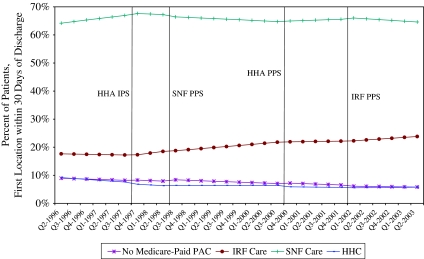
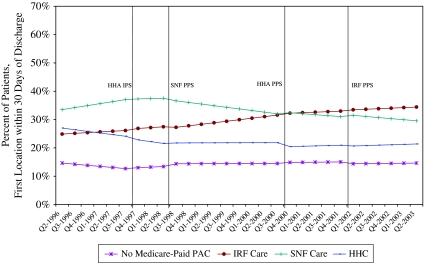
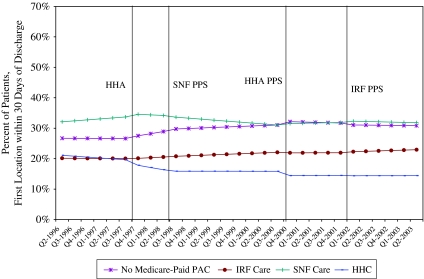
Principal findings: Although the effects of the payment systems on the use of post-acute care varied, most reduced the use of the site of care they directly affected and boosted the use of alternative sites of care. Payment system changes do not appear to have differentially affected the severely ill.
Conclusions: Payment system incentives play a significant role in determining where Medicare beneficiaries receive their post-acute care. Changing these incentives results in shifting of patients between post-acute sites.
Figures
References
-
- American Hospital Association (AHA) Statement by the Payment Systems for Medicare's Home Health Benefit. Hearing before the Subcommittee on Health of the Committee on Ways and Means, House of Representatives, August 6, 1998. 105th Congress, second session, serial no. 105–109, p. 174.
-
- Angelelli J, Gifford D, Intrator O, Gozalo P, Laliberte L, Mor V. Access to Postacute Nursing Home Care before and after the BBA. Balanced Budget Act. Health Affairs. 2002;21(5):254–64. - PubMed
-
- Aronow WS, Ahn C. Elderly Nursing Home Patients with Congestive Heart Failure after Myocardial Infarction Living in New York City Have a Higher Prevalence of Mortality in Cold Weather and Warm Weather Months. Journal of Gerontology Series A: Biological Sciences and Medical Sciences. 2004;59A:146–7. - PubMed
-
- Blewett LA, Kane RL, Finch M. Hospital Ownership of Post-Acute Care: Does it Increase Access to Post-Acute Care Services? Inquiry. 1995;32(4):457–67. - PubMed
Publication types
MeSH terms
Grants and funding
LinkOut - more resources
Full Text Sources
Medical
