


Impact of child malnutrition on the specific anti-Plasmodium falciparum antibody response
- PMID: 19490641
- PMCID: PMC2700128
- DOI: 10.1186/1475-2875-8-116
Impact of child malnutrition on the specific anti-Plasmodium falciparum antibody response
Abstract
Background: In sub-Saharan Africa, preschool children represent the population most vulnerable to malaria and malnutrition. It is widely recognized that malnutrition compromises the immune function, resulting in higher risk of infection. However, very few studies have investigated the relationship between malaria, malnutrition and specific immunity. In the present study, the anti-Plasmodium falciparum IgG antibody (Ab) response was evaluated in children according to the type of malnutrition.
Methods: Anthropometric assessment and blood sample collection were carried out during a cross-sectional survey including rural Senegalese preschool children. This cross-sectional survey was conducted in July 2003 at the onset of the rainy season. Malnutrition was defined as stunting (height-for-age <-2 z-scores) or wasting (weight-for-height <-2 z-scores). The analysis was performed on all malnourished children in July (n = 161, either stunted, n = 142 or wasted, n = 19), pair-matched to well-nourished controls. The IgG Ab response to P. falciparum whole extracts (schizont antigens) was assessed by ELISA in sera of the included children.
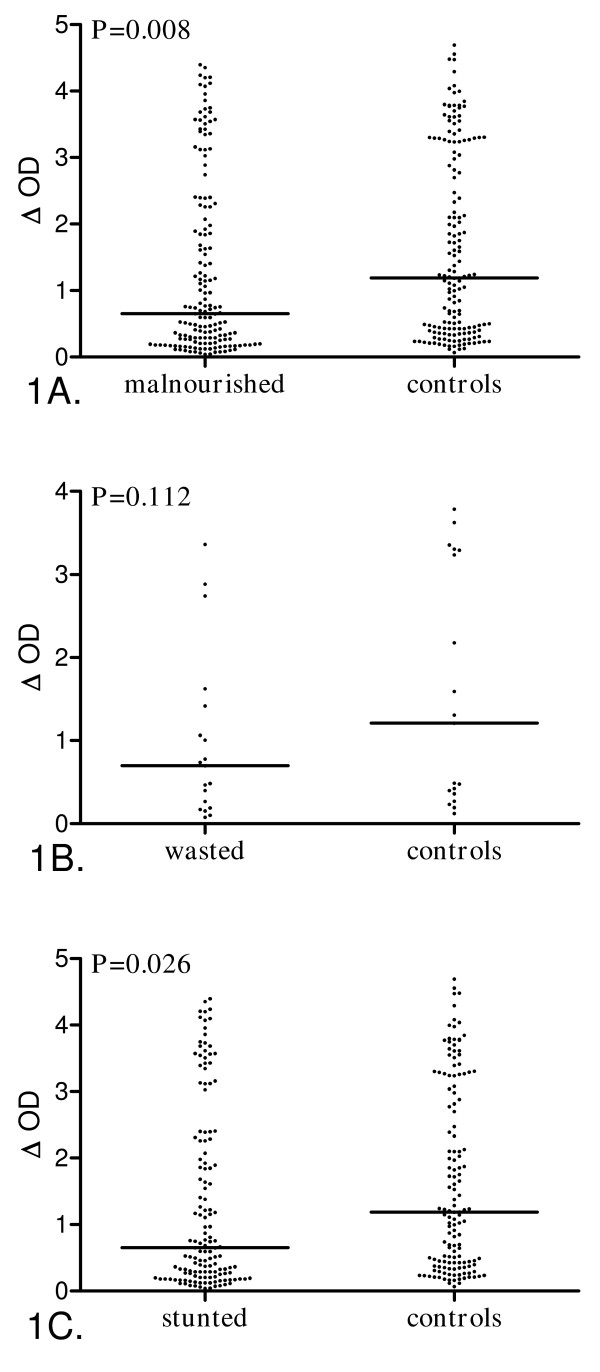
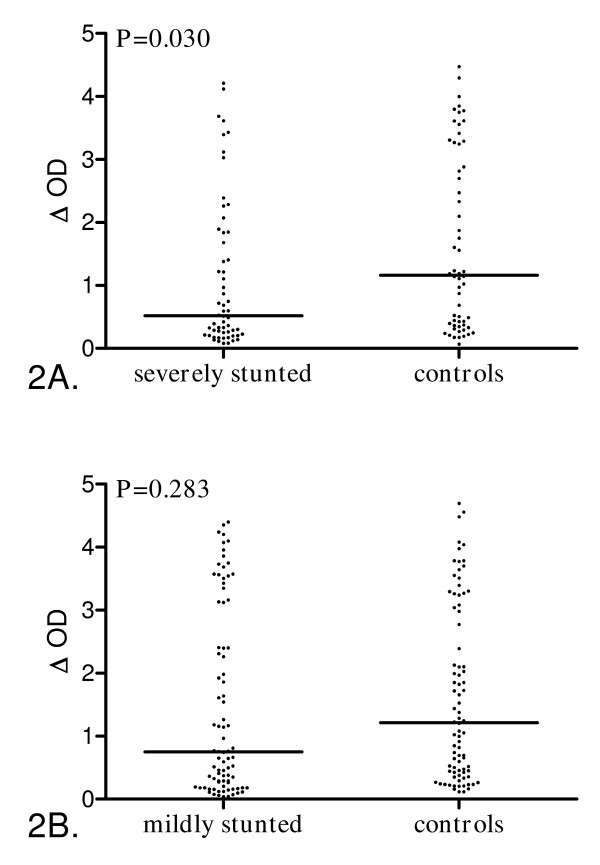
Results: Both the prevalence of anti-malarial immune responders and specific IgG Ab levels were significantly lower in malnourished children than in controls. Depending on the type of malnutrition, wasted children and stunted children presented a lower specific IgG Ab response than their respective controls, but this difference was significant only in stunted children (P = 0.026). This down-regulation of the specific Ab response seemed to be explained by severely stunted children (HAZ < or = -2.5) compared to their controls (P = 0.03), while no significant difference was observed in mildly stunted children (-2.5 < HAZ <-2.0). The influence of child malnutrition on the specific anti-P. falciparum Ab response appeared to be independent of the intensity of infection.
Conclusion: Child malnutrition, and particularly stunting, may down-regulate the anti-P. falciparum Ab response, both in terms of prevalence of immune responders and specific IgG Ab levels. This study provides further evidence for the influence of malnutrition on the specific anti-malarial immune response and points to the importance of taking into account child malnutrition in malaria epidemiological studies and vaccine trials.
Figures
References
-
- UNICEF, WHO Progress for Children: A World Fit for Children statistical review. 2007. pp. 19–24.
-
- Breman JG. The ears of the hippopotamus: manifestations, determinants, and estimates of the malaria burden. Am J Trop Med Hyg. 2001;64:1–11. - PubMed
-
- Caulfield LE, Richard SA, Black RE. Undernutrition as an underlying cause of malaria morbidity and mortality in children less than five years old. Am J Trop Med Hyg. 2004;71:55–63. - PubMed
Publication types
MeSH terms
Substances
LinkOut - more resources
Full Text Sources
Medical
