


The IRE1alpha-XBP1 pathway of the unfolded protein response is required for adipogenesis
- PMID: 19490910
- PMCID: PMC2963107
- DOI: 10.1016/j.cmet.2009.04.009
The IRE1alpha-XBP1 pathway of the unfolded protein response is required for adipogenesis
Abstract
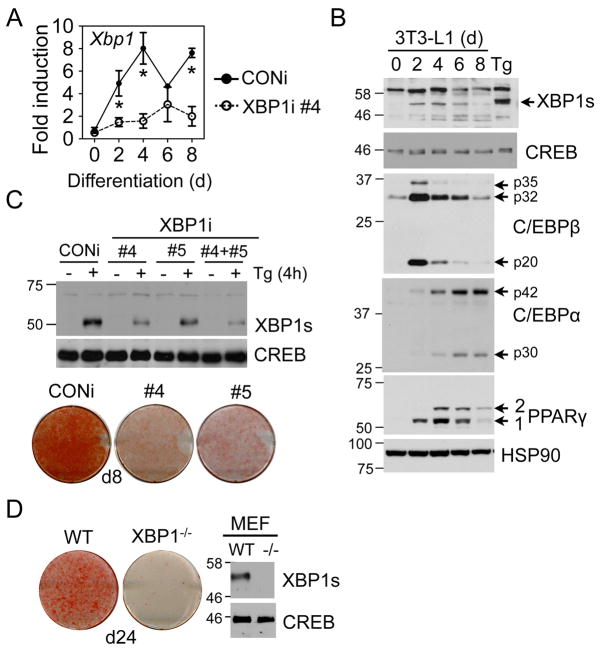
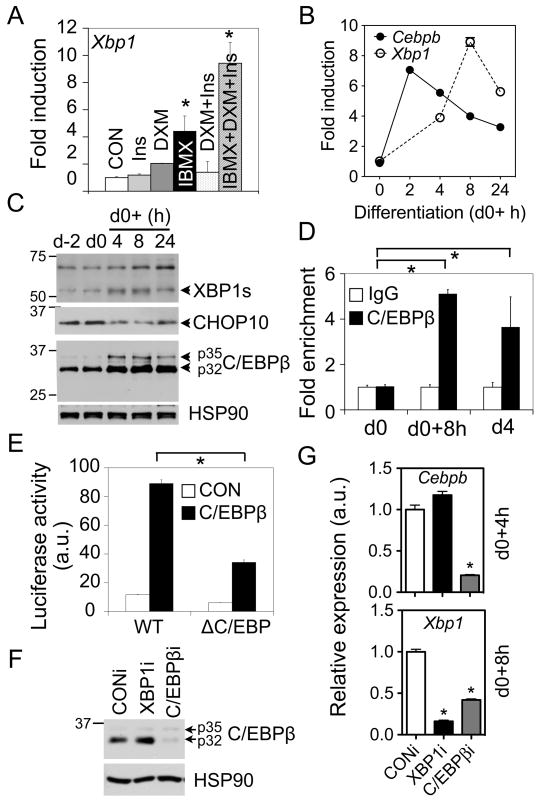
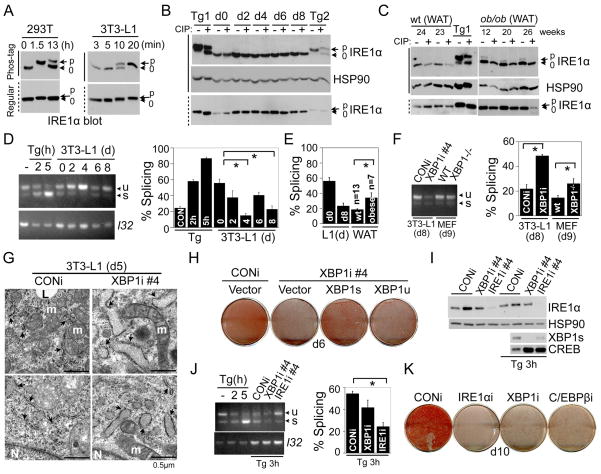
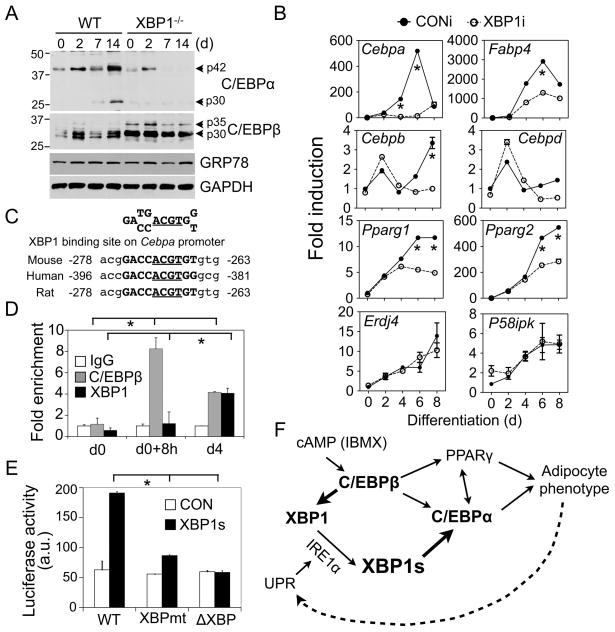
Signaling cascades during adipogenesis culminate in the expression of two essential adipogenic factors, PPARgamma and C/EBPalpha. Here we demonstrate that the IRE1alpha-XBP1 pathway, the most conserved branch of the unfolded protein response (UPR), is indispensable for adipogenesis. Indeed, XBP1-deficient mouse embryonic fibroblasts and 3T3-L1 cells with XBP1 or IRE1alpha knockdown exhibit profound defects in adipogenesis. Intriguingly, C/EBPbeta, a key early adipogenic factor, induces Xbp1 expression by directly binding to its proximal promoter region. Subsequently, XBP1 binds to the promoter of Cebpa and activates its gene expression. The posttranscriptional splicing of Xbp1 mRNA by IRE1alpha is required as only the spliced form of XBP1 (XBP1s) rescues the adipogenic defect exhibited by XBP1-deficient cells. Taken together, our data show that the IRE1alpha-XBP1 pathway plays a key role in adipocyte differentiation by acting as a critical regulator of the morphological and functional transformations during adipogenesis.
Figures
References
-
- Acosta-Alvear D, Zhou Y, Blais A, Tsikitis M, Lents NH, Arias C, Lennon CJ, Kluger Y, Dynlacht BD. XBP1 controls diverse cell type- and condition-specific transcriptional regulatory networks. Mol Cell. 2007;27:53–66. - PubMed
-
- Cao Z, Umek RM, McKnight SL. Regulated expression of three C/EBP isoforms during adipose conversion of 3T3-L1 cells. Genes Dev. 1991;5:1538–1552. - PubMed
-
- Clauss IM, Gravallese EM, Darling JM, Shapiro F, Glimcher MJ, Glimcher LH. In situ hybridization studies suggest a role for the basic region-leucine zipper protein hXBP-1 in exocrine gland and skeletal development during mouse embryogenesis. Dev Dyn. 1993;197:146–156. - PubMed
Publication types
MeSH terms
Substances
Grants and funding
LinkOut - more resources
Full Text Sources
Other Literature Sources
Molecular Biology Databases
