. 2009 Jul 28;48(29):6854-63.
doi: 10.1021/bi9002937.

Evidence for two retinoid cycles in the cone-dominated chicken eye

Affiliations

Evidence for two retinoid cycles in the cone-dominated chicken eye

Alberto Muniz et al. Biochemistry. .

Abstract

In the classic retinoid cycle, 11-cis retinol is synthesized in the retinal pigment epithelium (RPE) by two enzymes: Isomerase I (RPE65) and lecithin:retinol acyltransferase (LRAT). The purpose of this study is to provide experimental evidence for two active isomerases in the cone-dominated chicken eye: an LRAT-dependent Isomerase I in the RPE and an ARAT (acyl CoA:retinol acyltransferase)-dependent isomerase (Isomerase II) in the retina. First, we show that whole chicken retina in vitro, removed from the RPE/choroid and sclera, produces 11-cis retinoids upon light exposure, indicating the existence of RPE-independent isomerase (Isomerase II) activity in the retina. Reverse transcriptase polymerase chain reaction studies show high levels of RPE65 expression in the RPE, low levels in the retina, and none in primary Muller cell cultures, indicating the presence of Isomerase I in the RPE and a minimal amount in the retina. Activities of the RPE and retina isomerases were then measured by enzyme assays with specific enzyme inhibitors. 2,2'-Bipyridine, a known Isomerase I inhibitor, and N-ethylmaleimide (NEM), a known LRAT inhibitor, significantly reduced Isomerase I activity but not Isomerase II activity. Progesterone, a known ARAT inhibitor, completely blocked Isomerase II activity but not Isomerase I activity. Thus, this study reports novel results for distinguishing the biochemical properties of Isomerase I from those of Isomerase II, as well a difference in their locations in the chicken eye. On the basis of these differences, the cone-dominated chicken eye must contain two retinoid cycles: a classic visual cycle for retinoid exchange between the RPE and the retina supported by Isomerase I in the RPE and an additional visual cycle for retinoid processing in the retina supported by Isomerase II.


Figures
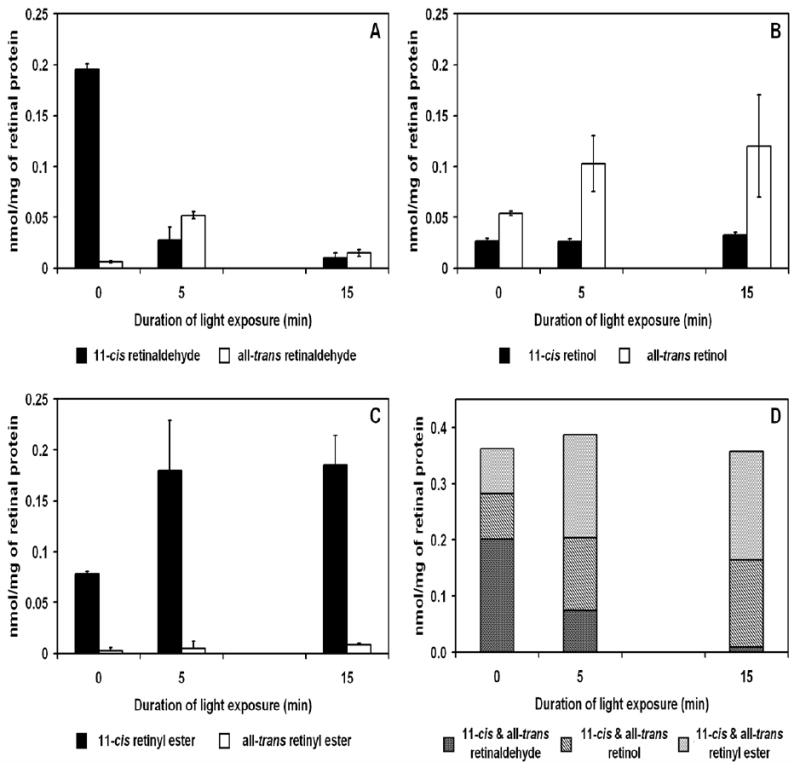
Figure 1
Figure 1
Changes in retinoid concentrations in response to light-adaptation in isolated chicken retina. Isolated dark adapted chicken retinas were light exposed (≈ 3000 lux) for indicated time intervals at 40°C. (A) Change in retinaldehyde concentrations (nmol/mg) in isolated retina when dark-adapted for 5 minutes and 15 minutes after light exposure. 11-cis Retinaldehyde decreased from 0.20 ± 0.01 to 0.01 ± 0.00 nmol/mg. All-trans Retinaldehyde increased after 5 minutes of light exposure and decreased back to near dark-adapted levels after 15 minutes of light exposure. (B) The decrease in 11-cis retinaldehyde was accompanied by a corresponding increase in all-trans retinol after light exposure while 11-cis retinol concentrations remained constant. (C) 11-cis Retinyl ester concentrations doubled from 0.08 ± 0.00 to 0.18 ± 0.03 nmol/mg after light exposure demonstrating the existence of isomerase in the isolated chicken retina. No change in all-trans retinyl ester concentrations was detected. (D) Total retinoid concentrations showed little variance under light or dark conditions. (n=3)
Figure 2
Figure 2
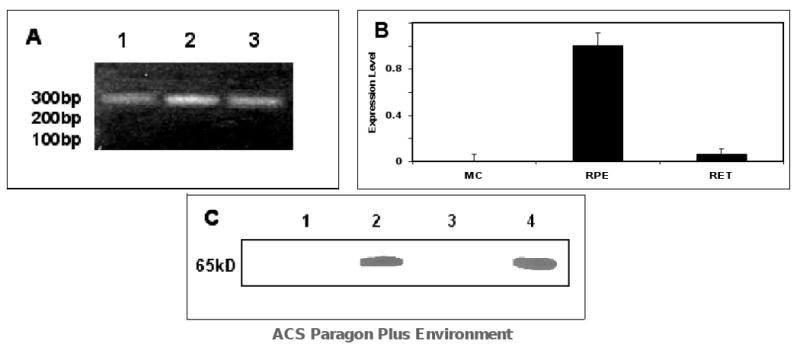
Expression of RPE65 in chicken primary Müller cell cultures, RPE, and retina by RT-PCR and Western Blot. (A) RPE65 product was confirmed by electrophoresis: Lanes: 1. PCR product from primary Müller cell cultures, 2. PCR product from chicken RPE, 3. PCR Product from chicken retina. (B) Normalized RPE65 expression levels in chicken primary Müller cell cultures, chicken RPE, and chicken retina (n=6). (C) Western blot anti-RPE65: Lane 1. chicken primary Müller cell culture homogenate, Lane 2. chicken RPE homogenate, Lane 3. chicken retina homogenate, Lane 4. Bovine RPE homogenate (positive control). 50 μg of protein was loaded in each lane. No detectable amounts of RPE65 were observed in the chicken retina or chicken primary Müller cell culture samples.
Figure 3
Figure 3
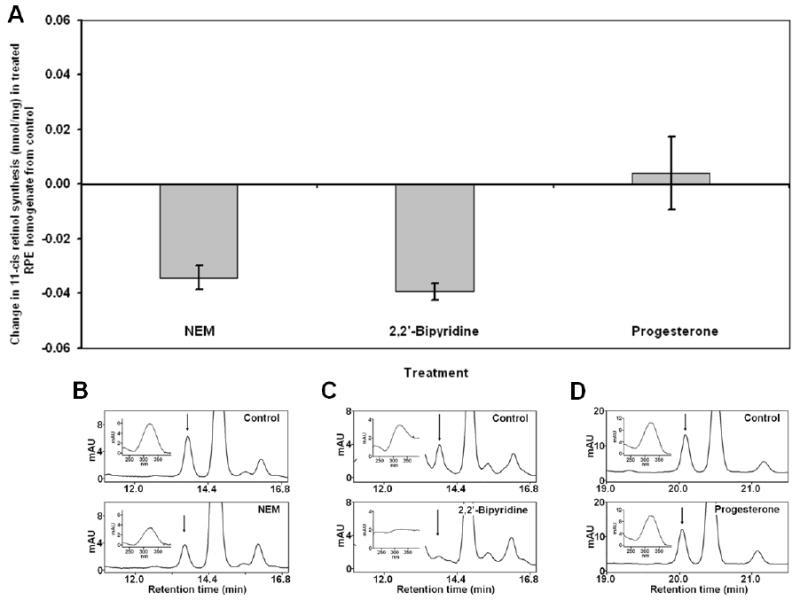
Inhibition of Isomerase activity in chicken RPE homogenate by NEM, 2,2′-bipyridine, and progesterone. Isomerase assays were performed on chicken RPE homogenates in the presence or absence of indicated inhibitors. The effect of treatment was determined by measuring the change in 11-cis retinol synthesized from treated RPE homogenate.from 11-cis retinol synthesized in control experiments. (A) Effect of NEM on RPE homogenate from control was -0.034 ± 0.004 nmol/mg. 2,2′-Bipyridine also provided an inhibitory effect on 11-cis retinol synthesis in RPE homogenate (-0.039 ± 0.003 nmol/mg). Progesterone had no significant effect on RPE retinoid isomerase activity (0.004 ± 0.013 nmol/mg). (B-D) Representative HPLC chromatograms of retinoid extracts from control and treated (NEM, 2,2′-Bipyridine, and progesterone from left to right) RPE homogenates. Insets show absorbance spectrum of HPLC peak indicated by arrow (11-cis retinol). (n = 3)
Figure 4
Figure 4
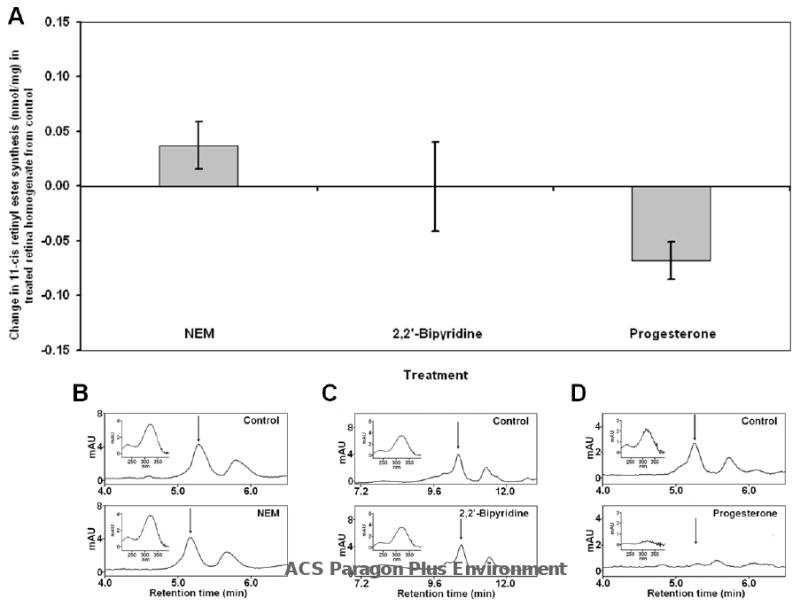
Inhibition of Isomerase activity in chicken retina homogenate by NEM, 2,2′-bipyridine, and progesterone. Isomerase assays were performed on chicken retina homogenates in the presence or absence of indicated inhibitors. The effect of treatment was determined by measuring the change in 11-cis retinyl esters synthesized from treated retina homogenate from 11-cis retinyl esters synthesized in control experiments. (A) Effect of NEM on retina homogenate from control was not significant 0.037 ± 0.021 nmol/mg. 2,2′-Bipyridine also produced no inhibitory effects on 11-cis retinyl ester synthesis in retina homogenate (-0.001 ± .041 nmol/mg). However, progesterone produced a significant inhibitory effect on the isomerase activity in the retina (-0.068 ± 0.017 nmol/mg). (B-D) Representative HPLC chromatograms of retinoid extracts from control and treated (NEM, 2,2′-bipyridine, and progesterone from left to right) retinal homogenates. Insets show absorbance spectrum of HPLC peak indicated by arrow (11-cis retinyl ester). (n = 3)
Figure 5
Figure 5
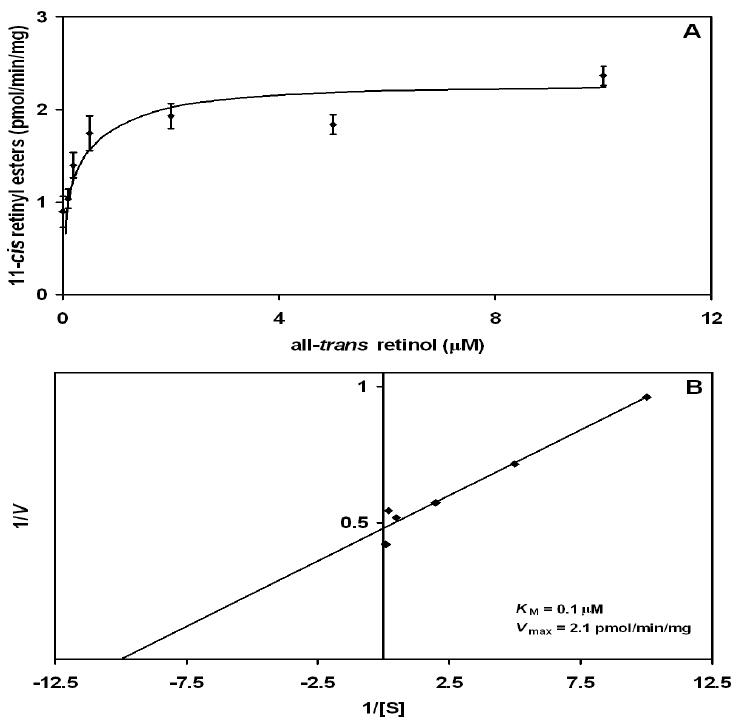
Enzyme kinetics of the formation of 11-cis retinyl esters from all-trans retinol substrate in chicken retina homogenate. (A) Saturation curve of Isomerase II in chicken retina homogenate. Protein was incubated with increasing concentrations of all-trans retinol while maintaining constant palm-CoA concentrations. (B) Lineweaver-Burk plot conversion of the substrate saturation curve yielded apparent kinetic constants: Vmax = 2.10 pmol/min/mg and KM = 0.10 μM. Protein saturation experiments were conducted from 0.0 μg to 1000.0 μg/ml of chicken retina homogenate. 1000.0 μg/ml of chicken retina homogenate was used for all kinetic studies. 11-cis Retinyl esters were undetectable at protein concentrations lower than 1000.0 μg/ml. Synthesis of 11-cis retinoids was not observed when protein was heated to 90°C for 5 minutes prior to incubation (data not shown).
Figure 6
Figure 6
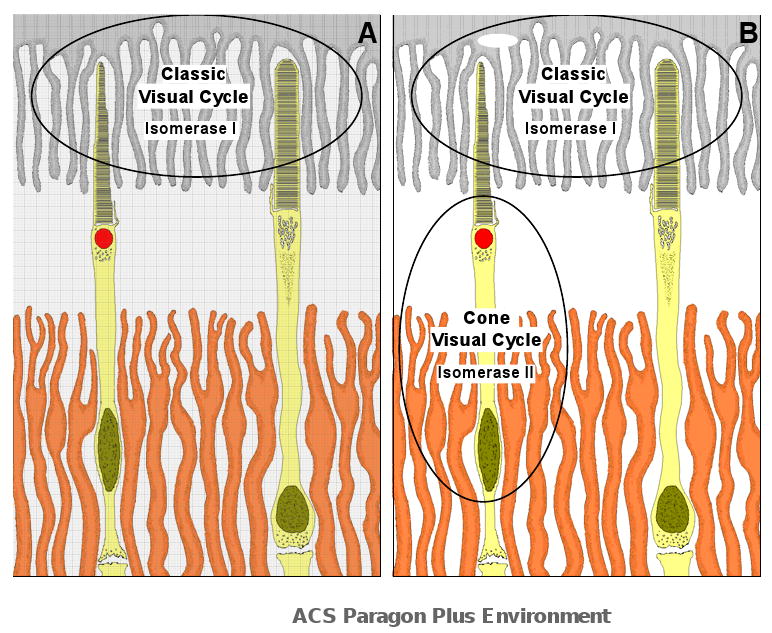
Location of two visual cycles involving exchange of retinoids between photoreceptors and RPE (classic, canonical visual cycle) or Müller cells (cone visual cycle). (A) The classic visual cycle involving both rod and cone photoreceptors and RPE (grey shade), operates under light illumination. All-trans retinaldehyde released from photopigments are reduced and transported from the outer segment to the RPE where they are processed (esterified, hydroisomerized, oxidized) to become 11-cis-retinaldehyde and returned to the photoreceptor for pigment regeneration (1-5). This visual cycle is supported by Isomerase I (RPE 65) and LRAT. Under intense light illumination, the rate of cone pigment regeneration exceeds the rate of chromophore recovery from the classic visual cycle and an additional visual cycle to supply chromophore for cone pigment regeneration occurs between cone outer segment and Müller cells (orange shade) in the retina (B). All-trans retinaldehyde released from cone pigments are transported from the cone outer segment to Müller cells (30;31) where they are processed (esterified and isomerized) to become cis-retinoids and returned to the cone photoreceptors for pigment regeneration (8;11;13). This visual cycle is supported by Isomerase II (an unidentified protein). It is not known how the cone cycle is activated by intense light illumination or how chromophores are selectively transported to the RPE and to the Müller cell (when both cycles are in operation). In addition, the relative contribution of chromophore (from the RPE and the Müller cells) for pigment regeneration is also not known. However, IRBP has been implicated as the transport protein for retinal chromophore for both visual cycles (46). Based on results in the present study, the classic visual cycle in the chicken RPE is supported by RPE65 (Isomerase I). Isomerase I was inhibited by 2,2′-bipyridine (an iron chelator), NEM (an LRAT inhibitor) but not by progesterone (an ARAT inhibitor). In contrast, Isomerase II activity is inhibited by progesterone but not by 2,2′-bipyridine and NEM. Based on results from enzyme assays, Isomerase I produced cis-retinoids at a rate 6 times faster than Isomerase II in the chicken eye, suggesting a faster recovery of visual chromophores from the classic visual cycle. This schematic diagram was adopted from a previous anatomical study of the chicken retina (47).

References

    1. Crouch RK, Chader GJ, Wiggert B, Pepperberg DR. Retinoids and the visual process. Photochem Photobiol. 1996;64(4):613–621. - PubMed
    1. Saari JC. Biochemistry of visual pigment regeneration: the Friedenwald lecture. Invest Ophthalmol Vis Sci. 2000;41(2):337–348. - PubMed
    1. McBee JK, Palczewski K, Baehr W, Pepperberg DR. Confronting complexity: the interlink of phototransduction and retinoid metabolism in the vertebrate retina. Prog Retin Eye Res. 2001;20(4):469–529. - PubMed
    1. Rando RR. The biochemistry of the visual cycle. Chem Rev. 2001;101(7):1881–1896. - PubMed
    1. Lamb TD, Pugh EN., Jr Dark adaptation and the retinoid cycle of vision. Prog Retin Eye Res. 2004;23(3):307–380. - PubMed

Publication types