


Drug interactions with new and investigational antiretrovirals
- PMID: 19492868
- PMCID: PMC2857544
- DOI: 10.2165/00003088-200948040-00001
Drug interactions with new and investigational antiretrovirals
Abstract
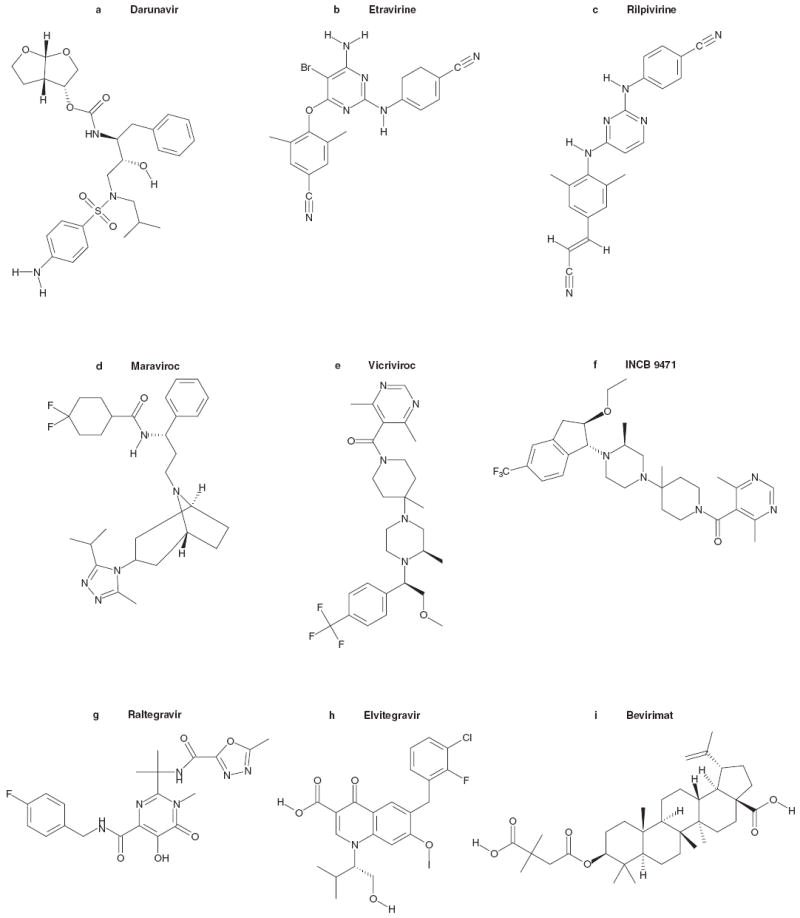
More than 20 individual and fixed-dose combinations of antiretrovirals are approved for the treatment of human immunodeficiency virus (HIV) infection. However, owing to the ongoing limitations of drug resistance and adverse effects, new treatment options are still required. A number of promising new agents in existing or new drug classes are in development or have recently been approved by the US FDA. Since these agents will be used in combination with other new and existing antiretrovirals, understanding the potential for drug interactions between these compounds is critical to their appropriate use. This article summarizes the drug interaction potential of new and investigational protease inhibitors (darunavir), non-nucleoside reverse transcriptase inhibitors (etravirine and rilpivirine), chemokine receptor antagonists (maraviroc, vicriviroc and INCB 9471), integrase inhibitors (raltegravir and elvitegravir) and maturation inhibitors (bevirimat).
Conflict of interest statement
The other authors have no conflicts of interest that are directly relevant to the content of this review.
Figures
Comment in
-
Drug interactions with new and investigational antiretrovirals.Clin Pharmacokinet. 2010;49(1):67-8; author reply 68-9. doi: 10.2165/11531240-000000000-00000. Clin Pharmacokinet. 2010. PMID: 20020564 No abstract available.
Similar articles
-
Minimal pharmacokinetic interaction between the human immunodeficiency virus nonnucleoside reverse transcriptase inhibitor etravirine and the integrase inhibitor raltegravir in healthy subjects.Antimicrob Agents Chemother. 2008 Dec;52(12):4228-32. doi: 10.1128/AAC.00487-08. Epub 2008 Oct 6. Antimicrob Agents Chemother. 2008. PMID: 18838586 Free PMC article. Clinical Trial.
-
New antiretroviral drugs.Curr HIV/AIDS Rep. 2006 Jul;3(2):93-101. doi: 10.1007/s11904-006-0024-z. Curr HIV/AIDS Rep. 2006. PMID: 16608666 Review.
-
New drugs.J HIV Ther. 2008 Jun;13(2):27-33. J HIV Ther. 2008. PMID: 18953271 No abstract available.
-
The clinical pharmacology of antiretrovirals in development.Expert Opin Drug Metab Toxicol. 2006 Jun;2(3):447-58. doi: 10.1517/17425255.2.3.447. Expert Opin Drug Metab Toxicol. 2006. PMID: 16863445 Review.
-
Pharmacokinetics of antiretroviral drugs in anatomical sanctuary sites: the male and female genital tract.Antivir Ther. 2011;16(8):1149-67. doi: 10.3851/IMP1919. Antivir Ther. 2011. PMID: 22155899 Review.
Cited by
-
Disease-drug and drug-drug interaction in COVID-19: Risk and assessment.Biomed Pharmacother. 2021 Jul;139:111642. doi: 10.1016/j.biopha.2021.111642. Epub 2021 Apr 27. Biomed Pharmacother. 2021. PMID: 33940506 Free PMC article. Review.
-
Effects of rilpivirine, 17β-estradiol and β-naphthoflavone on the inflammatory status of release of adipocytokines in 3T3-L1 adipocytes in vitro.Mol Biol Rep. 2019 Jun;46(3):2643-2655. doi: 10.1007/s11033-019-04671-4. Epub 2019 Mar 29. Mol Biol Rep. 2019. PMID: 30927158
-
Drug interactions with new and investigational antiretrovirals.Clin Pharmacokinet. 2010;49(1):67-8; author reply 68-9. doi: 10.2165/11531240-000000000-00000. Clin Pharmacokinet. 2010. PMID: 20020564 No abstract available.
-
Progress in structure-based drug development targeting chemokine receptors.Front Pharmacol. 2025 Jun 9;16:1603950. doi: 10.3389/fphar.2025.1603950. eCollection 2025. Front Pharmacol. 2025. PMID: 40552145 Free PMC article. Review.
-
MDR1 and BCRP Transporter-Mediated Drug-Drug Interaction between Rilpivirine and Abacavir and Effect on Intestinal Absorption.Antimicrob Agents Chemother. 2017 Aug 24;61(9):e00837-17. doi: 10.1128/AAC.00837-17. Print 2017 Sep. Antimicrob Agents Chemother. 2017. PMID: 28696229 Free PMC article.
References
-
- Prezista® (darunavir) tablet: US prescribing information. Raritan (NJ): Tibotec Therapeutics, 2008 Dec. [2009 Mar 25]. [online]. Available from URL: http://www.prezista.com/prezista/documents/us_package_insert.pdf.
-
- Sekar V, Spinosa-Guzman S, Lefebvre E, et al. Clinical pharmacology of TMC114 – a potent HIV protease inhibitor. XVI International AIDS Conference; 2006 Aug 13-18; Toronto (ON). abstract no. TUPE0083.
-
- Sekar V, De Meyer S, Vangeneugden T, et al. Pharmacokinetic/pharmacodynamic analyses of TMC114 in the POWER 1 and POWER 2 trials in treatment-experienced HIV-infected patients. 13th Conference on Retroviruses and Opportunistic Infections; 2006 Feb 5-8; Denver (CO).
Publication types
MeSH terms
Substances
Grants and funding
LinkOut - more resources
Full Text Sources
Other Literature Sources
Medical
