Review
. 2009 Jun;265(6):663-79.
doi: 10.1111/j.1365-2796.2009.02098.x.

Cholinergic control of inflammation

Affiliations
Review

Cholinergic control of inflammation

M Rosas-Ballina et al. J Intern Med. 2009 Jun.

Abstract

Cytokine production is necessary to protect against pathogens and promote tissue repair, but excessive cytokine release can lead to systemic inflammation, organ failure and death. Inflammatory responses are finely regulated to effectively guard from noxious stimuli. The central nervous system interacts dynamically with the immune system to modulate inflammation through humoral and neural pathways. The effect of glucocorticoids and other humoral mediators on inflammatory responses has been studied extensively in the past decades. In contrast, neural control of inflammation has only been recently described. We summarize autonomic regulation of local and systemic inflammation through the 'cholinergic anti-inflammatory pathway', a mechanism consisting of the vagus nerve and its major neurotransmitter, acetylcholine, a process dependent on the nicotinic acetylcholine receptor alpha7 subunit. We recapitulate additional sources of acetylcholine and their contribution to the inflammatory response, as well as acetylcholine regulation by acetylcholinesterase as a means to attenuate inflammation. We discuss potential therapeutic applications to treat diseases characterized by acute or chronic inflammation, including autoimmune diseases, and propose future research directions.


Figures
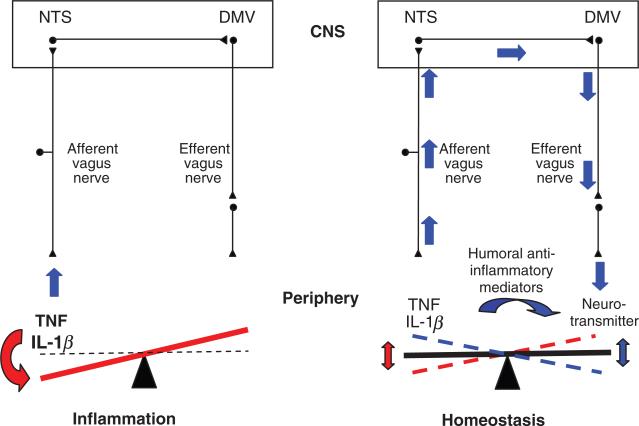
Fig. 1
Fig. 1
Inflammatory reflex. Pathogens and tissue damage induce release of cytokines, which serve to limit the extent of infection and promote tissue repair. Humoral and neural regulatory pathways regulate the magnitude of the inflammatory response. Cytokines released at the inflammatory site activate afferent fibres of the vagus nerve and reach the nucleus tractus solitarius in the brain stem, thus providing the autonomic nervous system information regarding peripheral inflammatory status. Compensatory signals are conveyed by the efferent vagus nerve and reach the site of inflammation where neurotransmitters act upon macrophages and other cells of the immune system to attenuate the inflammatory response. NTS, nucleus tractus solitarius; DMV, dorsal motor nucleus of the vagus; CNS, central nervous system.
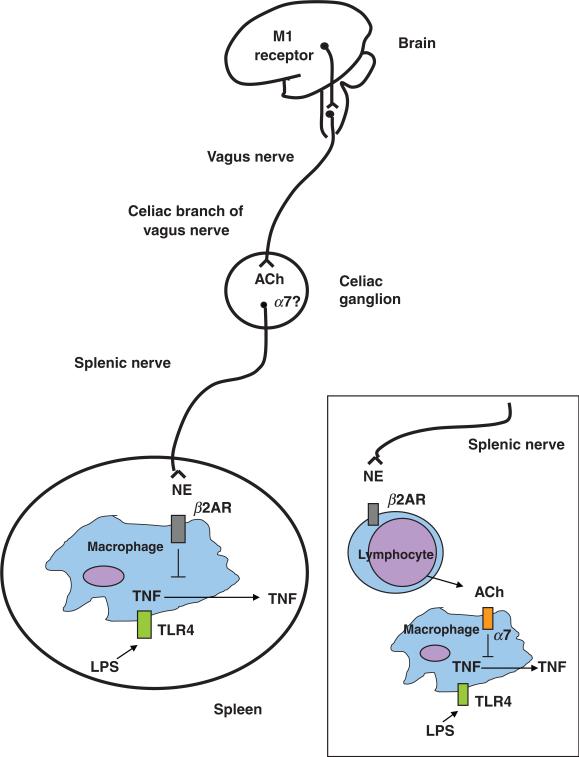
Fig. 2
Fig. 2
The cholinergic anti-inflammatory pathway, the efferent arm of the inflammatory reflex, is composed of the vagus nerve and its major neurotransmitter, acetylcholine. Electrical stimulation of the cervical vagus nerve attenuates systemic TNF through a pathway that requires the α7 subunit of the nicotinic acetylcholine receptor. Administration of α7 agonists or activation of a brain cholinergic network that depends on M1 muscarinic receptors and increases vagus nerve activity, attenuate systemic TNF levels. Two-neuron model of vagus nerve modulation of cytokine production via the splenic nerve: the preganglionic neuron, originates in the dorsal motor nucleus of the vagus; the postganglionic neuron, located in ganglia of the celiac-superior mesenteric plexus, reaches the spleen through the splenic nerve. In this model, electrical stimulation of the cervical vagus nerve attenuates systemic TNF through a pathway that requires the α7 subunit of the nicotinic acetylcholine receptor, the splenic nerve and catecholamines. Vagus nerve firing would modulate norepinephrine release by the splenic nerve. In this scenario, release of norepinephrine by the splenic nerve would act on β2-adrenergic receptors expressed on macrophages to attenuate TNF, and α7 expressed on neurons of the celiac/superior mesenteric plexus would convey signals between the vagus and the splenic nerve. An alternate possibility is that norepinephrine originating from splenic nerve terminals induces release of acetylcholine from cell sources other than neurons (e.g. lymphocytes), which would then act on α7 expressed on macrophages to attenuate TNF. NE, norepinephrine; β2AR, beta2-adrenergic receptor; ACh, acetylcholine.
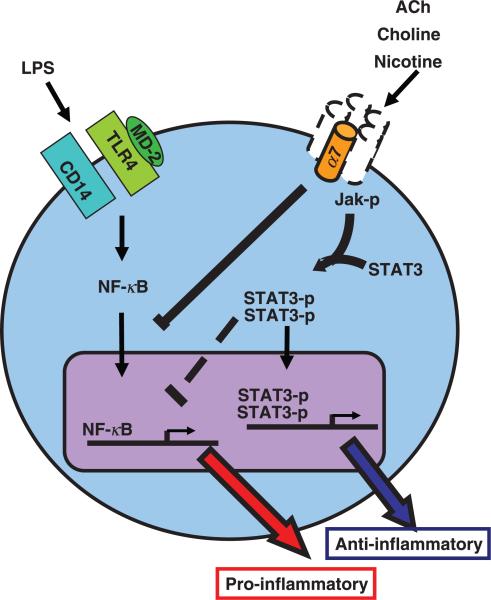
Fig. 3
Fig. 3
Cholinergic signalling through α7. Activation of α7 in endotoxin-stimulated macrophages leads to reduced proinflammatory cytokine production and decreased translocation of NF-κB into the cell nucleus. In peritoneal macrophages, activation of α7 leads to recruitment and activation of Jak2 with subsequent STAT3 activation. Whether these pathways converge or function independently to attenuate pro-inflammatory cytokine production is not known. Also unknown is the subunit composition of α7-containing nicotinic acetylcholine receptors (homomer versus heteromer) in macrophages and whether they function as calcium channels. Dotted lines represent unknown α7 signalling components or events.

References

    1. Serhan CN, Savill J. Resolution of inflammation: the beginning programs the end. Nat Immunol. 2005;6:1191–7. - PubMed
    1. Riedemann NC, Guo RF, Ward PA. Novel strategies for the treatment of sepsis. Nat Med. 2003;9:517–24. - PubMed
    1. Calandra T, Roger T. Macrophage migration inhibitory factor: a regulator of innate immunity. Nat Rev Immunol. 2003;3:791–800. - PMC - PubMed
    1. Qin S, Wang H, Yuan R, et al. Role of HMGB1 in apoptosis-mediated sepsis lethality. J Exp Med. 2006;203:1637–42. - PMC - PubMed
    1. Wang H, Bloom O, Zhang M, et al. HMG-1 as a late mediator of endotoxin lethality in mice. Science. 1999;285:248–51. - PubMed