


Is there an advantage in scoring early embryos on more than one day?
- PMID: 19493872
- PMCID: PMC2727402
- DOI: 10.1093/humrep/dep198
Is there an advantage in scoring early embryos on more than one day?
Abstract
Background: This study was undertaken to determine what characteristics should be recorded on which days to build a predictive model for selection of Day 3 embryos.
Methods: Embryos failing to form a clinical sac or that formed a viable fetus (to > or =12 weeks), and transferred singly (n = 269) or in pairs (n = 1326) were scored for early cleavage and pronuclear status on Day 1, and cell number, fragmentation, and symmetry on Days 2 and 3, with number of nuclei per blastomere also recorded on Day 2. Seven candidate models were identified using a priori clinical knowledge and univariate analyses. Each model was fit on a training-set and evaluated on a test-set with resampling, with discrimination assessed using the area under the ROC curve (AUC) and calibration assessed using the Hosmer-Lemeshow statistics.
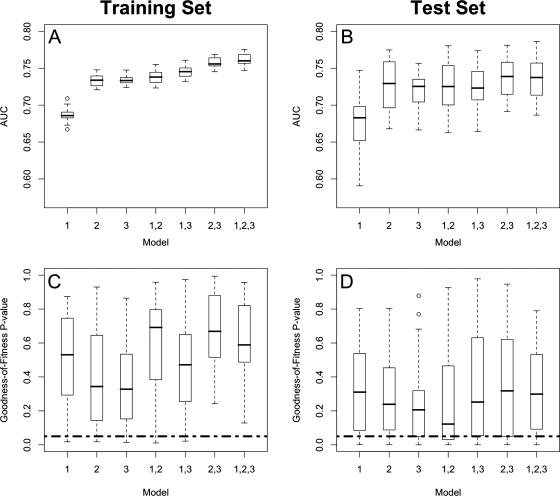
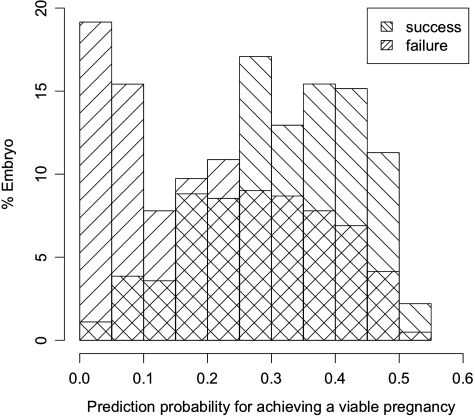
Results: Models built using Day 1, 2 or 3 scores independently on the 30 resampled data sets showed that Day 1 evaluations provided the poorest predictive value (median AUC = 0.683 versus 0.729 and 0.725, for Day 2 and 3). Combining information from Day 1, 2 and 3 marginally improved discrimination (median AUC = 0.737). Using the final Day 3 model fitted on the whole dataset, the median AUC was 0.732 (95% CI, 0.700-0.764), and 68.6% of embryos would be correctly classified with a cutoff probability equal to 0.3.
Conclusions: Day 2 or Day 3 evaluations alone are sufficient for morphological selection of cleavage stage embryos. The derived regression coefficients can be used prospectively in an algorithm to rank embryos for selection.
Figures
References
-
- Booth PJ, Watson TJ, Leese HJ. Prediction of porcine blastocyst formation using morphological, kinetic, and amino acid depletion and appearance criteria determined during the early cleavage of in vitro-produced embryos. Biol Reprod. 2007;77:765–779. - PubMed
-
- Brison DR, Hollywood K, Arnesen R, Goodacre R. Predicting human embryo viability: the road to non-invasive analysis of the secretome using metabolic footprinting. Reprod BioMed Online. 2007;15:296–302. - PubMed
-
- Cook NR. Use and misuse of the receiver operating characteristic curve in risk prediction. Circulation. 2007;115:928–935. - PubMed
-
- Cummins JM, Breen TM, Harrison KL, Shwan JM, Wilson LM, Hennessey JF. A formula for scoring human embryo growth rates in in vitro fertilization: its value in predicting pregnancy and in comparison with visual estimates of embryo quality. J In Vitro Fert Embryo Transf. 1986;3:284–295. - PubMed
-
- Desai N, Goldstein J, Rowland DY, Goldfarb MJ. Morphological evaluation of human embryos and derivation of an embryo quality system specific for day 3 embryos: a preliminary study. Hum Reprod. 2000;15:2190–2196. - PubMed
Publication types
MeSH terms
Grants and funding
LinkOut - more resources
Full Text Sources
Other Literature Sources
