


Differential regulation of the renal sodium-phosphate cotransporters NaPi-IIa, NaPi-IIc, and PiT-2 in dietary potassium deficiency
- PMID: 19493963
- PMCID: PMC2724260
- DOI: 10.1152/ajprenal.90765.2008
Differential regulation of the renal sodium-phosphate cotransporters NaPi-IIa, NaPi-IIc, and PiT-2 in dietary potassium deficiency
Abstract
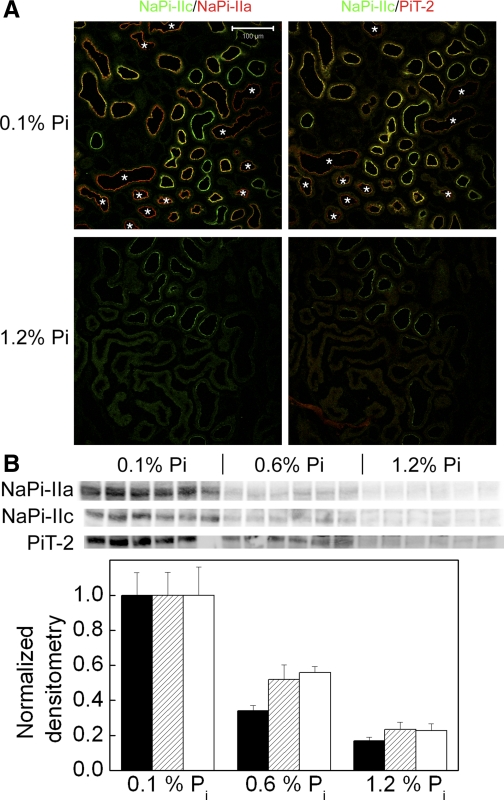
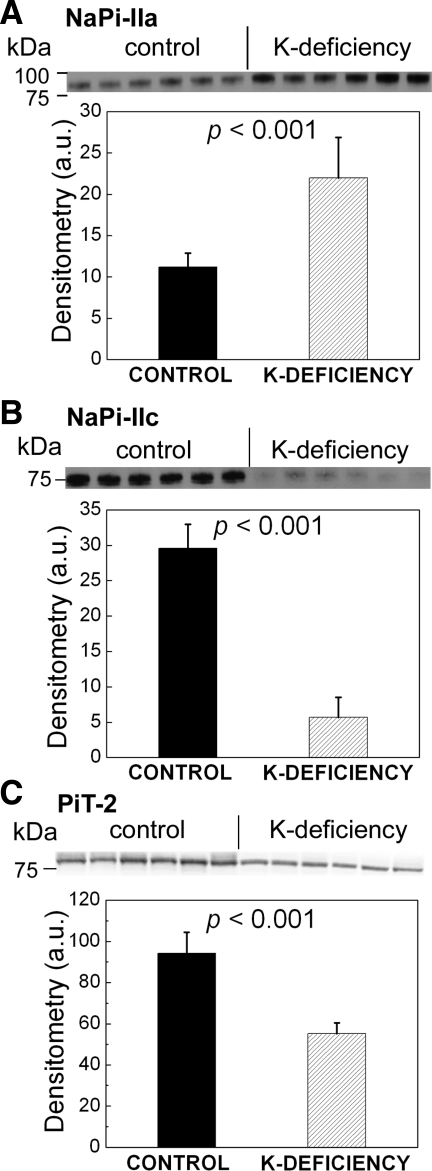
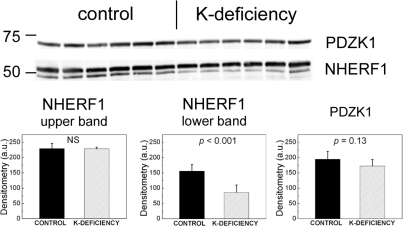
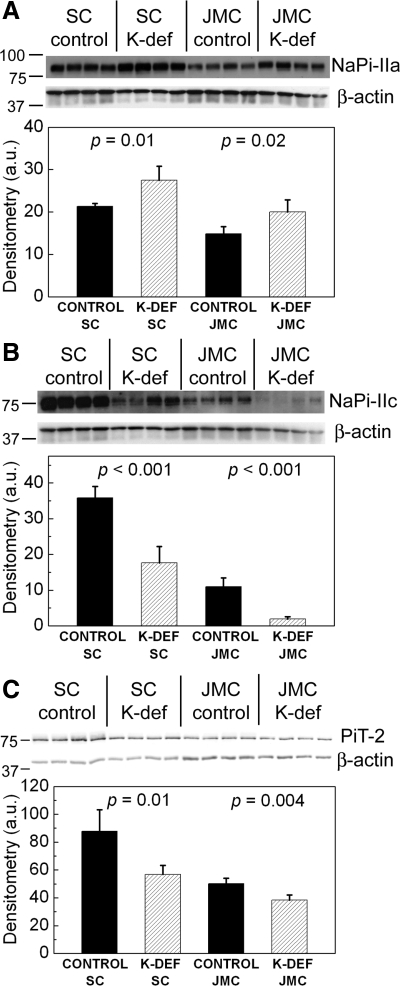
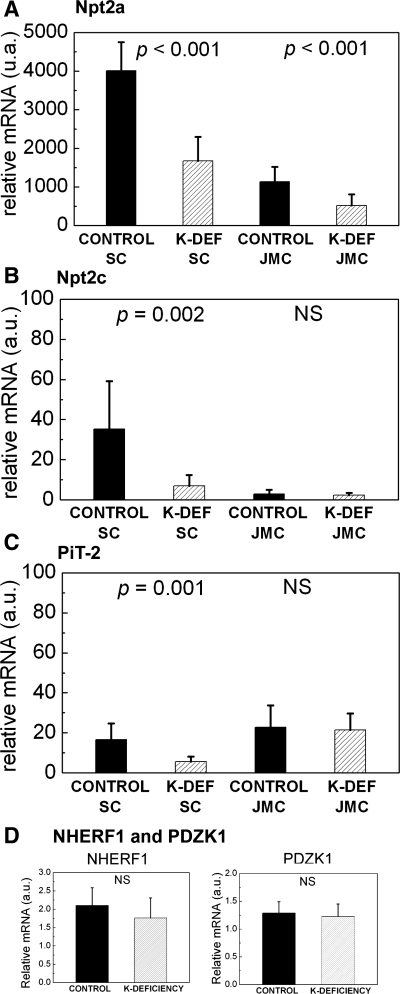
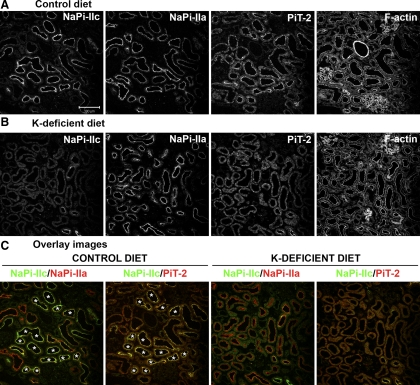
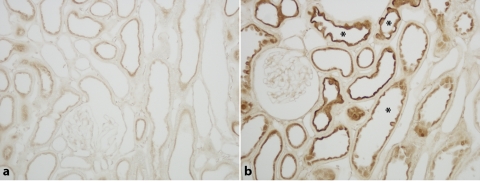
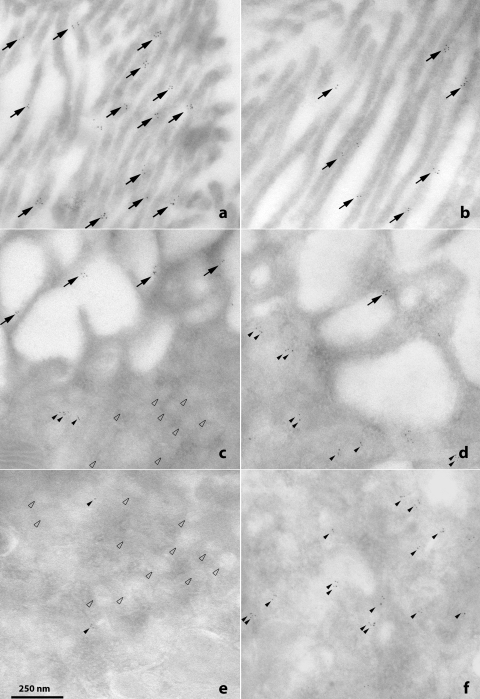
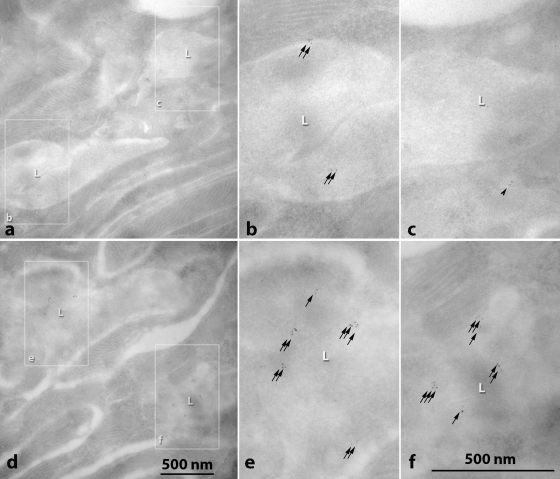
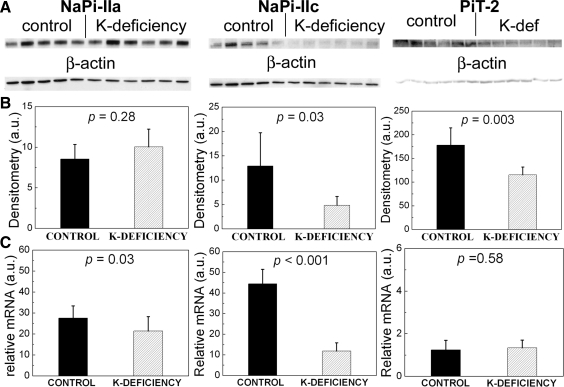
Dietary potassium (K) deficiency is accompanied by phosphaturia and decreased renal brush border membrane (BBM) vesicle sodium (Na)-dependent phosphate (P(i)) transport activity. Our laboratory previously showed that K deficiency in rats leads to increased abundance in the proximal tubule BBM of the apical Na-P(i) cotransporter NaPi-IIa, but that the activity, diffusion, and clustering of NaPi-IIa could be modulated by the altered lipid composition of the K-deficient BBM (Zajicek HK, Wang H, Puttaparthi K, Halaihel N, Markovich D, Shayman J, Beliveau R, Wilson P, Rogers T, Levi M. Kidney Int 60: 694-704, 2001; Inoue M, Digman MA, Cheng M, Breusegem SY, Halaihel N, Sorribas V, Mantulin WW, Gratton E, Barry NP, Levi M. J Biol Chem 279: 49160-49171, 2004). Here we investigated the role of the renal Na-P(i) cotransporters NaPi-IIc and PiT-2 in K deficiency. Using Western blotting, immunofluorescence, and quantitative real-time PCR, we found that, in rats and in mice, K deficiency is associated with a dramatic decrease in the NaPi-IIc protein abundance in proximal tubular BBM and in NaPi-IIc mRNA. In addition, we documented the presence of a third Na-coupled P(i) transporter in the renal BBM, PiT-2, whose abundance is also decreased by dietary K deficiency in rats and in mice. Finally, electron microscopy showed subcellular redistribution of NaPi-IIc in K deficiency: in control rats, NaPi-IIc immunolabel was primarily in BBM microvilli, whereas, in K-deficient rats, NaPi-IIc BBM label was reduced, and immunolabel was prevalent in cytoplasmic vesicles. In summary, our results demonstrate that decreases in BBM abundance of the phosphate transporter NaPi-IIc and also PiT-2 might contribute to the phosphaturia of dietary K deficiency, and that the three renal BBM phosphate transporters characterized so far can be differentially regulated by dietary perturbations.
Figures
References
-
- Ambuhl PM, Zajicek HK, Wang H, Puttaparthi K, Levi M. Regulation of renal phosphate transport by acute and chronic metabolic acidosis in the rat. Kidney Int 53: 1288–1298, 1998. - PubMed
-
- Bergwitz C, Roslin NM, Tieder M, Loredo-Osti JC, Bastepe M, Abu-Zahra H, Frappier D, Burkett K, Carpenter TO, Anderson D, Garabedian M, Sermet I, Fujiwara TM, Morgan K, Tenenhouse HS, Juppner H. SLC34A3 mutations in patients with hereditary hypophosphatemic rickets with hypercalciuria predict a key role for the sodium-phosphate cotransporter NaPi-IIc in maintaining phosphate homeostasis. Am J Hum Genet 78: 179–192, 2006. - PMC - PubMed
-
- Biber J, Custer M, Werner A, Kaissling B, Murer H. Localization of NaPi-1, a Na/Pi cotransporter, in rabbit kidney proximal tubules. II. Localization by immunohistochemistry. Pflügers Arch 424: 210–215, 1993. - PubMed
Publication types
MeSH terms
Substances
Grants and funding
LinkOut - more resources
Full Text Sources
Molecular Biology Databases
Research Materials
Miscellaneous
