. 2009 Aug;297(2):F333-40.
doi: 10.1152/ajprenal.00207.2009. Epub 2009 Jun 3.

Activation of the nitric oxide-cGMP pathway reduces phasic contractions in neonatal rat bladder strips via protein kinase G

Affiliations

Activation of the nitric oxide-cGMP pathway reduces phasic contractions in neonatal rat bladder strips via protein kinase G

Debra E Artim et al. Am J Physiol Renal Physiol. 2009 Aug.

Abstract

Nitric oxide (NO), a neurotransmitter in the lower urinary tract, stimulates soluble guanylyl cyclase (sGC) and in turn cGMP-dependent protein kinase G (PKG) to modulate a number of downstream targets. NO donors reduce bladder hyperactivity in some pathological models but do not affect normal bladder activity in the adult rat. In this study, the NO donor S-nitroso-N-acetyl-DL-penicillamine (SNAP; 100 microM) decreased the amplitude and frequency of spontaneous and carbachol-enhanced contractions in neonatal rat bladder strips, which are intrinsically hyperactive. This effect was blocked by inhibition of sGC and mimicked by application of a membrane-permeable cGMP analog (8-bromo-cGMP, 100 microM). Inhibition of PKG prevented or reversed the inhibitory effects of 8-bromo-cGMP. A portion of the SNAP-mediated inhibition was also dependent upon PKG; however, a short-lasting, sGC-dependent inhibitory effect of SNAP was still present after PKG inhibition. Inhibition of NO synthase with L-NAME (100 microM) did not change the amplitude or frequency of contractions. However, inhibition of endogenous phosphodiesterase (PDE)-5 with zaprinast (25 microM) reduced the amplitude and frequency of phasic contractions and increased the magnitude of inhibition produced by maximal concentrations of SNAP, suggesting that endogenous PDEs are constitutively active and regulate cGMP production. These results suggest that the NO-cGMP-PKG pathway may be involved in inhibitory control of the neonatal rat bladder.


Figures
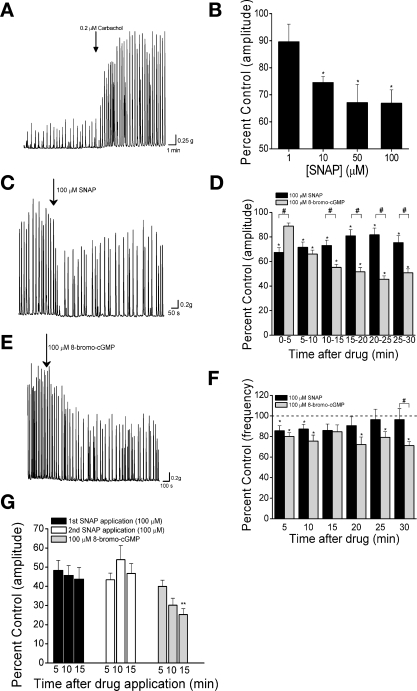
Fig. 1.
Fig. 1.
S-nitroso-N-acetyl-dl-penicillamine (SNAP) and 8-bromo-cGMP reduce the amplitude and frequency of carbachol-enhanced spontaneous contractions (SCcarb). A: carbachol-induced enhancement of spontaneous activity in a bladder strip from neonatal rat. Arrow indicates time of carbachol (100 nM) application. B: concentration dependence of SNAP-mediated inhibition of SCcarb amplitude (n = ≥7 for each concentration). C and E: inhibition of SCcarb by 100 μM SNAP (C) and 100 μM 8-bromo-cGMP (E). D and F: summary data showing average effect of 100 μM SNAP (n = 15) and 100 μM 8-bromo-cGMP (n = 13) on SCcarb amplitude (D) and frequency (F). G: summary of inhibition of SCcarb amplitude by 2 consecutive applications of 100 μM SNAP followed by 1 application of 100 μM 8-bromo-cGMP (n = 12). *P < 0.05 compared with control. #P < 0.05 between groups. **P < 0.05 compared with maximum SNAP inhibition by 2-tailed t-test with layered Bonferroni correction.
Fig. 2.
Fig. 2.
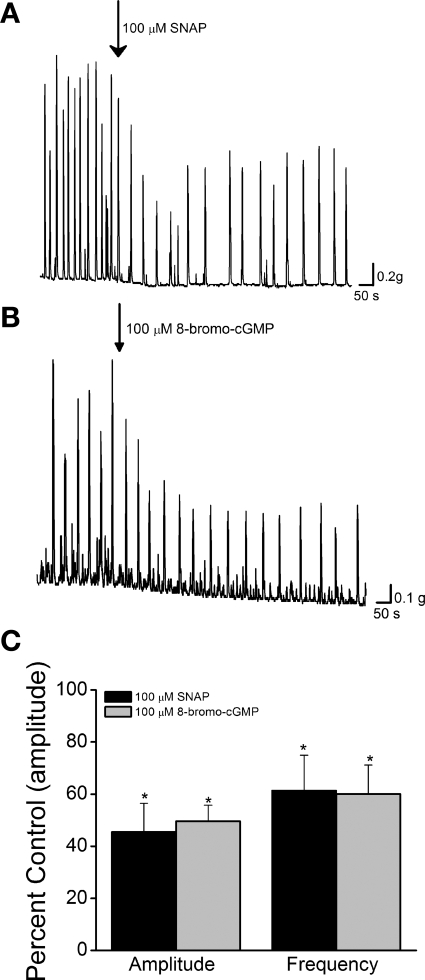
Inhibition of spontaneous contractions by SNAP and 8-bromo-cGMP. A and B: spontaneous contractions (not enhanced with carbachol) inhibited by 100 μM SNAP (A) or 100 μM 8-bromo-cGMP (B). C: summary data showing inhibition of spontaneous contraction amplitude and frequency by 100 μM SNAP (n = 6) or 100 μM 8-bromo-cGMP (n = 5). *P < 0.05 compared with control by 2-tailed t-test.
Fig. 3.
Fig. 3.
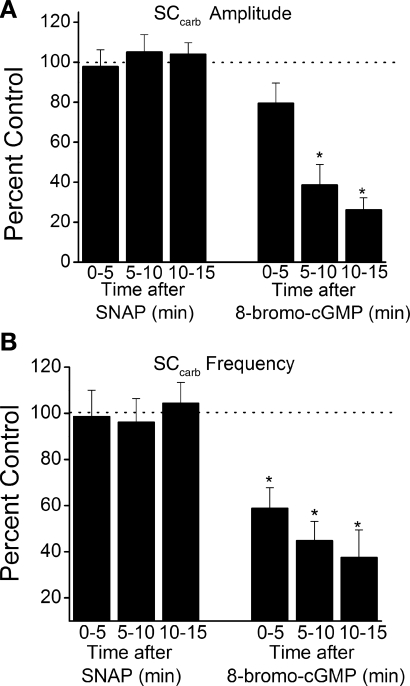
1H-[1,2,4]oxadiazolo[4,3-a]quinoxalin-1-one (ODQ) prevents effects of SNAP. Summary data from strips pretreated with 1 μM ODQ are shown. A and B: effects of 100 μM SNAP (n = 10) or 100 μM 8-bromo-cGMP (n = 8) on SCcarb amplitude (A) and frequency (B) in rat neonatal bladder strips pretreated for 15 min with 1 μM ODQ. *P < 0.05 vs. control by 2-tailed t-test.
Fig. 4.
Fig. 4.
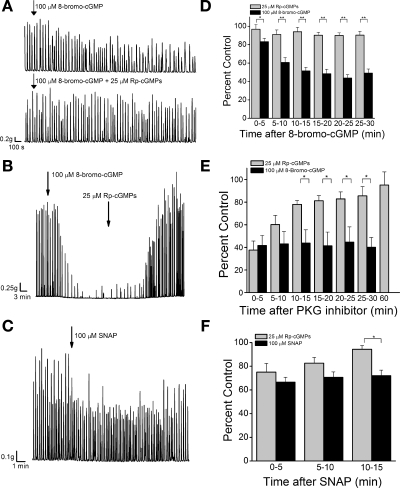
Role of PKG in SNAP- and 8-bromo-cGMP-mediated inhibition of SCcarb. A: 100 μM 8-bromo-cGMP was added to a bladder strip without (top) or with (bottom) PKG inhibitor (25 μM Rp-cGMPS). B: PKG inhibition reversed the inhibitory effect of 100 μM 8-bromo-cGMP. C: 100 μM SNAP added to a bladder strip pretreated with 25 μM Rp-cGMPS. D: summary data showing 100 μM 8-bromo-cGMP inhibition of SCcarb contraction in the presence and absence of 25 μM Rp-cGMPS (n = 9). E: summary data showing 25 μM Rp-cGMPS reversal of 100 μM 8-bromo-cGMP inhibition of SCcarb contraction (n = 4). E and F: summary data showing 100 μM SNAP inhibition of SCcarb amplitude in the presence and absence of 25 μM Rp-cGMPS (n = 10). *P < 0.05, **P < 0.01 between groups by 2-tailed t-test with layered Bonferroni correction.
Fig. 5.
Fig. 5.
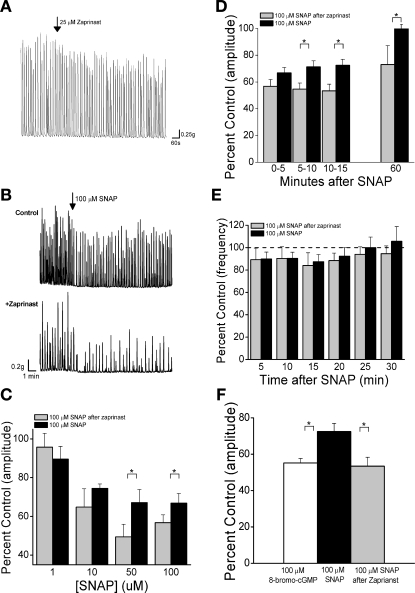
Inhibition of phosphodiesterase reduces the amplitude and frequency of SCcarb and enhances the inhibitory effect of SNAP. A: effect of 25 μM zaprinast on SCcarb. B: SNAP-mediated reduction of SCcarb in a vehicle-treated strip (0.1% DMSO; top) and in a strip pretreated with 25 μM zaprinast (bottom). C: concentration-response data for SNAP-mediated inhibition of SCcarb amplitude in control strips (without zaprinast) and in strips pretreated with 25 μM zaprinast (n = ≥6 for each concentration and treatment). D and E: summary data showing 100 μM SNAP-mediated inhibition of SCcarb amplitude (D) and frequency (E) in vehicle-treated control strips and strips pretreated with 25 μM zaprinast (n = 13). F: summary data comparing SCcarb amplitude with 100 μM SNAP, 100 μM 8-bromo-cGMP, and 100 μM SNAP after zaprinast application (n = ≥8 for each condition). *P < 0.05 between groups by 2-tailed t-test with layered Bonferroni correction.

References

    1. Andersson KE, Persson K. Nitric oxide synthase and nitric oxide-mediated effects in lower urinary tract smooth muscles. World J Urol 12: 274–280, 1994. - PubMed
    1. Andersson KE, Persson K. Nitric oxide synthase and the lower urinary tract: possible implications for physiology and pathophysiology. Scand J Urol Nephrol Suppl 175: 43–53, 1995. - PubMed
    1. Birder LA, Apodaca G, De Groat WC, Kanai AJ. Adrenergic- and capsaicin-evoked nitric oxide release from urothelium and afferent nerves in urinary bladder. Am J Physiol Renal Physiol 275: F226–F229, 1998. - PubMed
    1. Birder LA, Nealen ML, Kiss S, de Groat WC, Caterina MJ, Wang E, Apodaca G, Kanai AJ. Beta-adrenoceptor agonists stimulate endothelial nitric oxide synthase in rat urinary bladder urothelial cells. J Neurosci 22: 8063–8070, 2002. - PMC - PubMed
    1. Bowman A, Drummond AH. Cyclic GMP mediates neurogenic relaxation in the bovine retractor penis muscle. Br J Pharmacol 81: 665–674, 1984. - PMC - PubMed

Publication types

MeSH terms

LinkOut - more resources