


Genetic diversity among food-borne and waterborne norovirus strains causing outbreaks in Sweden
- PMID: 19494060
- PMCID: PMC2725682
- DOI: 10.1128/JCM.02168-08
Genetic diversity among food-borne and waterborne norovirus strains causing outbreaks in Sweden
Abstract
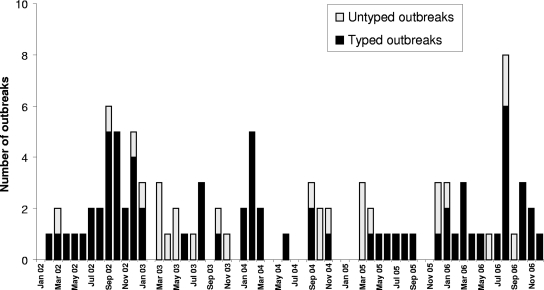
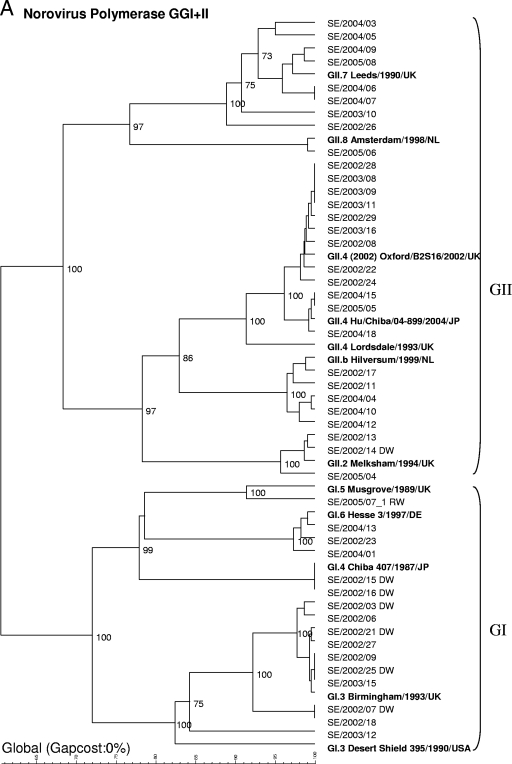
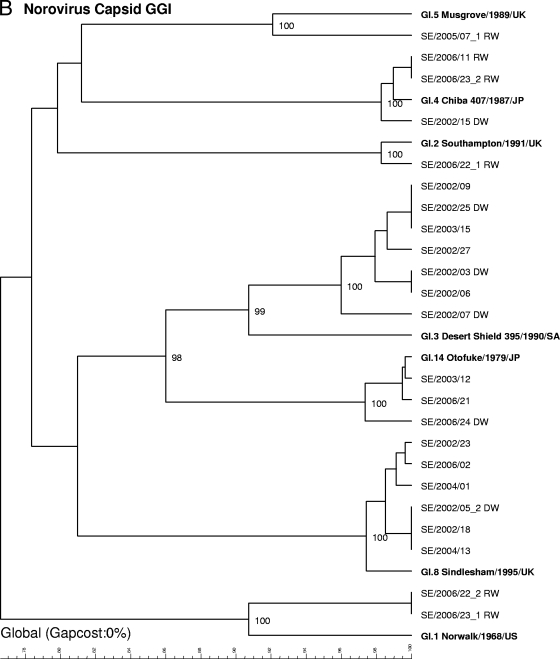
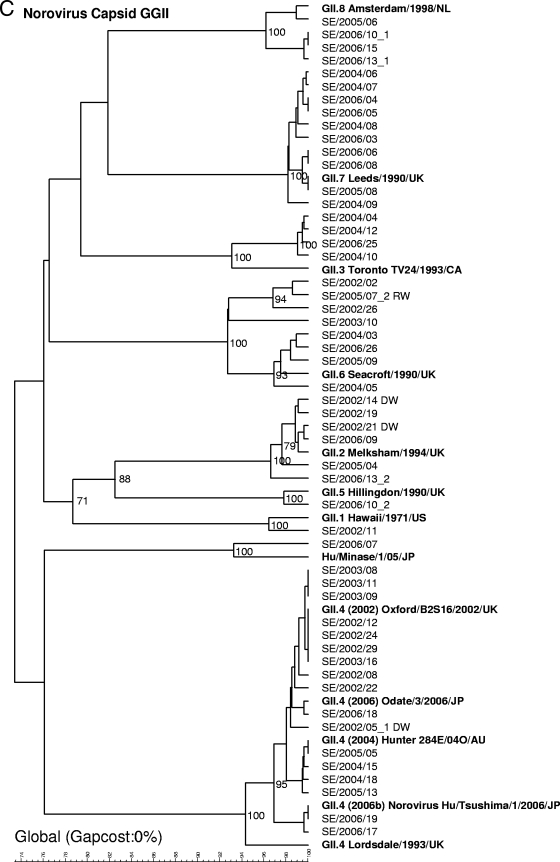
A total of 101 food-borne and waterborne outbreaks that were caused by norovirus and that resulted in more than 4,100 cases of illness were reported to the Swedish Institute for Infectious Disease Control from January 2002 to December 2006. Sequence and epidemiological data for isolates from 73 outbreaks were analyzed. In contrast to health care-related outbreaks, no clear seasonality could be observed. Sequence analysis showed a high degree of genetic variation among the noroviruses detected. Genogroup II (GII) viruses were detected in 70% of the outbreaks, and of those strains, strains of GII.4 were the most prevalent and were detected in 25% of all outbreaks. The GII.4 variants detected in global outbreaks in health care settings during 2002, 2004, and 2006 were also found in the food-borne outbreaks. GI strains totally dominated as the cause of water-related (drinking and recreational water) outbreaks and were found in 12 of 13 outbreaks. In 14 outbreaks, there were discrepancies among the polymerase and capsid genotype results. In four outbreaks, the polymerase of the recombinant GII.b virus occurred together with the GII.1 or GII.3 capsids, while the GII.7 polymerase occurred together with the GII.6 and GII.7 capsids. Mixed infections were observed in six outbreaks; four of these were due to contaminated water, and two were due to imported frozen berries. Contaminated food and water serve as important reservoirs for noroviruses. The high degree of genetic diversity found among norovirus strains causing food-borne and waterborne infections stresses the importance of the use of broad reaction detection methods when such outbreaks are investigated.
Figures
References
-
- Ando, T., J. S. Noel, and R. L. Fankhauser. 2000. Genetic classification of “Norwalk-like viruses.” J. Infect. Dis. 181(Suppl. 2)S336-S348. - PubMed
-
- Baert, L., M. Uyttendaele, and J. Debevere. 2008. Evaluation of viral extraction methods on a broad range of ready-to-eat foods with conventional and real-time RT-PCR for norovirus GII detection. Int. J. Food Microbiol. 123101-108. - PubMed
-
- Berg, D. E., M. A. Kohn, T. A. Farley, and L. M. McFarland. 2000. Multi-state outbreaks of acute gastroenteritis traced to fecal-contaminated oysters harvested in Louisiana. J. Infect. Dis. 181(Suppl. 2)S381-S386. - PubMed
-
- Bon, F., K. Ambert-Balay, H. Giraudon, J. Kaplon, S. Le Guyader, M. Pommepuy, A. Gallay, V. Vaillant, H. de Valk, R. Chikhi-Brachet, A. Flahaut, P. Pothier, and E. Kohli. 2005. Molecular epidemiology of caliciviruses detected in sporadic and outbreak cases of gastroenteritis in France from December 1998 to February 2004. J. Clin. Microbiol. 434659-4664. - PMC - PubMed
Publication types
MeSH terms
Substances
Associated data
- Actions
- Actions
- Actions
- Actions
- Actions
- Actions
- Actions
- Actions
- Actions
- Actions
- Actions
- Actions
- Actions
- Actions
- Actions
- Actions
- Actions
- Actions
- Actions
- Actions
- Actions
- Actions
- Actions
- Actions
- Actions
- Actions
- Actions
- Actions
- Actions
- Actions
- Actions
- Actions
- Actions
- Actions
- Actions
- Actions
- Actions
- Actions
- Actions
- Actions
- Actions
- Actions
- Actions
- Actions
- Actions
- Actions
- Actions
- Actions
- Actions
- Actions
- Actions
- Actions
- Actions
- Actions
- Actions
- Actions
- Actions
- Actions
- Actions
- Actions
- Actions
- Actions
- Actions
- Actions
- Actions
- Actions
- Actions
- Actions
- Actions
- Actions
- Actions
- Actions
- Actions
- Actions
- Actions
- Actions
- Actions
- Actions
- Actions
- Actions
- Actions
- Actions
- Actions
- Actions
- Actions
- Actions
- Actions
- Actions
- Actions
- Actions
- Actions
- Actions
- Actions
- Actions
- Actions
- Actions
- Actions
- Actions
- Actions
- Actions
- Actions
- Actions
- Actions
- Actions
- Actions
- Actions
- Actions
- Actions
- Actions
- Actions
- Actions
- Actions
- Actions
- Actions
- Actions
- Actions
- Actions
- Actions
- Actions
- Actions
LinkOut - more resources
Full Text Sources
Medical
