


Performance assessment of the GenoType MTBDRplus test and DNA sequencing in detection of multidrug-resistant Mycobacterium tuberculosis
- PMID: 19494067
- PMCID: PMC2725636
- DOI: 10.1128/JCM.02499-08
Performance assessment of the GenoType MTBDRplus test and DNA sequencing in detection of multidrug-resistant Mycobacterium tuberculosis
Abstract
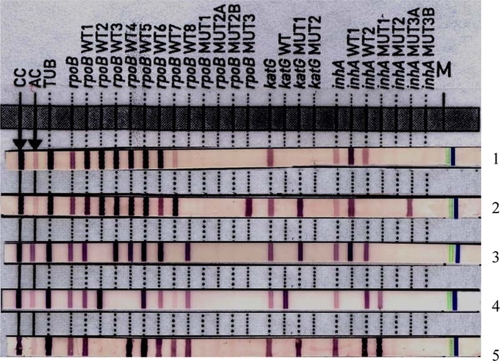
To facilitate the management of multidrug-resistant (MDR) tuberculosis, two nucleic acid sequence-based methods, the GenoType MTBDRplus test and DNA sequencing, were assessed for the rapid detection of drug-resistant Mycobacterium tuberculosis for the first time in the Asia-Pacific region. The performances of these two assays in detecting the presence of rifampin (rifampicin) (RIF) and isoniazid (INH) resistance-associated mutations in the rpoB, katG, inhA regulatory region, inhA, and oxyR-ahpC genes were compared to that of a conventional agar proportion drug susceptibility test. A total of 242 MDR and 30 pansusceptible M. tuberculosis isolates were evaluated in this study. The sensitivities obtained for RIF-resistant detection by the GenoType MTBDRplus test and by resistance gene sequencing were 95.5% and 97.9%, respectively. The sensitivities for INH resistance detection by the GenoType MTBDRplus test and by resistance gene sequencing were 81.8% and 93.4%, respectively. Together, the sensitivity for MDR tuberculosis detection was 78.5% with the GenoType MTBDRplus test and 91.3% by resistance gene sequencing. The specificity for RIF resistance, INH resistance, and MDR detection was 100% by both methods. The GenoType MTBDRplus test has the advantage of a short turnaround time for drug-resistant M. tuberculosis detection. Overall, the two assays performed equally well in detecting RIF resistance (P = 0.13). However, DNA sequencing demonstrated superior performance in detecting INH resistance (P < 0.001) and MDR tuberculosis (P < 0.001). We suggest that new alleles of INH resistance genes should be evaluated to improve the sensitivity of the GenoType MTBDRplus test, especially for different geographic areas with genetically diverse M. tuberculosis strains.
Figures
References
-
- Baker, L. V., T. J. Brown, O. Maxwell, A. L. Gibson, Z. Fang, M. D. Yates, and F. A. Drobniewski. 2005. Molecular analysis of isoniazid-resistant Mycobacterium tuberculosis isolates from England and Wales reveals the phylogenetic significance of the ahpC −46A polymorphism. Antimicrob. Agents Chemother. 491455-1464. - PMC - PubMed
-
- Barnard, M., H. Albert, G. Coetzee, R. O'Brien, and M. E. Bosman. 2008. Rapid molecular screening for multidrug resistant tuberculosis in a high-volume public health laboratory in South Africa. Am. J. Respir. Crit. Care Med. 177787-792. - PubMed
-
- Bártfai, Z., A. Somoskövi, C. Ködmön, N. Szabó, E. Puskás, L. Kosztolányi, E. Faragó, J. Mester, L. M. Parsons, and M. Salfinger. 2001. Molecular characterization of rifampin-resistant isolates of Mycobacterium tuberculosis from Hungary by DNA sequencing and the line probe assay. J. Clin. Microbiol. 393736-3739. - PMC - PubMed
Publication types
MeSH terms
Substances
LinkOut - more resources
Full Text Sources
Other Literature Sources
