


Competing risk regression models for epidemiologic data
- PMID: 19494242
- PMCID: PMC2732996
- DOI: 10.1093/aje/kwp107
Competing risk regression models for epidemiologic data
Abstract
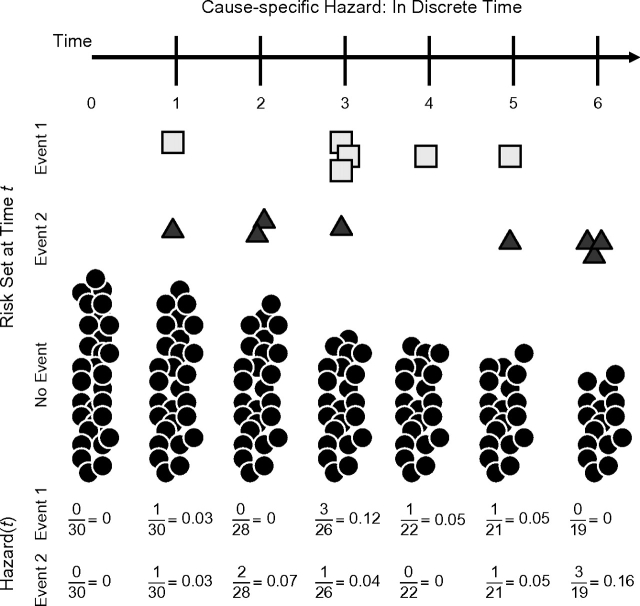
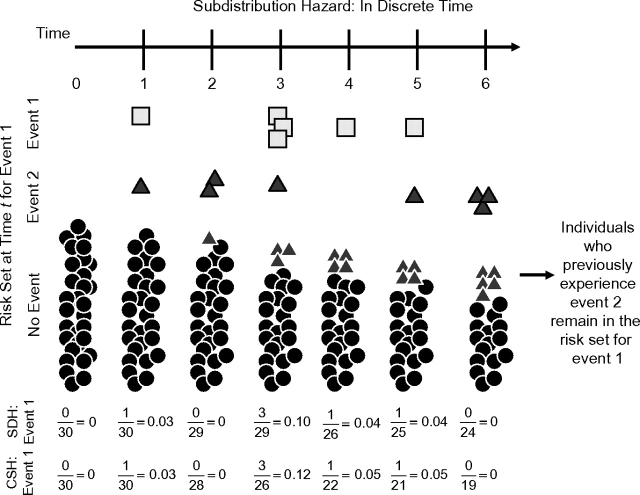
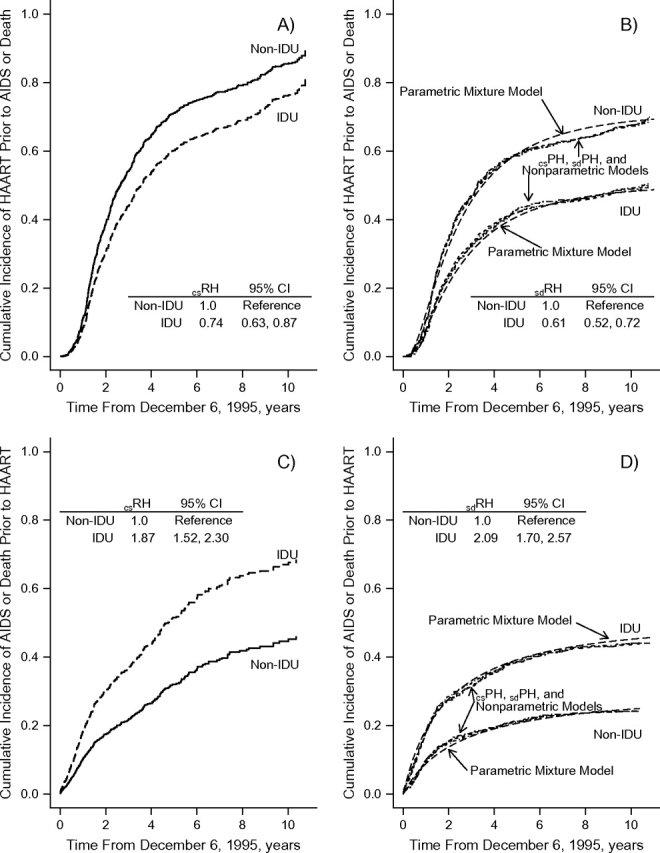
Competing events can preclude the event of interest from occurring in epidemiologic data and can be analyzed by using extensions of survival analysis methods. In this paper, the authors outline 3 regression approaches for estimating 2 key quantities in competing risks analysis: the cause-specific relative hazard ((cs)RH) and the subdistribution relative hazard ((sd)RH). They compare and contrast the structure of the risk sets and the interpretation of parameters obtained with these methods. They also demonstrate the use of these methods with data from the Women's Interagency HIV Study established in 1993, treating time to initiation of highly active antiretroviral therapy or to clinical disease progression as competing events. In our example, women with an injection drug use history were less likely than those without a history of injection drug use to initiate therapy prior to progression to acquired immunodeficiency syndrome or death by both measures of association ((cs)RH = 0.67, 95% confidence interval: 0.57, 0.80 and (sd)RH = 0.60, 95% confidence interval: 0.50, 0.71). Moreover, the relative hazards for disease progression prior to treatment were elevated ((cs)RH = 1.71, 95% confidence interval: 1.37, 2.13 and (sd)RH = 2.01, 95% confidence interval: 1.62, 2.51). Methods for competing risks should be used by epidemiologists, with the choice of method guided by the scientific question.
Figures
References
-
- Crowder MJ. Classical Competing Risks. Boca Raton, FL: Chapman & Hall/CRC; 2001.
-
- Kalbfleisch JD, Prentice RL. The Statistical Analysis of Failure Time Data. New York, NY: John Wiley & Sons, Inc; 1980.
-
- Pintilie M. Competing Risks: A Practical Perspective. Chichester, England: John Wiley & Sons, Ltd; 2006.
-
- Lau B, Gange SJ, Moore RD. Risk of non-AIDS-related mortality may exceed risk of AIDS-related mortality among individuals enrolling into care with CD4+ counts greater than 200 cells/mm3. J Acquir Immune Defic Syndr. 2007;44(2):179–187. - PubMed
Publication types
MeSH terms
Grants and funding
LinkOut - more resources
Full Text Sources
Medical
