. 2009 Jul;22(7):1310-9.
doi: 10.1021/tx900115z.

Tandem mass spectrometry-based detection of c4'-oxidized abasic sites at specific positions in DNA fragments

Affiliations

Tandem mass spectrometry-based detection of c4'-oxidized abasic sites at specific positions in DNA fragments

Goutam Chowdhury et al. Chem Res Toxicol. 2009 Jul.

Abstract

Oxidative damage to DNA has been linked to aging, cancer, and other biological processes. Reactive oxygen species and various antitumor agents including bleomycin and ionizing radiation have been shown to cause oxidative DNA sugar damage. Detection of DNA lesions is important for understanding the toxicological or therapeutic consequences associated with such agents. C4'-oxidized abasic sites (C4-AP) are produced by the antitumor drug bleomycin and ionizing radiation. The currently available methods for the detection of C4-AP cannot provide both structural and sequence information. We have developed an LC-ESI-MS-based approach for specific detection and mapping of C4-AP from a mixture of lesions. We show using Fe-bleomycin-damaged DNA that C4-AP can be detected at cytosine and thymine sites by direct MS analysis. Our results reveal that collision-induced dissociation of C4-AP-containing oligonucleotides results in preferential fragmentation at C4-AP sites with the formation of the unique a* ions (18 amu more than the a-B ions) that allow mapping of the C4-AP sites. Various chemical modification strategies (e.g., reduction with NaBH4 and NaBD4 and derivatization with methoxyamine and hydrazine, followed by LC-MS analysis) were also used for unambiguous detection of C4-AP sites. Finally, we show that the methods described here can detect the presence of C4-AP at specific sites in a complex sample such as hydroxyl radical-damaged DNA. The LC-MS approach was also used for the simultaneous detection of the other C4'-oxidation end product, 3'-phosphoglycolate, at a specific site in hydroxyl radical-damaged DNA. Thus, LC-MS provides a rapid and direct approach for the detection and mapping of oxidative DNA lesions.


Figures

Figure 1
Figure 1
ESI-LC-MS chromatogram and spectra of Fe-BLM-damaged ds DNA fragment 1. The DNA fragment 1 (20 μM) in 50 mM HEPES buffer (pH 7.5), was treated with activated BLM (50 μM) for 10 min at 23 °C under aerobic conditions and analyzed by LC-MS. A) TIC of activated BLM damaged ds DNA fragment 1. B) LCMS spectra of the peaks eluting near tR 3.10 min (TIC).
Figure 2
Figure 2
ESI-LC-MS/MS chromatogram and spectra of two species formed in Fe-BLM-damaged DNA fragment 1. The species with m/z 1090.0(−4) and 1093.9(−4) correspond to DNA fragment 1 having C4-AP (ring-opened unhydrated species) in place of thymine (T8) and cytosine, respectively. A) Proposed structure of the a* ion resulting from preferential fragmentation at the C4-AP site. B) Calculated a* and w ions resulting from fragmentation at BLM target sites. C) LC-MS/MS chromatogram of m/z 1090.0(−4). D) CID spectra of m/z 1090.0(−4) species showing the presence of two peaks corresponding to selective cleavage at T8. E) LC-MS/MS chromatogram of m/z 1093.9(−4) species. F) CID spectra of the m/z 1093.9(−4) species showing the presence of peaks corresponding to selective cleavage at C6., C12, and C14.
Figure 3
Figure 3
ESI-LC-MS and ESI-LC-MS/MS spectra of Fe-BLM-damaged ds DNA fragment 1 following reduction with NaBH4 or NaBD4. An aqueous solution of the Fe-BLM (50 μM)-damaged DNA fragment 1 (20 μM) was treated with either NaBH4 or NaBD4 (100 mM) for 15 min at 23 °C and analyzed by LC-MS. A) LC-MS spectra of a region of the chromatogram of NaBH4-reduced Fe-BLM-damaged DNA showing the presence of peaks at m/z 1091.2(−4) and 1094.9(−4). B) LC-MS spectra of a region of the chromatogram of NaBD4-reduced Fe-BLM-damaged DNA showing the presence of peaks at m/z 1091.7(−4) and 1095.4(−4). C) CID spectra of m/z 1091.2(−4) species from NaBH4-reduced Fe-BLM-damaged DNA. D) CID spectra of m/z 1091.7(−4) species from NaBD4-reduced Fe-BLM-damaged DNA.
Figure 4
Figure 4
ESI-LC-MS/MS chromatogram and spectra of Fe-BLM damaged ds DNA fragment 1 following derivatization with methoxyamine. The Fe-BLM (50 μM) damaged DNA fragment (20 μM) was treated with CH3ONH2 (20 mM) for 30 min at 23 °C in the presence of potassium phosphate buffer (50 mM, pH 7.4). A) LC-MS/MS chromatogram of m/z 1108.4. B) CID spectra of m/z 1108.4(−4) species.
Figure 5
Figure 5
ESI-LC-MS/MS and ESI-LC-MS3 chromatograms and spectra of m/z 1148.8(−3) species formed in Fe-BLM-damaged DNA fragment 1 following hydrazine treatment. A Fe-BLM (50 μM) damaged DNA fragment (20 μM) was treated with NH2NH2 (40 mM) for 30 min at 23 °C in the presence of potassium phosphate buffer (50 mM, pH 7.4) and analyzed using tandem MS. A) LC-MS/MS chromatogram of m/z 1148.8(−3). B) CID spectrum of m/z 1148.8(−3) species. C) LC-MS3 chromatogram of m/z 1148.8(−3), 518(−1) species. D) CID spectrum of the m/z 1148.8(−3), 518(−1) species.
Figure 6
Figure 6
ESI-LC-MS/MS chromatogram and spectra of two products formed in hydroxyl radical-damaged ds DNA fragment 1 in the absence of treatment and after reduction with NaBH4. The products with m/z 1093.8(−4) correspond to DNA fragment 1 having C4-AP (ring open unhydraded species) in place of cytosine; m/z 1095(−4) corresponds to DNA fragment 1 having C4-AP reduced to 6 by NaBH4. ds DNA fragment 1 (40 μM), in potassium phosphate buffer (50 mM, pH 7.4), was treated with a mixture of ferrous ammonium sulfate (10 μM) and EDTA (20 μM), ascorbate (1 mM) and H2O2 (8.8 μM) for 5 min at 23 °C. For reduction, hydroxyl radical-damaged DNA was treated with NaBH4 (100 mM) for 15 min at 23 °C and analyzed by LC-MS. A) LC-MS/MS chromatogram of m/z 1093.8(−4). B) CID spectra of the m/z 1093.8(−4) species showing the presence of peaks corresponding to selective cleavage at cytosine bases. C) LC-MS/MS chromatogram of m/z 1095(−4) species in hydroxyl radical-damaged DNA after NaBH4 reduction. D) CID spectrum of m/z 1095(−4) species from NaBH4-reduced hydroxyl radical-damaged DNA.
Figure 7
Figure 7
ESI-LC-MS/MS chromatograms and spectra of the m/z 1016(−4) and 1039(−3) species formed in hydroxyl radical damaged DNA fragment 1 following hydrazine treatment. The species with m/z 1016(−4) and 1039(−3) corresponds to 3PMP resulting from C4′-H abstraction at C14 and G11, respectively. A) LC-MS/MS chromatogram of m/z 1016(−4) species. B) CID spectra of m/z 1016(−4) species. C) LC-MS/MS chromatogram of m/z 1039(−3) species. D) CID spectra of m/z 1039(−3) species.
Figure 8
Figure 8
ESI-LC-MS/MS chromatogram and spectrum of m/z 1007.5(−4) species formed in hydroxyl radical damaged DNA fragment 1. The species with m/z 1007.5(−4) corresponds to 3PG resulting from C4′-H abstraction at C14. A) LC-MS/MS chromatogram of m/z 1007.5(−4) species. B) CID spectra of m/z 1007.5(−4) species.
Scheme 1
Scheme 1
Proposed mechanism of formation of C4-AP and 3PG in DNA.
Scheme 2
Scheme 2
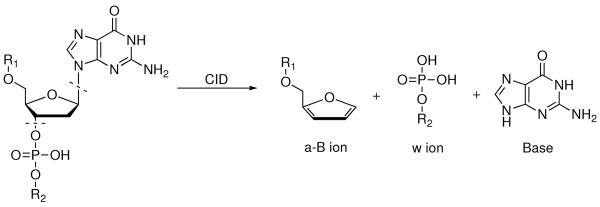
Fragments resulting from collision-induced dissociation of DNA
Scheme 3
Scheme 3
Products formed as a result of reaction of C4-AP-containing DNA fragments with NaBH4, NaBD4, methoxyamine, and hydrazine.

References

    1. Finkel T, Holbrook NJ. Oxidants, oxidative stress and the biology of ageing. Nature. 2000;408:239–247. - PubMed
    1. Klaunig JE, Kamendulis LM. The role of oxidative stress in carcinogenesis. Annu. Rev. Pharmacol. Toxicol. 2004;44:239–267. - PubMed
    1. Andreassi MG. DNA damage, vascular senescence and atherosclerosis. J. Mol. Med. 2008;86:1033–1043. - PubMed
    1. Lovell MA, Markesbery WR. Oxidative DNA damage in mild cognitive impairment and late-stage Alzheimer's disease. Nucleic Acids Res. 2007;35:7497–7504. - PMC - PubMed
    1. Dedon PC, Tannenbaum SR. Reactive nitrogen species in the chemical biology of inflammation. Arch. Biochem. Biophys. 2004;423:12–22. - PubMed

Publication types