. 2009 Jun 5:4:24.
doi: 10.1186/1750-1326-4-24.

Oxidative modifications, mitochondrial dysfunction, and impaired protein degradation in Parkinson's disease: how neurons are lost in the Bermuda triangle

Affiliations

Oxidative modifications, mitochondrial dysfunction, and impaired protein degradation in Parkinson's disease: how neurons are lost in the Bermuda triangle

Kristen A Malkus et al. Mol Neurodegener. .

Abstract

While numerous hypotheses have been proposed to explain the molecular mechanisms underlying the pathogenesis of neurodegenerative diseases, the theory of oxidative stress has received considerable support. Although many correlations have been established and encouraging evidence has been obtained, conclusive proof of causation for the oxidative stress hypothesis is lacking and potential cures have not emerged. Therefore it is likely that other factors, possibly in coordination with oxidative stress, contribute to neuron death. Using Parkinson's disease (PD) as the paradigm, this review explores the hypothesis that oxidative modifications, mitochondrial functional disruption, and impairment of protein degradation constitute three interrelated molecular pathways that execute neuron death. These intertwined events are the consequence of environmental exposure, genetic factors, and endogenous risks and constitute a "Bermuda triangle" that may be considered the underlying cause of neurodegenerative pathogenesis.


Figures
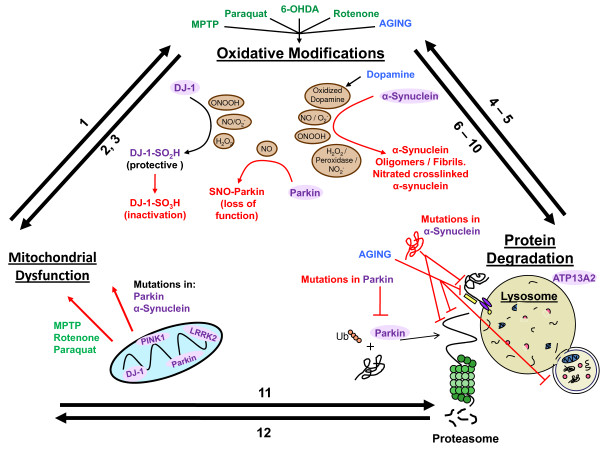
Figure 1
Figure 1
A "Bermuda Triangle" of insults leads to neurondeath in PD. Known risk factors for the onset of Parkinson's disease (PD) include environmental (green), genetic (purple), and endogenous (blue) influences. Contributions from these risk factors trigger oxidative modifications, mitochondrial dysfunction, and impaired protein degradation that together form a "Bermuda triangle" of interrelated molecular events that underlie neurodegeneration. The interactions between these pathways are supported by the following (for details and citations, please refer to text): (1) Disturbances in mitochondrial respiration generate reactive oxygen species. (2) Overexpression of SOD is protective against mitochondrial toxins. (3) NOS deficiency or inhibition attenuates MPTP, paraquat, and rotenone toxicity. (4) Inhibition of degradation systems leads to increased sensitivity to oxidative stressors. (5) Impaired degradation leads to an accumulation of substrates, increasing the probability for oxidative modifications. (6) Excessive production of reactive oxygen and nitrogen species modifies proteins, leading to inactivation, crosslinking, and aggregation. (7) α-Synuclein modified by oxidized dopamine impedes CMA. (8) Oxidative modifications modify the lysosomal membrane and crosslink membrane proteins. (9) UPS and CMA are not able to unfold and remove oxidatively proteins. (10) Oxidative modification of proteasome subunits inhibits UPS function. (11) Macroautophagy is the principle mechanism for the degradation of damaged mitochondria. (12) Proteasome inhibition increases mitochondrial reactive species generation and decreases complex I and II activity.

References

    1. Merlini G, Bellotti V. Molecular mechanisms of amyloidosis. N Engl J Med. 2003;349:583–596. doi: 10.1056/NEJMra023144. - DOI - PubMed
    1. Jenner P, Olanow CW. Oxidative stress and the pathogenesis of Parkinson's disease. Neurology. 1996;47:S161–S170. - PubMed
    1. Storch A, Jost WH, Vieregge P, Spiegel J, Greulich W, Durner J, Muller T, Kupsch A, Henningsen H, Oertel WH, Fuchs G, Kuhn W, Niklowitz P, Koch R, Herting B, Reichmann H, German Coenzyme, QSG Randomized, double-blind, placebo-controlled trial on symptomatic effects of coenzyme Q(10) in Parkinson disease. Arch Neurol. 2007;64:938–944. doi: 10.1001/archneur.64.7.nct60005. - DOI - PubMed
    1. Bandhyopadhyay U, Cuervo AM. Chaperone-mediated autophagy in aging and neurodegeneration: lessons from alpha-synuclein. Exp Geront. 2007;42:120–128. doi: 10.1016/j.exger.2006.05.019. - DOI - PubMed
    1. Rubinsztein DC. The roles of intracellular protein-degradation pathways in neurodegeneration. Nature. 2006;443:780–786. doi: 10.1038/nature05291. - DOI - PubMed

LinkOut - more resources
