


Molecular and tissue interactions governing induction of cranial ectodermal placodes
- PMID: 19500565
- PMCID: PMC2747488
- DOI: 10.1016/j.ydbio.2009.05.572
Molecular and tissue interactions governing induction of cranial ectodermal placodes
Abstract
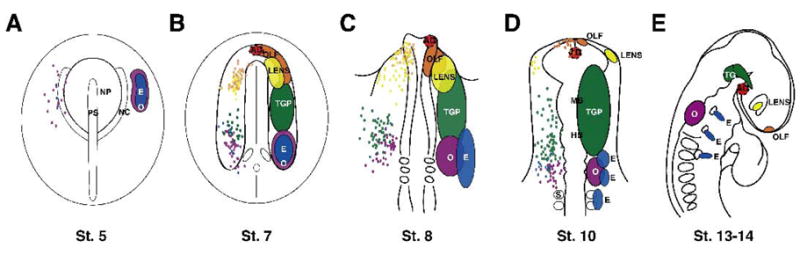
Whereas neural crest cells are the source of the peripheral nervous system in the trunk of vertebrates, the "ectodermal placodes," together with neural crest, form the peripheral nervous system of the head. Cranial ectodermal placodes are thickenings in the ectoderm that subsequently ingress or invaginate to make important contributions to cranial ganglia, including epibranchial and trigeminal ganglia, and sensory structures, the ear, nose, lens, and adenohypophysis. Recent studies have uncovered a number of molecular signals mediating induction and differentiation of placodal cells. Here, we described recent advances in understanding the tissue interactions and signals underlying induction and neurogenesis of placodes, with emphasis on the trigeminal and epibranchial. Important roles of Fibroblast Growth Factors, Platelet Derived Growth Factors, Sonic Hedgehog, TGFbeta superfamily members, and Wnts are discussed.
Figures
References
-
- Abu-Elmagd M, Ishii Y, Cheung M, Rex M, Le Rouedec D, Scotting PJ. cSox3 expression and neurogenesis in the epibranchial placodes. Dev Biol. 2001;237:258–69. - PubMed
-
- Adamska M, Herbrand H, Adamski M, Kruger M, Braun T, Bober E. FGFs control the patterning of the inner ear but are not able to induce the full ear program. Mech Dev. 2001;109:303–13. - PubMed
-
- Ahrens K, Schlosser G. Tissues and signals involved in the induction of placodal Six1 expression in Xenopus laevis. Dev Biol. 2005;288:40–59. - PubMed
-
- Alvarez Y, Alonso MT, Vendrell V, Zelarayan LC, Chamero P, Theil T, Bosl MR, Kato S, Maconochie M, Riethmacher D, Schimmang T. Requirements for FGF3 and FGF10 during inner ear formation. Development. 2003;130:6329–38. - PubMed
-
- Bailey AP, Bhattacharyya S, Bronner-Fraser M, Streit A. Lens specification is the ground state of all sensory placodes, from which FGF promotes olfactory identity. Dev Cell. 2006;11:505–17. - PubMed
Publication types
MeSH terms
Substances
Grants and funding
LinkOut - more resources
Full Text Sources
