


Nine-year incidence of visual impairment in the Barbados Eye Studies
- PMID: 19500851
- PMCID: PMC2762108
- DOI: 10.1016/j.ophtha.2009.02.017
Nine-year incidence of visual impairment in the Barbados Eye Studies
Abstract
Objective: To describe the 9-year incidence of visual impairment and primary causes of blindness among black participants of the Barbados Eye Studies (BES).
Design: Population-based prospective cohort study.
Participants: The BES followed a nationally representative cohort selected by simple random sampling, aged 40 to 84 years at baseline, with reexaminations after 4 years (Barbados Incidence Study of Eye Diseases [BISED]) and 9 years (BISED II). BISED II included 2793 (81%) of those eligible.
Methods: Cumulative 9-year incidence rates were estimated by the Product-Limit approach. The study was reviewed and approved by the institutional review boards of collaborating institutions.
Main outcome measures: Best-corrected visual acuity (VA) was assessed by the Ferris-Bailey chart, following a modified Early Treatment of Diabetic Retinopathy Study protocol. Low vision and blindness were defined by World Health Organization (WHO) criteria as VA <6/18 to 6/120, and <6/120, respectively, in the better eye, and by U.S. criteria as VA < or =20/40 and < or =20/200, respectively. Vision loss was defined as a decrease of 15 letters or more read correctly in the better eye between baseline and follow-up examinations.
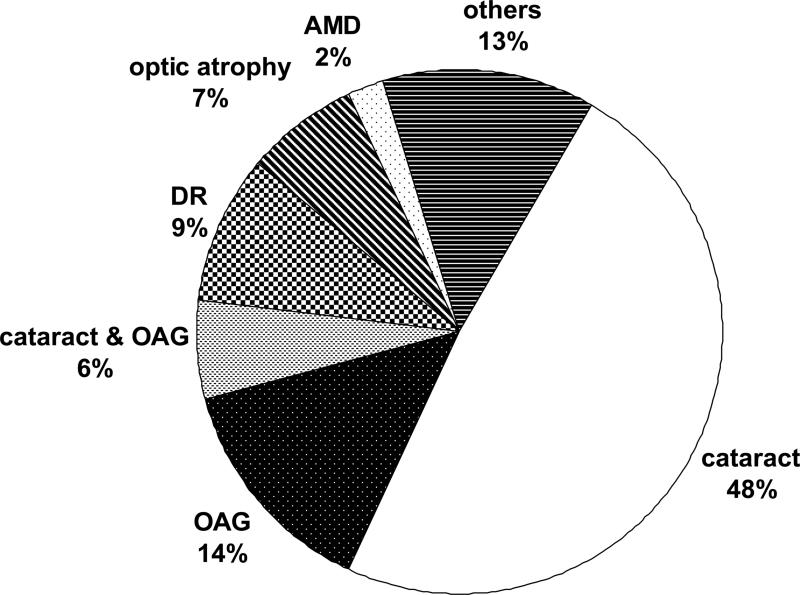
Results: The 9-year incidence was 1.0% and 2.1% for blindness and 6.0% and 9.0% for low vision, by WHO and U.S. criteria, respectively. Older age at baseline was associated with higher incidence of low vision and blindness, reaching 23.0% (95% confidence interval [CI], 18.8-28.0) and 4.3% (95% CI, 2.7-6.9) at age 70 years or more, based on WHO criteria. The primary causes of incident bilateral blindness (U.S. criteria) in 126 eyes were age-related cataract (48.3%), open-angle glaucoma (OAG) (14.3%), combined cataract and OAG (6.3%), diabetic retinopathy (8.7%), and optic atrophy (7.1%). Age-related macular degeneration (2.4%) rarely caused blindness.
Conclusions: Incident visual impairment is exceedingly high in this population. Cataract, OAG, and diabetic retinopathy remain the major causes of blindness, underpinning the clinical and public health significance of these conditions in this and similar populations.
Figures
Similar articles
-
Four-year incidence of visual impairment: Barbados Incidence Study of Eye Diseases.Ophthalmology. 2004 Jan;111(1):118-24. doi: 10.1016/j.ophtha.2003.04.002. Ophthalmology. 2004. PMID: 14711723
-
Prevalence and causes of visual impairment in The Barbados Eye Study.Ophthalmology. 2001 Oct;108(10):1751-6. doi: 10.1016/s0161-6420(01)00590-5. Ophthalmology. 2001. PMID: 11581045
-
Prevalence and Causes of Visual Impairment in a Chinese Adult Population: The Taizhou Eye Study.Ophthalmology. 2015 Jul;122(7):1480-8. doi: 10.1016/j.ophtha.2015.03.022. Epub 2015 May 16. Ophthalmology. 2015. PMID: 25986897
-
Causes of blindness and vision impairment in 2020 and trends over 30 years, and prevalence of avoidable blindness in relation to VISION 2020: the Right to Sight: an analysis for the Global Burden of Disease Study.Lancet Glob Health. 2021 Feb;9(2):e144-e160. doi: 10.1016/S2214-109X(20)30489-7. Epub 2020 Dec 1. Lancet Glob Health. 2021. PMID: 33275949 Free PMC article.
-
Epidemiology of Ocular Functions and Diseases in Persons With Diabetes.In: Cowie CC, Casagrande SS, Menke A, Cissell MA, Eberhardt MS, Meigs JB, Gregg EW, Knowler WC, Barrett-Connor E, Becker DJ, Brancati FL, Boyko EJ, Herman WH, Howard BV, Narayan KMV, Rewers M, Fradkin JE, editors. Diabetes in America. 3rd edition. Bethesda (MD): National Institute of Diabetes and Digestive and Kidney Diseases (US); 2018 Aug. CHAPTER 21. In: Cowie CC, Casagrande SS, Menke A, Cissell MA, Eberhardt MS, Meigs JB, Gregg EW, Knowler WC, Barrett-Connor E, Becker DJ, Brancati FL, Boyko EJ, Herman WH, Howard BV, Narayan KMV, Rewers M, Fradkin JE, editors. Diabetes in America. 3rd edition. Bethesda (MD): National Institute of Diabetes and Digestive and Kidney Diseases (US); 2018 Aug. CHAPTER 21. PMID: 33651534 Free Books & Documents. Review.
Cited by
-
Long-term trends in glaucoma-related blindness in Olmsted County, Minnesota.Ophthalmology. 2014 Jan;121(1):134-141. doi: 10.1016/j.ophtha.2013.09.003. Epub 2013 Oct 25. Ophthalmology. 2014. PMID: 24823760 Free PMC article.
-
Epidemiology of glaucoma in sub-saharan Africa: prevalence, incidence and risk factors.Middle East Afr J Ophthalmol. 2013 Apr-Jun;20(2):111-25. doi: 10.4103/0974-9233.110605. Middle East Afr J Ophthalmol. 2013. PMID: 23741130 Free PMC article. Review.
-
Incidence of visual impairment over a 20-year period: the Beaver Dam Eye Study.Ophthalmology. 2013 Jun;120(6):1210-9. doi: 10.1016/j.ophtha.2012.11.041. Epub 2013 Mar 1. Ophthalmology. 2013. PMID: 23466270 Free PMC article.
-
Six-Year Incidence of Visual Impairment in a Multiethnic Asian Population: The Singapore Epidemiology of Eye Diseases Study.Ophthalmol Sci. 2023 Sep 3;3(4):100392. doi: 10.1016/j.xops.2023.100392. eCollection 2023 Dec. Ophthalmol Sci. 2023. PMID: 38025163 Free PMC article.
-
Annual incidences of visual impairment during 10-year period in Mie prefecture, Japan.Jpn J Ophthalmol. 2017 Jul;61(4):293-298. doi: 10.1007/s10384-017-0517-x. Epub 2017 Apr 26. Jpn J Ophthalmol. 2017. PMID: 28447270
References
-
- Tielsch JM, Sommer A, Witt K, et al. Blindness and visual impairment in an American urban population. The Baltimore Eye Survey. Arch Ophthalmol. 1990;108:286–90. - PubMed
-
- Rubin GS, West SK, Munoz B, et al. A comprehensive assessment of visual impairment in a population of older Americans. The SEE Study. Salisbury Eye Evaluation Project. Invest Ophthalmol Vis Sci. 1997;38:557–68. - PubMed
-
- Hyman L, Wu SY, Connell AMS, et al. Prevalence and causes of visual impairment in the Barbados Eye Study. Ophthalmology. 2001;108:1751–6. - PubMed
Publication types
MeSH terms
Grants and funding
LinkOut - more resources
Full Text Sources
