. 2010 Apr;42(4):424-31.
doi: 10.1165/rcmb.2008-0408OC. Epub 2009 Jun 5.

TLR-4-mediated innate immunity is reduced in cystic fibrosis airway cells

Affiliations

TLR-4-mediated innate immunity is reduced in cystic fibrosis airway cells

Gerrit John et al. Am J Respir Cell Mol Biol. 2010 Apr.

Abstract

Airway epithelial cells contribute to the inflammatory response of the lung, and their innate immune response is primarily mediated via Toll-like receptor (TLR) signaling. Cystic fibrosis (CF) airways are chronically infected with Pseudomonas aeruginosa, suggesting a modified immune response in CF. We investigated the TLR-4 expression and the inflammatory profile (IL-8 and IL-6 secretion) in CF bronchial epithelial cell line CFBE41o- and its CF transmembrane ion condcutance regulator (CFTR)-corrected counterpart grown under air-liquid interface conditions after stimulation with lipopolysaccharide (LPS) from gram-negative bacteria. In CFTR-corrected cells, IL-8 and IL-6 secretions were constitutively activated but significantly increased after LPS stimulation compared with CFBE41o-. Blocking TLR-4 by a specific antibody significantly inhibited IL-8 secretion only in CFTR-corrected cells. Transfection with specific siRNA directed against TLR-4 mRNA significantly reduced the response to LPS in both cell lines. Fluorescence-activated cell sorter analysis revealed significantly higher levels of TLR-4 surface expression in CFTR-corrected cells. In histologic lung sections of patients with CF, the TLR-4 expression in the bronchial epithelium was significantly reduced compared with healthy control subjects. In CF the loss of CFTR function appears to decrease innate immune responses, possibly by altering the expression of TLR-4 on airway epithelial cells. This may contribute to chronic bacterial infection of CF airways.


Figures
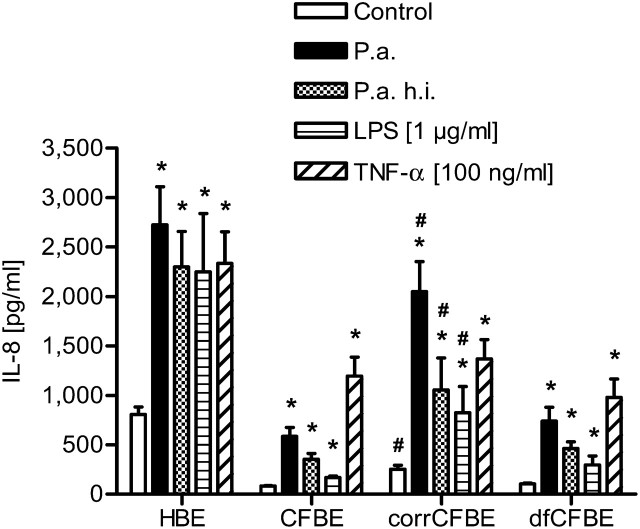
Figure 1.
Figure 1.
Secretion of IL-8, analyzed by enzyme-linked immunosorbent assay (ELISA), in cells from human bronchial epithelial cell line (HBE), CF bronchial epithelial cell line (CFBE), CFTR-complemented counterpart CFBE cell line (corrCFBE), and the (DF508) control plasmid cell line (dfCFBE), 24 hours after 1 hour of stimulation with living and heat-inactivated (h.i.) P. aeruginosa (P.a.) (1 × 10⁸/ml), and LPS (1 μg/ml). TNF-α (100 ng/ml) served as positive control (n = 4). *Significantly different than control, #significantly different than CFBE and dfCFBE, with P < 0.05.
Figure 2.
Figure 2.
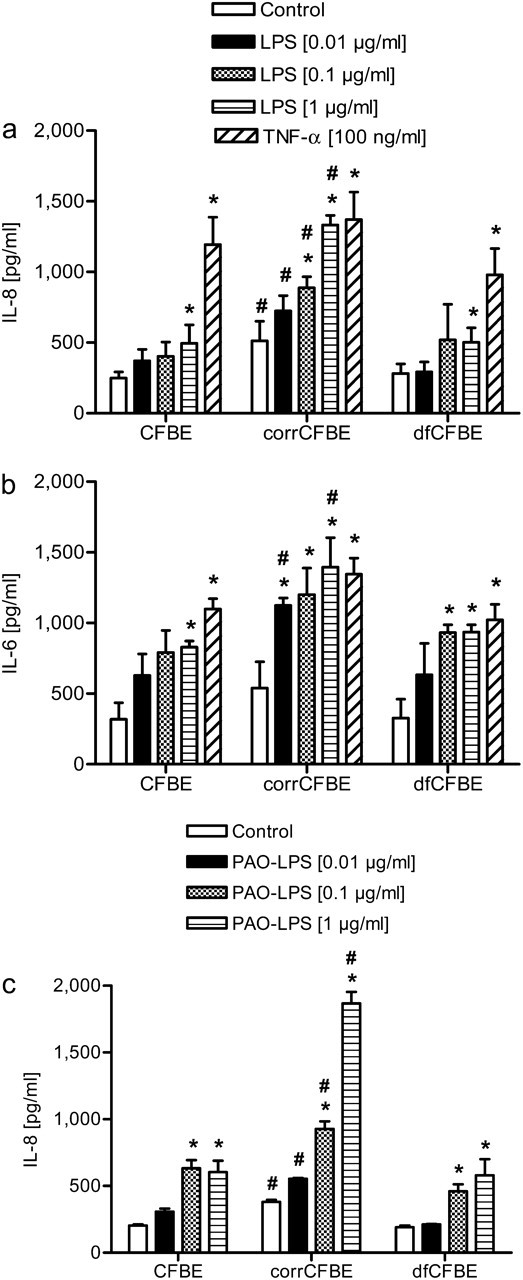
Secretion of IL-8 (a and c) and IL-6 (b), analyzed by ELISA, in CFBE, corrCFBE, and dfCFBE cells, 24 hours after 1 hour of stimulation with LPS at 0.01, 0.1, and 1 μg/ml. TNF-α (100 ng/ml) served as positive control. The cells were stimulated either with LPS from Salmonella enterica sv. Arizona (a and b) or with LPS from P. aeruginosa (c) (n = 4). *Significantly different than control, #significantly different than CFBE and dfCFBE, with P < 0.05.
Figure 3.
Figure 3.
Inhibition of Toll-like receptor (TLR)-4–mediated cytokine secretion by incubation with a monoclonal antibody to TLR-4. IL-8 secretion was analyzed by ELISA in CFBE, corrCFBE, and dfCFBE cells, 24 hours after 1 hour of incubation with a monoclonal antibody (Ab) to TLR-4 (1 μg/ml) and subsequent stimulation with LPS (1 μg/ml) for 1 hour (n = 4). *LPS treatment significantly different than LPS+Ab with P < 0.05.
Figure 4.
Figure 4.
Inhibition of TLR-4–mediated cytokine secretion by transfection of specific siRNA directed against TLR-4 mRNA. IL-8 secretion was analyzed by ELISA in CFBE, corrCFBE, and dfCFBE cells, 24 hours after 48 hours of transfection with TLR-4 and negative control siRNA, and subsequent stimulation with LPS (1 μg/ml) for 1 hour. Data are given relative to each negative control = 100% (n = 4). *Significantly different than negative control with P < 0.05.
Figure 5.
Figure 5.
mRNA and protein expression analysis of TLR-4 in CFBE, corrCFBE, and dfCFBE cells. (a) mRNA expression of TLR-4 and adapter molecules CD14 and MD-2 under unstimulated conditions was analyzed by quantitative real-time RT-PCR, using the ΔΔCT analysis to calculate expression in comparison to GAPDH and normalized to the level of CFBE cells (n = 5). (b) FACS analysis showing surface expression of TLR-4 under basal conditions and 24 hours after 1 hour of stimulation with LPS (1 μg/ml) (n = 5) *Significantly different than CFBE and dfCFBE with P < 0.05; #significantly different than unstimulated control with P < 0.05. (c–j) Immunofluorescence analysis of CFBE (c and g), corrCFBE (d and h) and dfCFBE (e and i) cells for TLR-4, and of CFBE cells for isotype control (f and j). (c–f) Cells were incubated with CellTracker Orange Fluorescent Probe, fixed, and stained with FITC-conjugated antibody to TLR-4 (green). (g–j) Cells were fixed, permeabilized, and stained again for TLR-4, while cellular DNA was stained with DAPI (blue).
Figure 6.
Figure 6.
Immunhistochemistry for TLR-4 in normal (a and b) and cystic fibrosis (CF) (c and d) lung tissue sections from two donors and two patients with CF.

References

    1. Rommens JM, Iannuzzi MC, Kerem B, Drumm ML, Melmer G, Dean M, Rozmahel R, Cole JL, Kennedy D, Hidaka N. Identification of the cystic fibrosis gene: chromosome walking and jumping. Science 1989;245:1059–1065. - PubMed
    1. Welsh MJ, Smith AE. Molecular mechanisms of CFTR chloride channel dysfunction in cystic fibrosis. Cell 1993;73:1251–1254. - PubMed
    1. Davis PB, Drumm M, Konstan MW. Cystic fibrosis. Am J Respir Crit Care Med 1996;154:1229–1256. - PubMed
    1. Heijerman H. Infection and inflammation in cystic fibrosis: a short review. J Cyst Fibros 2005;4:3–5. - PubMed
    1. Machen TE. Innate immune response in CF airway epithelia: hyperinflammatory? Am J Physiol Cell Physiol 2006;291:C218–C230. - PubMed

Publication types

MeSH terms