


Human v6: the medial motion area
- PMID: 19502476
- PMCID: PMC2803738
- DOI: 10.1093/cercor/bhp112
Human v6: the medial motion area
Abstract
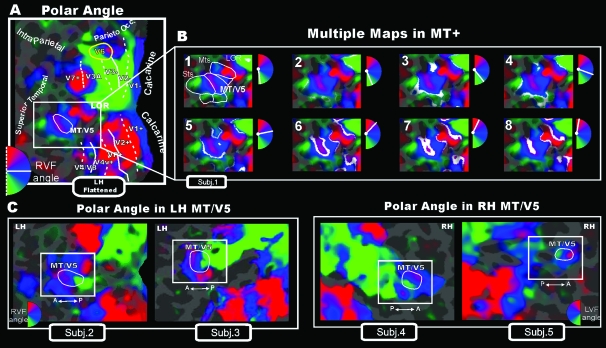
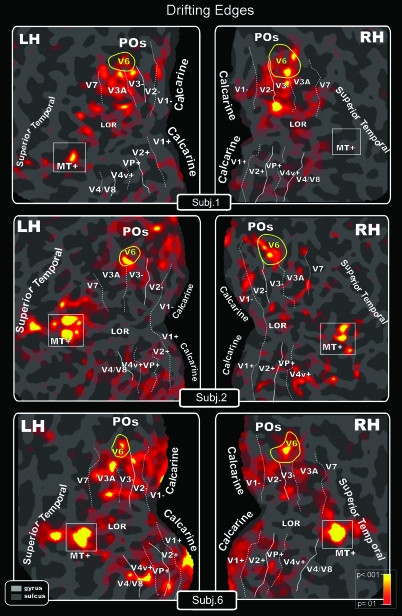
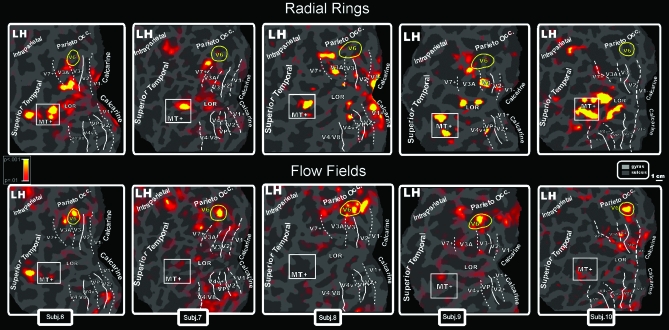
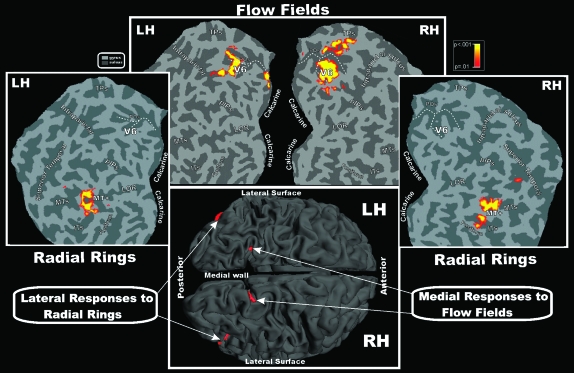
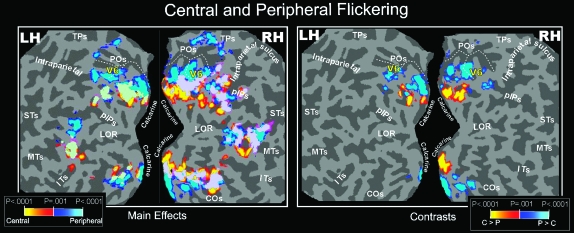
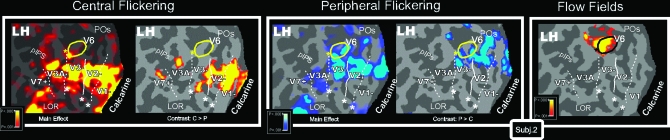
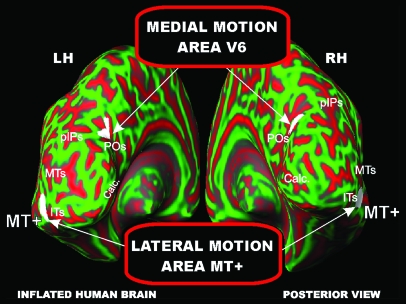
Cortical-surface-based functional Magnetic Resonance Imaging mapping techniques and wide-field retinotopic stimulation were used to verify the presence of pattern motion sensitivity in human area V6. Area V6 is highly selective for coherently moving fields of dots, both at individual and group levels and even with a visual stimulus of standard size. This stimulus is a functional localizer for V6. The wide retinotopic stimuli used here also revealed a retinotopic map in the middle temporal cortex (area MT/V5) surrounded by several polar-angle maps that resemble the mosaic of small areas found around macaque MT/V5. Our results suggest that the MT complex (MT+) may be specialized for the analysis of motion signals, whereas area V6 may be more involved in distinguishing object and self-motion.
Figures
References
-
- Albright TD. Direction and orientation selectivity of neurons in visual area MT of the macaque. J Neurophysiol. 1984;52(6):1106–1130. - PubMed
-
- Allman JM, Kaas J. A representation of the visual field in the caudal third of the middle temporal gyrus of the owl monkey (Aotus trivirgatus) Brain Res. 1971;31:85–105. - PubMed
-
- Allman JM, Kaas J. Representation of the visual field on the medial wall of the occipital–parietal cortex in the owl monkey. Science. 1976;191:572–575. - PubMed
-
- Beer J, Blakemore C, Previc FH, Liotti M. Areas of the human brain activated by ambient visual motion, indicating three kinds of self-movement. Exp Brain Res. 2002;143(1):78–88. - PubMed
-
- Blanke O, Landis T, Mermoud C, Spinelli L, Safran AB. Direction-selective motion blindness after unilateral posterior brain damage. Eur J Neurosci. 2003;18(3):709–722. - PubMed
