. 2009 Jun;5(6):e1000466.
doi: 10.1371/journal.ppat.1000466. Epub 2009 Jun 5.

Genomic analyses of the microsporidian Nosema ceranae, an emergent pathogen of honey bees

Affiliations

Genomic analyses of the microsporidian Nosema ceranae, an emergent pathogen of honey bees

R Scott Cornman et al. PLoS Pathog. 2009 Jun.

Abstract

Recent steep declines in honey bee health have severely impacted the beekeeping industry, presenting new risks for agricultural commodities that depend on insect pollination. Honey bee declines could reflect increased pressures from parasites and pathogens. The incidence of the microsporidian pathogen Nosema ceranae has increased significantly in the past decade. Here we present a draft assembly (7.86 MB) of the N. ceranae genome derived from pyrosequence data, including initial gene models and genomic comparisons with other members of this highly derived fungal lineage. N. ceranae has a strongly AT-biased genome (74% A+T) and a diversity of repetitive elements, complicating the assembly. Of 2,614 predicted protein-coding sequences, we conservatively estimate that 1,366 have homologs in the microsporidian Encephalitozoon cuniculi, the most closely related published genome sequence. We identify genes conserved among microsporidia that lack clear homology outside this group, which are of special interest as potential virulence factors in this group of obligate parasites. A substantial fraction of the diminutive N. ceranae proteome consists of novel and transposable-element proteins. For a majority of well-supported gene models, a conserved sense-strand motif can be found within 15 bases upstream of the start codon; a previously uncharacterized version of this motif is also present in E. cuniculi. These comparisons provide insight into the architecture, regulation, and evolution of microsporidian genomes, and will drive investigations into honey bee-Nosema interactions.


Conflict of interest statement

ME, SH, and BD are employed by 454 Life Sciences/Roche Applied Sciences.

Figures
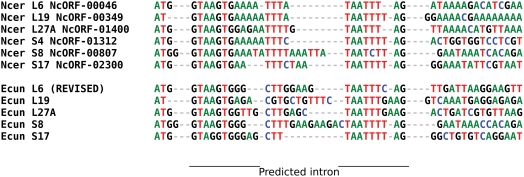
Figure 1
Figure 1. Alignment of the 5′ region of six ribosomal protein genes in N. ceranae that contain predicted introns, together with the five orthologs of these genes in E. cuniculi.
Alignment begins with the start codon, which is interrupted by an intron in the ribosomal protein L19. The gene model for the E. cuniculi L6 protein was modified based on comparison with the N. ceranae nucleotide sequence and translation. Introns were manually aligned to illustrate regions of sequence conservation. Ncer = N. ceranae, Ecun = E. cuniculi.
Figure 2
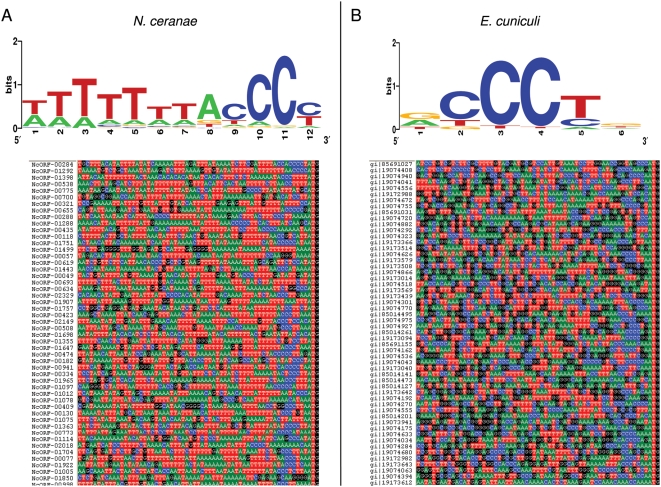
Figure 2. Conserved sense-strand motif upstream of start codons of N. ceranae and E. cuniculi genes.
A. Sequence logo of motif identified by MEME and representative unaligned sequence upstream of the start codon (the last three positions) of N. ceranae genes. B. Sequence logo of motif identified by MEME and representative unaligned sequence upstream of the start codon of E. cuniculi genes. See text for details.
Figure 3
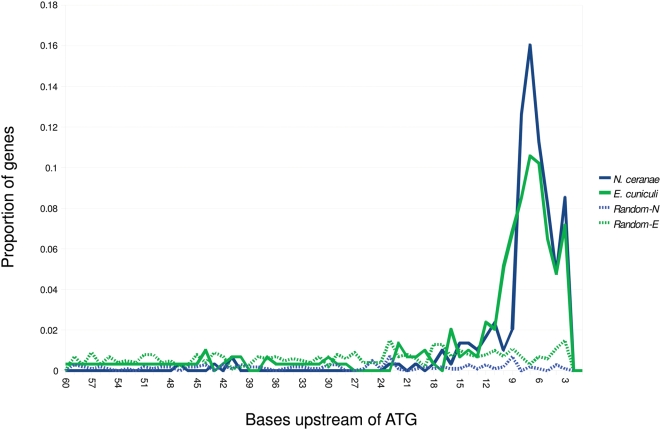
Figure 3. Over-representation of the nucleotide sequence ‘CCC’, common to both motifs shown in Figure 2, in the region upstream of start codons.
The horizontal axis is the distance from the start codon in bases (5′ to 3′ with the ATG not shown at the 3′ end), and the vertical axis is the proportion of genes in the sample (n = 292, see text) in which the first base of a cytosine triplet occurs that number of bases upstream of the start. Both genomes show a much higher frequency of CCC occurring close to the start codon than do random sequences of the same length and base composition (“N-random” and “E-random” refer to the base composition of N. ceranae and E. cuniculi sequences, respectively). For x-axis values of 1 or 2, the frequency is zero by definition.
Figure 4
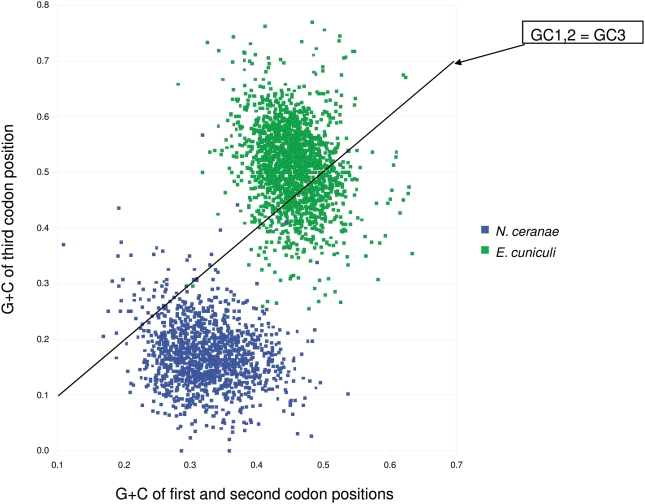
Figure 4. G+C content of N. ceranae and E. cuniculi genes.
The horizontal axis is the proportion of G+C in the first two codon positions (GC1,2), whereas the vertical axis represents the G+C content of the third position (GC3). Substitutions at the third position are usually synonymous and thus are expected to reflect mutational equilibrium in the absence of other evolutionary forces such as codon bias. The two genomes overlap very little in G+C content of genes, and differ more at the third position than at the first two positions.
Figure 5
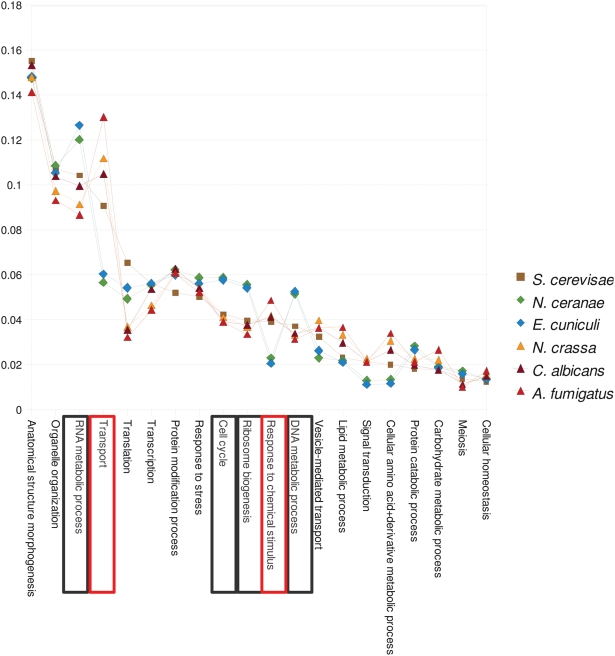
Figure 5. The twenty most abundant ontology terms of the GO Slim classification for yeast, S. cerevisiae, in descending order and compared with the abundance of these terms applied to five other genomes as described in the Materials and Methods.
Lines are used instead of points in order to highlight the variation among species. The microsporidians N. ceranae and E. cuniculi differ concordantly from the four fungal genomes, which together represent a diversity of phylogenetic positions and life-history strategies, including facultative pathogens. The concordance of the microsporidian annotations imply that common ancestry and/or shared life-history traits have shaped the allocation of their genomes to various functional categories. Terms in black boxes are notably more common in the microsporidia, whereas terms in red boxes are notably less common. Note that for all species the frequencies sum to one and therefore are not independent.

References

    1. Evans JD, Aronstein K, Chen YP, Hetru C, Imler J-L, et al. Immune pathways and defence mechanisms in honey bees Apis mellifera. Insect Mol Biol. 2006;15:645–656. - PMC - PubMed
    1. van Engelsdorp D, Hayes J, Jr, Underwood RM, Pettis J. A survey of honey bee colony losses in the U.S., Fall 2007 to Spring 2008. PLoS ONE. 2008;3:e4071. doi:10.1371/journal.pone.0004071. - PMC - PubMed
    1. Klee J, Besana AM, Genersch E, Gisder S, Nanetti A, et al. Widespread dispersal of the microsporidian Nosema ceranae, an emergent pathogen of the western honey bee, Apis mellifera. J Invert Pathol. 2007;96:1–10. - PubMed
    1. Slamovits CH, Fast NM, Law JS, Keeling PJ. Genome compaction and stability in microsporidian intracellular parasites. Curr Biol. 2004;14:891–896. - PubMed
    1. Fries I, Feng F, Da Silva A, Slemenda SB, Pieniazek NJ. Nosema ceranae n. sp. (Microspora, Nosematidae), morphological and molecular characterization of a microsporidian parasite of the Asian honey bee Apis cerana (Hymenoptera, Apidae). Eur J Protistol. 1996;32:356–365.

Publication types