. 2009 Dec;15(12):3697-707.
doi: 10.1089/ten.TEA.2009.0213.

Inhibition of histone deacetylase activity in reduced oxygen environment enhances the osteogenesis of mouse adipose-derived stromal cells

Affiliations

Inhibition of histone deacetylase activity in reduced oxygen environment enhances the osteogenesis of mouse adipose-derived stromal cells

Yue Xu et al. Tissue Eng Part A. 2009 Dec.

Abstract

Recent studies suggest that oxygen tension has a great impact on the osteogenic differentiation capacity of mesenchymal cells derived from adipose tissue: reduced oxygen impedes osteogenesis. We have found that expansion of mouse adipose-derived stromal cells (mASCs) in reduced oxygen tension (10%) results in increased cell proliferation along with induction of histone deacetylase (HDAC) activity. In this study, we utilized two HDAC inhibitors (HDACi), sodium butyrate (NaB) and valproic acid (VPA), and studied their effects on mASCs expanded in various oxygen tensions (21%, 10%, and 1% O(2)). Significant growth inhibition was observed with NaB or VPA treatment in each oxygen tension. Osteogenesis was enhanced by treatment with NaB or VPA, particularly in reduced oxygen tensions (10% and 1% O(2)). Conversely, adipogenesis was decreased with treatments of NaB or VPA at all oxygen tensions. Finally, NaB- or VPA-treated, reduced oxygen tension-exposed (1% O(2)) ASCs were grafted into surgically created mouse tibial defects and resulted in significantly increased bone regeneration. In conclusion, HDACi significantly promote the osteogenic differentiation of mASCs exposed to reduced oxygen tension; HDACi may hold promise for future clinical applications of ASCs for skeletal regeneration.


Figures

FIG. 1.
FIG. 1.
Cellular proliferation at various oxygen tensions with or without histone deacetylase inhibitors (HDACi). Cellular proliferation was assayed by bromodeoxyuridine (BrdU) incorporation after 6-day growth under 21%, 10%, and 1% O2 conditions. Hypoxia (10% and 1% oxygen) increased cellular proliferation in comparison with proliferation in normoxia (21% oxygen); see solid gray bars. Both HDACi, sodium butyrate (NaB) and valproic acid (VPA), significantly decreased BrdU uptake across all oxygen tensions (0.5–2 mM). Values are normalized to BrdU incorporation in normoxia with vehicle control; see far left. Error bars represent one standard deviation; n = 6, *p ≤ 0.05 versus 21% oxygen control; **p ≤ 0.05 versus 10% oxygen control; and ***p ≤ 0.05 versus 1% oxygen control.
FIG. 2.
FIG. 2.
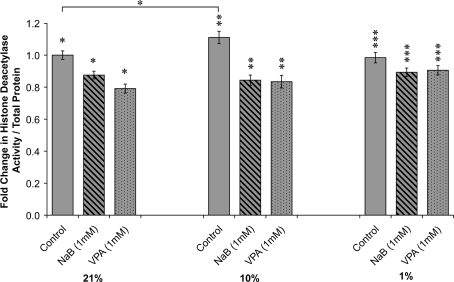
HDAC activity at various oxygen tensions with or without HDACi. ASCs were expanded in 21%, 10%, and 1% oxygen conditions; HDAC activity was measured by a colorimetric reaction and normalized to total protein content. HDAC activity significantly increased at 10% O2. Forty-eight hours of pretreatment with either NaB (1 mM) or VPA (1 mM) significantly reduced HDAC activity across all oxygen tensions. Values are normalized to control groups in 21% O2; error bars represent the standard deviation; n = 3; *p ≤ 0.05 versus 21% oxygen control; **p ≤ 0.05 versus 10% oxygen control; and ***p ≤ 0.05 versus 1% oxygen control.
FIG. 3.
FIG. 3.
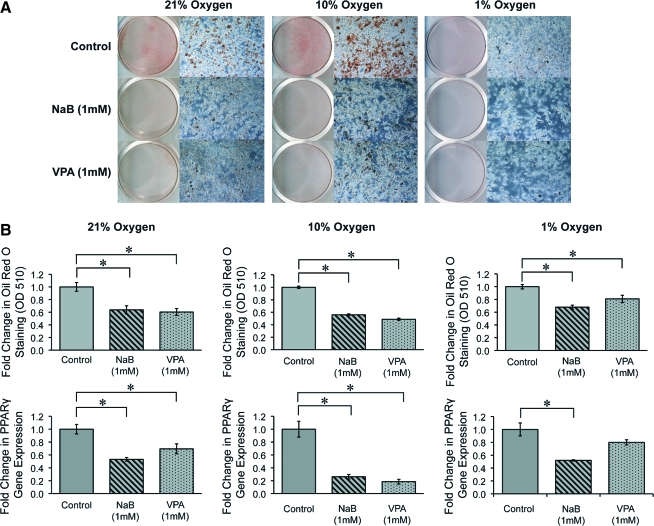
Adipogenic differentiation of mouse adipose-derived stromal cells (mASCs) exposed to various oxygen tensions, with or without HDACi pretreatment. ASCs were expanded under 21%, 10%, and 1% O2 conditions and were pretreated for 48 h with NaB (1 mM), VPA (1 mM), or vehicle as a control, followed by adipogenic induction. (A) Oil red O staining of intracellular lipid accumulation at 7-day differentiation. Lipid accumulation was observed in 21% and 10% O2, while little staining was apparent at 1% O2. HDACi-pretreated mASCs showed substantially reduced lipid at all oxygen tensions. (B) Top row demonstrates quantification of Oil red O staining by leaching and photometric detection. Significantly decreased staining was observed among both NaB- and VPA-pretreated ASCs. Bottom row shows PPAR-γ expression by quantitative real-time polymerase chain reaction. Significantly decreased gene expression in PPAR-γ was again observed among HDACi-pretreated ASCs. Photographs are the scanning view of whole wells and the 10 × microscopical fields that represent one of the triplicate wells; values are normalized to control groups at each oxygen tension; error bars represent one standard deviation; n = 3; *p ≤ 0.05. Color images available online at www.liebertonline.com/ten.
FIG. 4.
FIG. 4.
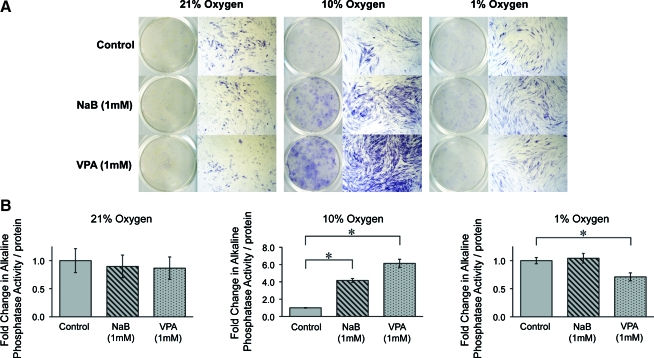
Alkaline phosphatase (ALP) activity in mASCs exposed to various oxygen tensions, with or without HDACi pretreatment. ASCs were expanded under 21%, 10%, and 1% O2 conditions and were pretreated for 48 h with NaB (1 mM), VPA (1 mM), or vehicle as a control, followed by osteogenic differentiation. (A) ALP staining at 1-week differentiation. Endogenous ALP staining in mASCs showed across all oxygen tensions. The intensity of staining was observed to increase among NaB- or VPA-pretreated mASCs exposed to 10% O2. (B) Quantification of ALP activity normalized to total protein content after 1-week differentiation. Similar to qualitative ALP staining, enzymatic activity was increased among NaB- or VPA-treated mASCs exposed to 10% oxygen condition. Photographs are the scanning view of whole wells and 10 × microscopical fields that represent one of the triplicate wells; values are normalized to control groups at each oxygen tension; error bars represent one standard deviation; n = 3; *p ≤ 0.05. Color images available online at www.liebertonline.com/ten.
FIG. 5.
FIG. 5.
Osteogenic gene expression in mASCs exposed to various oxygen tensions, with or without HDACi pretreatment. ASCs were expanded under 21%, 10%, and 1% O2 conditions and were pretreated for 48 h with NaB (1 mM), VPA (1 mM), or vehicle as a control, followed by osteogenic differentiation. (A) Runx2 gene expression after 7-day differentiation. (B) Alkaline phosphatase expression after 7-day differentiation. (C) Type I collagen expression at 7-day differentiation. (D) Osteopontin gene expression after 7-day differentiation. Significant enhancement of the osteogenic gene markers was observed under most conditions. Values are normalized to control groups at each oxygen tension; error bars represent one standard deviation; n = 3; *p ≤ 0.05.
FIG. 6.
FIG. 6.
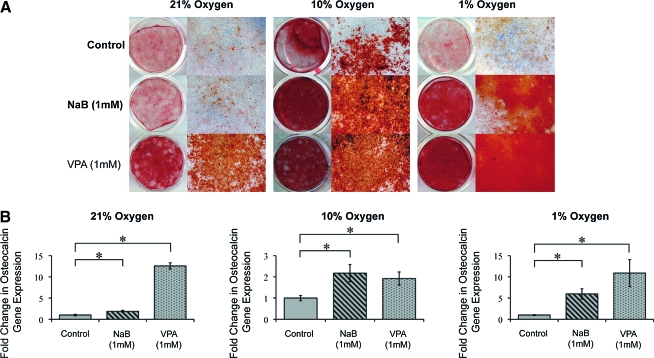
Terminal osteogenic differentiation in mASCs exposed to various oxygen tensions, with or without HDACi pretreatment. ASCs were expanded under 21%, 10%, and 1% O2 conditions and were pretreated for 48 h with NaB, VPA, or vehicle as a control, followed by osteogenic differentiation. (A) Alizarin red staining at 2-week differentiation. The intensity of staining was observed to increase among NaB- or VPA-pretreated ASCs, particularly those exposed to reduced oxygen tensions. (B) Osteocalcin gene expression by quantitative real-time polymerase chain reaction at 2-week osteogenic differentiation. Similarly, both NaB (1 mM) and VPA (1 mM) at all oxygen tensions significantly increased osteocalcin expression. Photographs are the scanning view of whole wells and 10 × microscopical fields that represent one of the triplicate wells; values are normalized to control groups at each oxygen tension; error bars represent one standard deviation; n = 3; *p ≤ 0.05. Color images available online at www.liebertonline.com/ten.
FIG. 7.
FIG. 7.
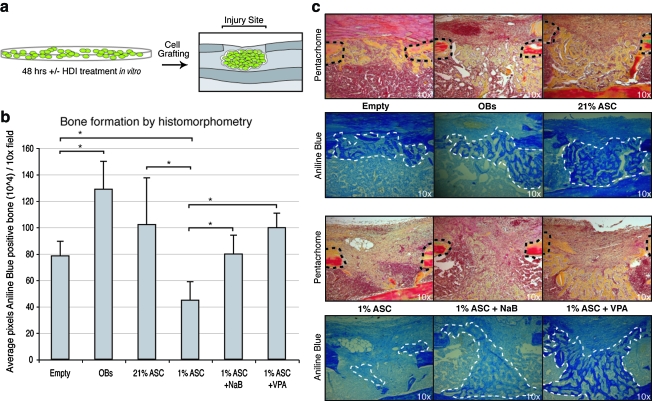
Grafting of mASCs in tibial defects. (a) Green fluorescent protein–positive mASCs were expanded under 21% and 1% O2 conditions with or without NaB (1 mM) or VPA (1 mM) for 48 h, followed by grafting into a mouse monocortical tibial defect. (b) Histomorphometric quantification of new bone formation, as pixels new bone per 10 × field. (c) Histology of defects without grafted cells (Empty), with mouse whole-calvarial-derived osteoblasts (OBs), or mASCs expanded at 21% or 1% oxygen, with or without NaB or VPA treatment (1 mM). In Pentachrome staining, bone within the defect site appears yellow. In adjacent Aniline Blue staining, bone within the defect site appears dark blue. Dashed black lines demarcate the edges of the defect, while dashed white lines encircle new bone within the defect site. Error bars represent one standard deviation, *p ≤ 0.05. Color images available online at www.liebertonline.com/ten.

References

    1. Malladi P. Xu Y. Chiou M. Giaccia A.J. Longaker M.T. Effect of reduced oxygen tension on chondrogenesis and osteogenesis in adipose-derived mesenchymal cells. Am J Physiol. 2006;290:C1139. - PubMed
    1. Xu Y. Malladi P. Chiou M. Bekerman E. Giaccia A.J. Longaker M.T. In vitro expansion of adipose-derived adult stromal cells in hypoxia enhances early chondrogenesis. Tissue Eng. 2007;13:2981. - PubMed
    1. Xu Y. Malladi P. Wagner D.R. Longaker M.T. Adipose-derived mesenchymal cells as a potential cell source for skeletal regeneration. Curr Opin Mol Ther. 2005;7:300. - PubMed
    1. Zuk P.A. Zhu M. Ashjian P. De Ugarte D.A. Huang J.I. Mizuno H. Alfonso Z.C. Fraser J.K. Benhaim P. Hedrick M.H. Human adipose tissue is a source of multipotent stem cells. Mol Biol Cell. 2002;13:4279. - PMC - PubMed
    1. Wang Y. Wan C. Deng L. Liu X. Cao X. Gilbert S.R. Bouxsein M.L. Faugere M.C. Guldberg R.E. Gerstenfeld L.C. Haase V.H. Johnson R.S. Schipani E. Clemens T.L. The hypoxia-inducible factor alpha pathway couples angiogenesis to osteogenesis during skeletal development. J Clin Invest. 2007;117:1616. - PMC - PubMed

Publication types

MeSH terms

LinkOut - more resources