


Pan-vertebrate toll-like receptors during evolution
- PMID: 19506737
- PMCID: PMC2691675
- DOI: 10.2174/138920208786241234
Pan-vertebrate toll-like receptors during evolution
Abstract
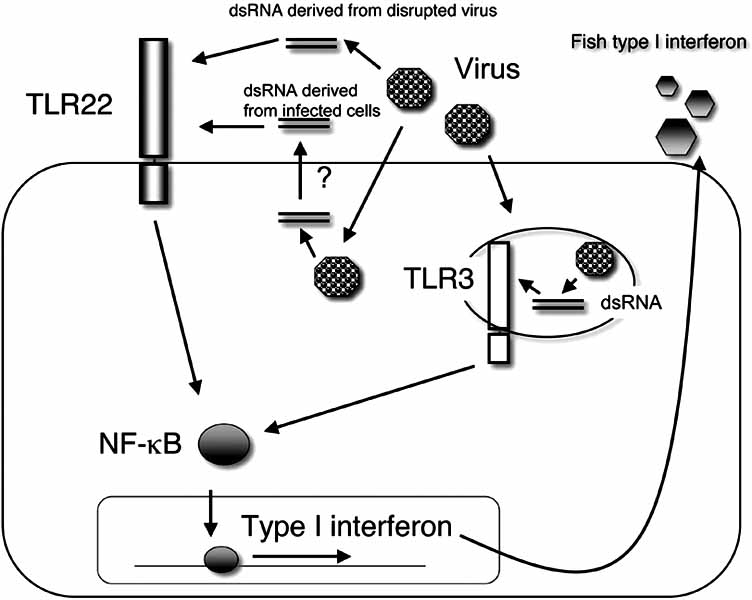
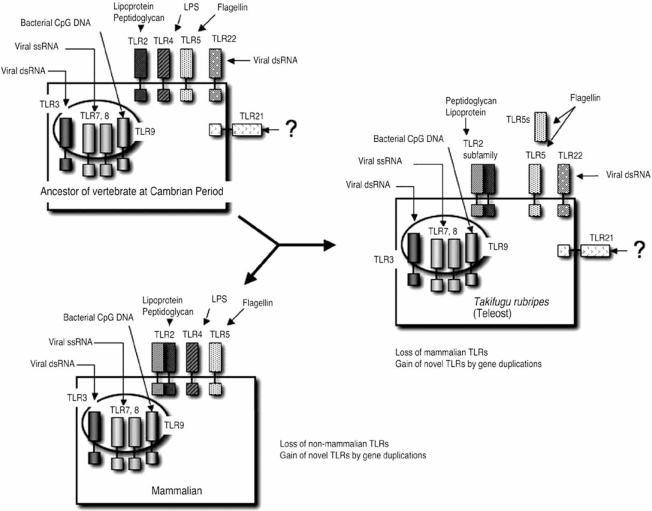
Human toll-like receptors (TLRs) recognize pathogen-associated molecular patterns (PAMPs) to raise innate immune responses. The human TLR family was discovered because of its sequence similarity to fruit fly (Drosophila) Toll, which is involved in an anti-fungal response. In this review, we focus on the origin of the vertebrate TLR family highlighted through functional and phylogenetic analyses of TLRs in non-mammalian vertebrates. Recent extensive genome projects revealed that teleosts contain almost all subsets of TLRs that correspond to human TLRs (TLR1, 2, 3, 4, 5, 7, 8, and 9), whereas the urochordate Cionaintestinalis contains only a few TLR genes. Therefore, mammals likely obtained almost all TLR family members at the beginning of vertebrate evolution. This premise is further supported by several functional analyses of non-mammalian TLRs. We have summarized several teleost TLRs with unique properties distinct from mammalian TLRs to outline their specific roles. According to Takifugu rubripes genome project, the puffer fish possesses fish-specific TLR21 and 22. Surprisingly, phylogenetic analyses indicate that TLR21 and 22 emerged during an early period of vertebrate evolution in parallel with other TLRs and that the mammalian ancestor lost TLR21 and 22 during evolution. Our laboratory recently revealed that TLR22 recognizes double-strand RNA and induces interferon production through the TICAM-1 adaptor, as in TLR3, but unlike TLR3, TLR22 localizes to the cell surface. Therefore, differential expression of TLR3 and TLR22, rather than simple redundancy of RNA sensors, may explain the effective protection of fish from RNA virus infection in the water. In this review, we summarize the similarities and differences of the TLR family in various vertebrates and introduce these unique TLRs for a possible application to the field of clinical practices for cancer or virus infection.
Figures
References
-
- Lemaitre B, Nicolas E, Michaut L, Reichhart JM, Hoffmann JA. The dorsoventral regulatory gene cassette spatzle/Toll/cactus controls the potent antifungal response in Drosophila adults. Cell. 1996;86:973–83. - PubMed
-
- Medzhitov R, Preston-Hurlburt P, Janeway CA Jr. A human homologue of the Drosophila Toll protein signals activation of adaptive immunity. Nature. 1997;388:394–7. - PubMed
-
- Sultzer BM. Genetic control of leucocyte responses to endotoxin. Nature. 1968;219:1253–4. - PubMed
-
- Apte RN, Ascher O, Pluznik DH. Genetic analysis of generation of serum interferon by bacterial lipopolysaccharide. J. Immunol. 1977;119:1898–902. - PubMed
-
- Poltorak A, He X, Smirnova I, Liu MY, Van Huffel C, Du X, Birdwell D, Alejos E, Silva M, Galanos C, Freudenberg M, Ricciardi-Castagnoli P, Layton B, Beutler B. Defective LPS signaling in C3H/HeJ and C57BL/10ScCr mice: mutations in Tlr4 gene. Science. 1998;282:2085–8. - PubMed
LinkOut - more resources
Full Text Sources