


Statewide evaluation of measuring physician delivery of self-management support in chronic disease care
- PMID: 19506971
- PMCID: PMC2710477
- DOI: 10.1007/s11606-009-1033-6
Statewide evaluation of measuring physician delivery of self-management support in chronic disease care
Abstract
Background: Self-management support is an important component of improving chronic care delivery.
Objective: To validate a new measure of self-management support and to characterize performance, including comparisons across chronic conditions.
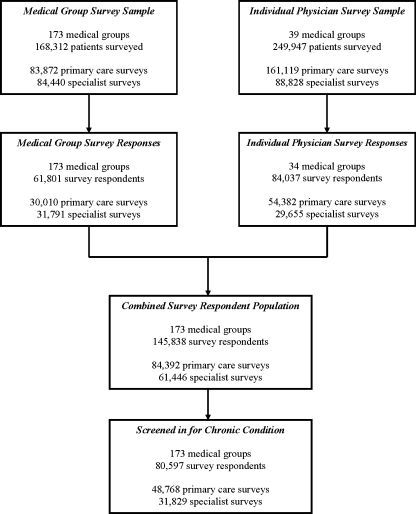
Design, setting, participants: We incorporated a new question module for self-management support within an existing annual statewide patient survey process in 2007.
Measurements: The survey identified 80,597 patients with a chronic illness on whom the new measure could be evaluated and compared with patients' experiences on four existing measures (quality of clinical interactions, coordination of care, organizational access, and office staff). We calculated Spearman correlation coefficients for self-management support scores for individual chronic conditions within each medical group. We fit multivariable logistic regression models to identify predictors of more favorable performance on self-management support.
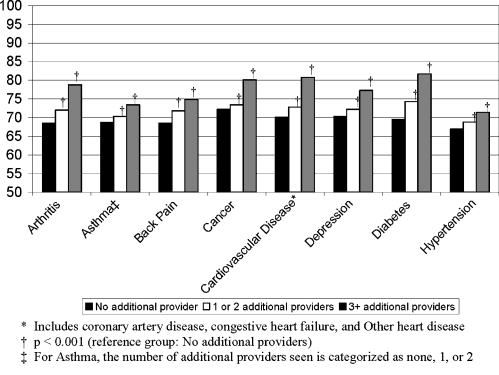
Results: Composite scores of patient care experiences, including quality of clinical interactions (89.2), coordination of care (77.6), organizational access (76.3), and office staff (85.8) were higher than for the self-management support composite score (69.9). Self-management support scores were highest for patients with cancer (73.0) and lowest for patients with hypertension (67.5). The minimum sample size required for medical groups to provide a reliable estimate of self-management support was 199. There was no consistent correlation between self-management support scores for individual chronic conditions within medical groups. Increased involvement of additional members of the healthcare team was associated with higher self-management support scores across all chronic conditions.
Conclusion: Measurement of self-management support is feasible and can identify gaps in care not currently included in standard measures of patient care experiences.
Figures
References
-
- Harvey PW, Petkov JN, Misan G, et al. Self-management support and training for patients with chronic and complex conditions improves health-related behaviour and health outcomes. Aust Health Rev. 2008;32:330–8. - PubMed
Publication types
MeSH terms
LinkOut - more resources
Full Text Sources
Medical
