Review
. 2009 Jul;103(1):61-9.
doi: 10.1093/bja/aep144. Epub 2009 Jun 9.

Sodium channels and the synaptic mechanisms of inhaled anaesthetics

Affiliations
Review

Sodium channels and the synaptic mechanisms of inhaled anaesthetics

H C Hemmings Jr. Br J Anaesth. 2009 Jul.

Abstract

General anaesthetics act in an agent-specific manner on synaptic transmission in the central nervous system by enhancing inhibitory transmission and reducing excitatory transmission. The synaptic mechanisms of general anaesthetics involve both presynaptic effects on transmitter release and postsynaptic effects on receptor function. The halogenated volatile anaesthetics inhibit neuronal voltage-gated Na(+) channels at clinical concentrations. Reductions in neurotransmitter release by volatile anaesthetics involve inhibition of presynaptic action potentials as a result of Na(+) channel blockade. Although voltage-gated ion channels have been assumed to be insensitive to general anaesthetics, it is now evident that clinical concentrations of volatile anaesthetics inhibit Na(+) channels in isolated rat nerve terminals and neurons, as well as heterologously expressed mammalian Na(+) channel alpha subunits. Voltage-gated Na(+) channels have emerged as promising targets for some of the effects of the inhaled anaesthetics. Knowledge of the synaptic mechanisms of general anaesthetics is essential for optimization of anaesthetic techniques for advanced surgical procedures and for the development of improved anaesthetics.


Figures

Fig 1
Fig 1
Steps in the process of synaptic transmission. The action potential invades the presynaptic bouton (1) leading to depolarization mediated by voltage-gated Na+ channels. This can be mimicked in isolated nerve terminals by the chemical secretogogue 4-aminopyridine. The depolarization activates voltage-gated Ca2+ channels closely coupled to docked and releasable synaptic vesicles. (2) Increased extracellular K+ can depolarize the membrane potential independent of Na+ channel involvement to an extent sufficient to activate Ca2+ channels and transmitter release. The local elevations in intracellular Ca2+ concentration bind to the SNARE vesicle fusion complex, leading to exocytosis of transmitter. (3) The transmitter enters the synaptic cleft where it diffuses to the postsynaptic cell, activates synaptic and extrasynaptic receptors, and thereby modifies the excitability of the postsynaptic cell. (4) Anaesthetics can potentially disrupt this process at multiple points. Considerable evidence implicates inhibition of presynaptic voltage-gated Na+ channels as a probable site of inhaled anaesthetic action, particularly at excitatory glutamatergic synapses.
Fig 2
Fig 2
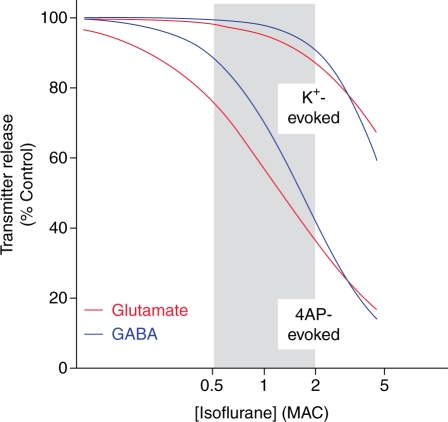
Selective inhibition of Na+ channel-dependent glutamate release by isoflurane. Nerve terminals isolated from rat cerebral cortex were pre-labelled with radio-labelled glutamate and GABA, and release was measured following stimulation with either 4-aminopyridine (4AP) or elevated extracellular K+ as described in Figure 1. Na+ channel-dependent release of both glutamate (IC50=0.44 mM) and GABA (IC50=0.58 mM) evoked by 4AP was more sensitive to inhibition by isoflurane than release of glutamate (IC50=2.6 mM) or GABA (IC50=1.9 mM) evoked by elevated K+, consistent with a greater sensitivity of presynaptic Na+ channels than Ca2+ channels or other downstream processes. Moreover, 4AP-evoked release of the excitatory transmitter glutamate was inhibited at significantly lower concentrations than release of the inhibitory transmitter GABA within the clinical concentration range (0.5–2 MAC, or minimum alveolar concentration, which corresponds to the mean effective dose) indicated by gray shading. IC50, concentration for 50% inhibition. Unpublished data from H.C.H. and R.I. Westphalen.

References

    1. Antognini JF, Schwartz K. Exaggerated anesthetic requirements in the preferentially anesthetized brain. Anesthesiology. 1993;79:1244–9. - PubMed
    1. Banks MI, Pearce RA. Dual actions of volatile anesthetics on GABA(A) IPSCs: dissociation of blocking and prolonging effects. Anesthesiology. 1999;90:120–34. - PubMed
    1. Bean BP, Shrager P, Goldstein DA. Modification of sodium and potassium channel gating kinetics by ether and halothane. J Gen Physiol. 1981;77:233–53. - PMC - PubMed
    1. Berg-Johnsen J, Langmoen IA. The effect of isoflurane on unmyelinated and myelinated fibres in the rat brain. Acta Physiology Scand. 1986;127:87–93. - PubMed
    1. Berg-Johnsen J, Langmoen IA. The effects of isoflurane on excitatory synaptic transmission in the rat hippocampus. Acta Anaesthesiol Scand. 1992;36:350–4. - PubMed

Publication types

MeSH terms