


Measuring social isolation among older adults using multiple indicators from the NSHAP study
- PMID: 19508982
- PMCID: PMC2800811
- DOI: 10.1093/geronb/gbp037
Measuring social isolation among older adults using multiple indicators from the NSHAP study
Abstract
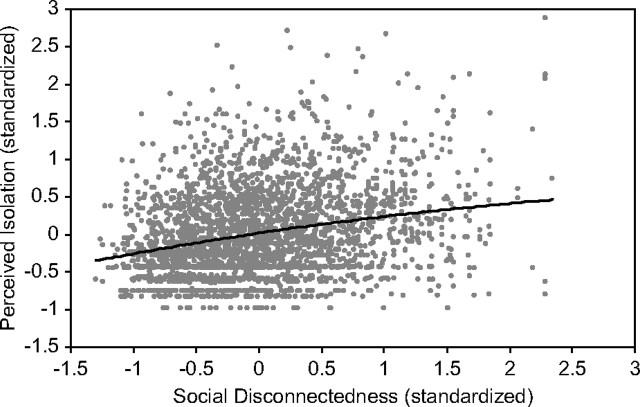
Objectives: The National Social Life, Health, and Aging Project (NSHAP) data contain multiple indicators of social connectedness, social participation, social support, and loneliness among older adults. We suggest that these indicators can be combined to measure two aspects of social isolation: social disconnectedness (i.e., physical separation from others) and perceived isolation (i.e., feelings of loneliness and a lack of social support). We use the NSHAP data to create scales measuring social disconnectedness and perceived isolation and examine their distribution among older adults.
Methods: We assess the reliability of the scales using Cronbach's alpha and item-total correlations and perform confirmatory factor analysis to test the model against the data. Finally, we test differences in scale means across subgroups to assess the distribution of social disconnectedness and perceived isolation among older adults.
Results: We find that 17 indicators combine into two reliable scales. The social disconnectedness scale has a two-factor structure, including the restricted social network dimension and the social inactivity dimension. The perceived isolation scale also comprises two dimensions: lack of support and loneliness. We find that social disconnectedness does not vary across age groups, but the oldest old feel more isolated than the young old. Social disconnectedness and perceived isolation are greater among those who have worse health. Discussion The creation of scales measuring social disconnectedness and perceived isolation provides one way to utilize the wide variety of indicators of social isolation collected in the NSHAP study. Although individual indicators of social connectedness or isolation are useful in their own right, these scales provide parsimonious, continuous variables that account for a variety of aspects of social isolation, which may be especially useful for inclusion in multivariate analyses predicting health outcomes.
Figures
References
-
- Barefoot JC, Gronbaek M, Jensen G, Schnohr P, Prescott E. Social network diversity and risks of ischemic heart disease and total mortality: Findings from the Copenhagen City Heart Study. American Journal of Epidemiology. 2005;161:960–967. - PubMed
-
- Benjamins MR. Religion and functional health among the elderly: Is there a relationship and is it constant? Journal of Aging and Health. 2004;16:355–374. - PubMed
-
- Berkman LF. The role of social relations in health promotion. Psychosomatic Medicine. 1995;57:245–254. - PubMed
-
- Berkman LF, Syme L. Social networks, host resistance, and mortality: A nine-year follow-up study of Alameda County residents. American Journal of Epidemiology. 1979;109:186–204. - PubMed
-
- Blazer DG. Social support and mortality in an elderly community population. American Journal of Epidemiology. 1982;115:684–694. - PubMed
