


Malignant B cells skew the balance of regulatory T cells and TH17 cells in B-cell non-Hodgkin's lymphoma
- PMID: 19509224
- PMCID: PMC2764404
- DOI: 10.1158/0008-5472.CAN-09-0266
Malignant B cells skew the balance of regulatory T cells and TH17 cells in B-cell non-Hodgkin's lymphoma
Abstract
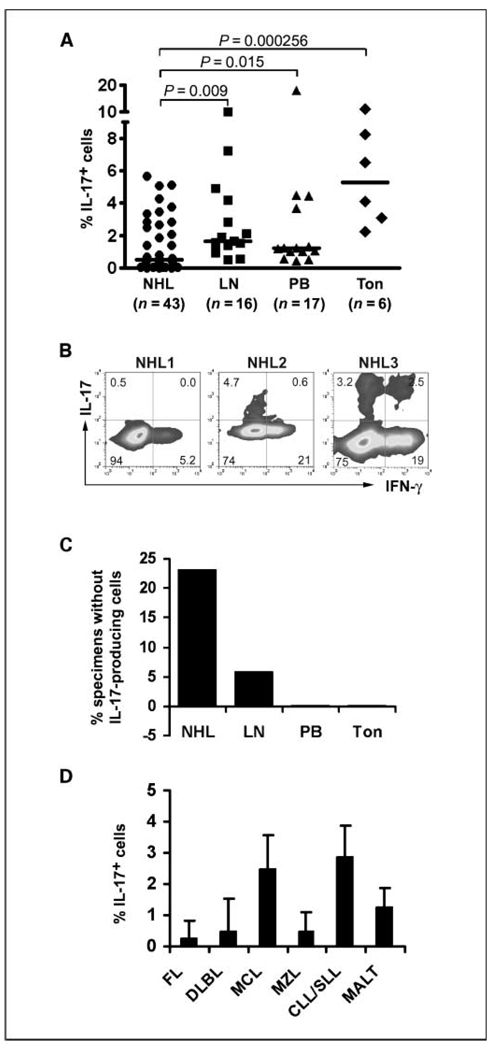
Using biopsy specimens from patients with B-cell non-Hodgkin's lymphoma, we observed a significantly low frequency of T(H)17 cells, including several samples with no detectable amount of interleukin (IL)-17-producing cells present in the tumor microenvironment. We found that, in the absence of lymphoma B cells, treatment with IL-1beta/IL-6 or lipopolysaccharide (LPS) enhanced IL-17 expression in CD4(+) T cells and this enhancement was attenuated when CD4(+) T cells were cocultured with lymphoma B cells. Blockade of CD27-CD70 or CD28-CD80/86 interactions by anti-CD70 or anti-CD80/86 antibodies restored LPS-mediated induction of IL-17 expression in CD4(+) T cells cocultured with lymphoma B cells. Because a subset of lymphoma B cells express IL-2 and given that IL-2 signaling is critically important in the development of regulatory T (T(reg)) cells, we tested the role of IL-2 signaling in T(H)17 cell development. We found that treatment with anti-IL-2 antibody to interrupt IL-2 signaling significantly inhibited Foxp3 expression in CD4(+) T cells. In contrast, interruption of IL-2 signaling up-regulated IL-17 expression in CD4(+) T cells and restored lymphoma-mediated down-regulation of IL-17-producing cells. Furthermore, the reversal of T(reg) cell activity by LPS or CpG-A resulted in an enhancement of IL-17-producing cells. Taken together, our study indicated that lymphoma B cells play an important role in skewing the balance between T(reg) and T(H)17 cells resulting in the establishment of a profoundly inhibitory tumor microenvironment.
Conflict of interest statement
No potential conflicts of interest were disclosed.
Figures


References
-
- Harrington LE, Hatton RD, Mangan PR, et al. Interleukin 17-producing CD4+ effector T-cells develop via a lineage distinct from the T helper type 1and 2 lineages. Nat Immunol. 2005;6:1123–1132. - PubMed
-
- Bettelli E, Carrier Y, Gao W, et al. Reciprocal developmental pathways for the generation of pathogenic effector TH17 and regulatory T-cells. Nature. 2006;441:235–238. - PubMed
-
- Sakaguchi S. Naturally arising CD4+ regulatory T-cells for immunologic self-tolerance and negative control of immune responses. Ann Rev Immunol. 2004;22:531–562. - PubMed
Publication types
MeSH terms
Substances
Grants and funding
LinkOut - more resources
Full Text Sources
Other Literature Sources
Research Materials
