. 2008 Jul;3(7):439-45.
doi: 10.4161/psb.3.7.5715.

Sugar-mediated semidian oscillation of gene expression in the cassava storage root regulates starch synthesis

Affiliations

Sugar-mediated semidian oscillation of gene expression in the cassava storage root regulates starch synthesis

Yona Baguma et al. Plant Signal Behav. 2008 Jul.

Abstract

Starch branching enzyme (SBE) activity in the cassava storage root exhibited a diurnal fluctuation, dictated by a transcriptional oscillation of the corresponding SBE genes. The peak of SBE activity coincided with the onset of sucrose accumulation in the storage, and we conclude that the oscillatory mechanism keeps the starch synthetic apparatus in the storage root sink in tune with the flux of sucrose from the photosynthetic source. When storage roots were uncoupled from the source, SBE expression could be effectively induced by exogenous sucrose. Turanose, a sucrose isomer that cannot be metabolized by plants, mimicked the effect of sucrose, demonstrating that downstream metabolism of sucrose was not necessary for signal transmission. Also glucose and glucose-1-P induced SBE expression. Interestingly, induction by sucrose, turanose and glucose but not glucose-1-P sustained an overt semidian (12-h) oscillation in SBE expression and was sensitive to the hexokinase (HXK) inhibitor glucosamine. These results suggest a pivotal regulatory role for HXK during starch synthesis. Abscisic acid (ABA) was another potent inducer of SBE expression. Induction by ABA was similar to that of glucose-1-P in that it bypassed the semidian oscillator. Both the sugar and ABA signaling cascades were disrupted by okadaic acid, a protein phosphatase inhibitor. Based on these findings, we propose a model for sugar signaling in regulation of starch synthesis in the cassava storage root.

Keywords: SBE; cassava; semidian oscillation; starch synthesis; sugar signaling.


Figures
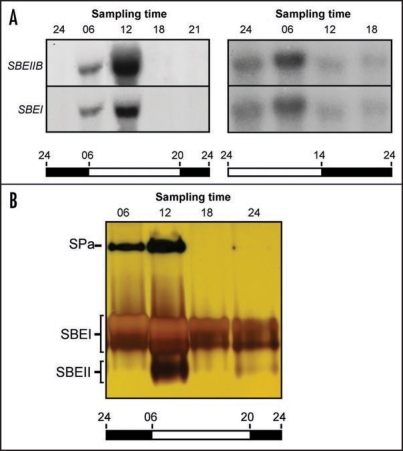
Figure 1
Figure 1
Activity rhythms in the cassava storage root from plants grown under LD conditions. (A) RNA gel blot analysis. Storage root RNA was extracted from plants grown under two different LD regimens at indicated times during the day and assayed for SBEII and SBEI gene activity. (B) Zymogram analysis. Protein was extracted from storage roots at indicated times during the day and analyzed for starch branching enzyme activity. Times are indicated as follows: 24, midnight; 06, 6 am; 12, noon; 18, 6 pm; 21, 9 pm. SPa, starch phosphorylase a.
Figure 2
Figure 2
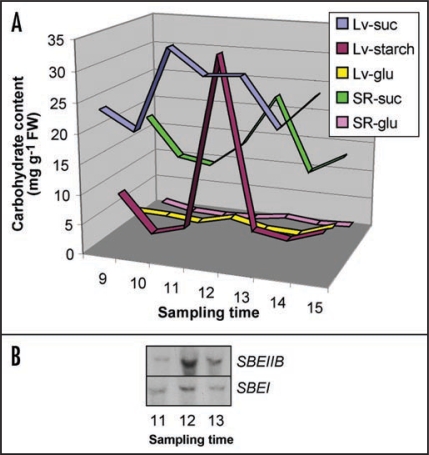
Changes in carbohydrate levels in the cassava storage root from plants grown under LD conditions. (A) Starch and sugars were extracted at indicated times during the day. Lv-suc, leaf sucrose; Lv-starch, leaf starch; Lv-glu, leaf glucose; SR-suc, storage root sucrose; SR-glu, storage root glucose. (B) SBEII and SBEI gene activity between 11 am (11) and 1 pm (13). Times are indicated as follows: 9, 9 am; 10, 10 am; 11, 11 am; 12, noon; 13, 1 pm; 14, 2 pm; 15, 3 pm.
Figure 3
Figure 3
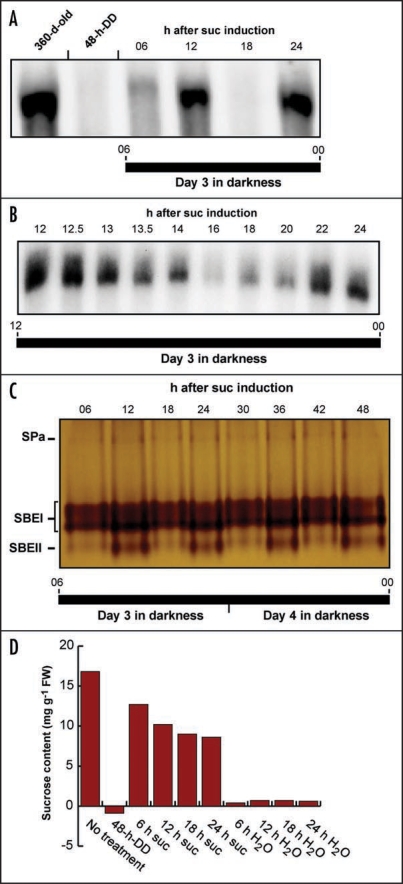
Sucrose induction of SBE expression and SBE activity in isolated discs of cassava storage roots kept under DD conditions. (A) RNA gel blot analysis of SBE expression. Root discs from dark-adapted plants (360-d-old) were depleted of endogenous sugars for 48 h (48-h-DD) and then transferred to sucrose medium. RNA was extracted at indicated times after sugar induction and assayed for SBEII and SBEI activity. (B) RNA gel blot analysis of SBE expression. A detailed time-course for SBEII and SBEI gene activity in the interval 12–24 h after sugar induction. (C) Zymogram analysis. Protein was extracted from storage root discs at indicated times after sugar induction and analyzed for starch branching enzyme activity. (For identification of the activity bands, see Sun et al., 2005). (D) Sucrose content. Sugars were extracted from storage root discs depleted of endogenous sugars for 48 h (48-h-DD) and at indicated times after addition of sucrose or H2O. SPa, starch phosphorylase a, Suc, sucrose.
Figure 4
Figure 4
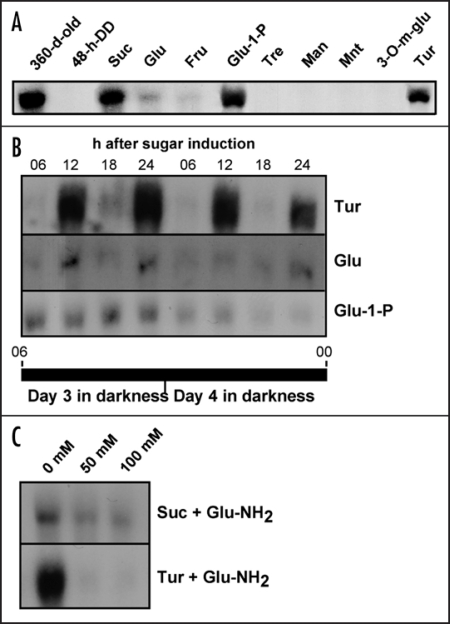
RNA gel blot analyses of SBE expression after application of sugars or sugar analogs to isolated discs of cassava storage roots kept under DD conditions. (A) SBE expression after addition of sucrose (Suc), glucose (Glu), fructose (Fru), glucose-1-P (Glu-1-P), trehalose (Tre), mannose (Man), mannitol (Mnt), 3-O-methyl glucose (3-O-m-glu) or turanose (Tur). (B) SBE expression at different time points after addition of turanose, glucose or glucose-1-P (Glu-1-P). Times are indicated as in Figure 1. (C) Sucrose or turanose-induced SBE expression in the presence of 0–100 mM glucosamine (Glu-NH2).
Figure 5
Figure 5
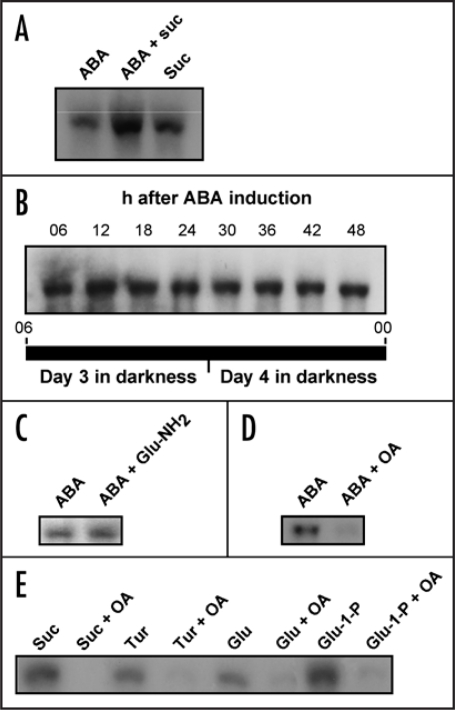
RNA gel blot analyses of SBE expression after application of sucrose, glucose, turanose and/or abscisic acid (ABA) to isolated discs of cassava storage roots kept under DD conditions. (A) Induction of SBE expression by ABA, sucrose or ABA + sucrose. (B) SBE expression at indicated times after induction with ABA. (C) Induction of SBE expression by ABA in the presence or absence of 100 mM glucosamine (Glu-NH2). (D) Induction of SBE expression by ABA in the presence or absence of okadaic acid (OA). (E) Induction of SBE expression by sucrose, turanose, glucose or glucose-1-P (Glu-1-P) in the presence or absence of okadaic acid.
Figure 6
Figure 6
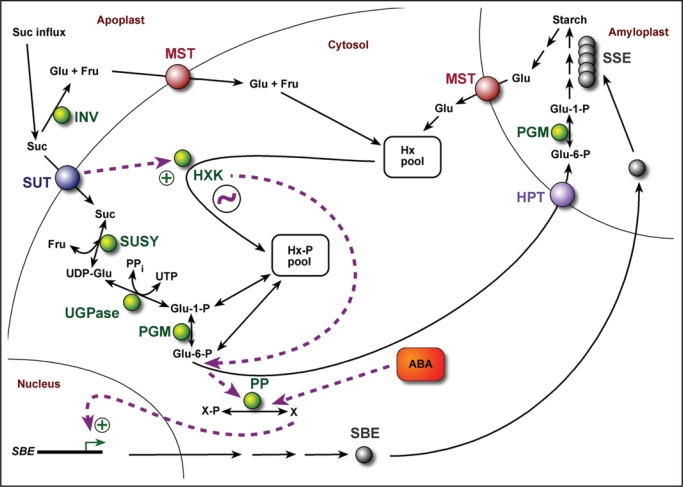
Model showing sugar and ABA signaling transduction (dashed purple arrows) during regulation of SBE gene expression in the cassava storage root. Sugar signaling is predominantly activated by the entry of sucrose. A signal is transmitted from the SUT to glucose-6-P, or a downstream regulator, via HXK. The sugar and ABA signaling pathways intersect at a protein phosphatase. The semidian oscillator (circled squiggle) is functionally associated with HXK. ABA, abscisic acid; Fru, fructose; Glu, glucose; HPT, hexose phosphate transporter; HXK, hexokinase; Hx, hexose; Hx-P, hexose-phosphate; INV, apoplastic invertase; MST, monosaccharide transporter; PGM, phophoglucomutase; PP, protein phosphatase; PPi, pyrophosphate; SBE, starch branching enzyme; SSE, starch synthesizing enzymes; SUSY, sucrose synthase; SUT, sucrose transporter; UGPase, UDP-glucose pyrophosphorylase; X, unknown protein.

References

    1. Jansson C. Sugar signaling mutants in Arabidopsis. In: Esser K, et al., editors. Progress in Botany. Berlin: Springer Verlag; 2004. pp. 42–52.
    1. Rolland F, Baena Gonzalez E, Sheen J. Sugar sensing and signaling in plants: Conserved and novel mechanisms. Annual Review of Plant Biology. 2006;57:675–709. - PubMed
    1. Sheen J, Zhou L, Jang JC. Sugars as signaling molecules. Curr Opinions Plant Biol. 1999;2:410–418. - PubMed
    1. Smeekens S. Sugar-Induced Signal Transduction in Plants. Ann Rev Plant Physiol Plant Mol Biol. 2000;51:49–81. - PubMed
    1. Sun C, Olsson H, Mangelsen E, Höglund AS, Jansson C. Antisense ODN inhibition as a potent strategy in plant biology: identification of SUSIBA2 as a transcriptional activator in plant sugar signaling. Plant J. 2005;44:128–138. - PubMed