


Plant polyamine catabolism: The state of the art
- PMID: 19513239
- PMCID: PMC2634460
- DOI: 10.4161/psb.3.12.7172
Plant polyamine catabolism: The state of the art
Abstract
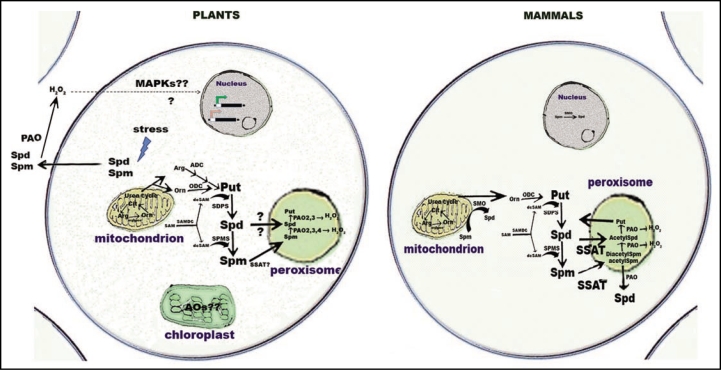
Polyamines have long been implicated in plant growth and development, as well as adaptation to abiotic and biotic stress. As a general rule of thumb the higher the polyamine titers the better. However, their molecular roles in plant stress responses still remain obscure. It has been postulated that they could act through their catabolism, which generates molecules which may act as secondary messengers signalling networks of numerous developmental and stress adaptation processes. Recently it was shown that plant and mammalian polyamine catabolism share critical features, giving new insight in plant polyamine catabolism. In this review, the advances in genes and proteins of polyamine catabolism in plants is presented and compared to other models.
Keywords: ROS signaling; abiotic stress; polyamine catabolism; polyamine oxidase; polyamines.
Figures
References
-
- Mattoo AK, Handa AK. Higher polyamines restore and invigorate metabolic memory in ripening fruit. Plant Sci. 2008;174:386–393.
-
- Kumar A, Altabella T, Taylor MA, Tiburcio AF. Recent advances in polyamine research. Trends Plant Sci. 1997:124–130.
-
- Malmberg RL, Watson MB, Galloway GL, Yu WL. Molecular genetic analysis of plant polyamines. Crit Rev Plant Sci. 1998;17:199–224.
-
- Bouchereau A, Aziz AF, Martin-Tanguy J. Polyamines and environmental challenges: recent development. Plant Sci. 1999;140:103–125.
LinkOut - more resources
Full Text Sources
