


Comment
doi: 10.1038/459787a.
Cell biology: The proteasome assembly line
- PMID: 19516331
- PMCID: PMC3808163
- DOI: 10.1038/459787a
Item in Clipboard
Comment
Cell biology: The proteasome assembly line
Nature.
.
Abstract
The assembly of the proteasome — the cellular machine that eliminates unwanted proteins — is a carefully choreographed affair, involving a complex sequence of steps overseen by dedicated protein chaperones.
Figures
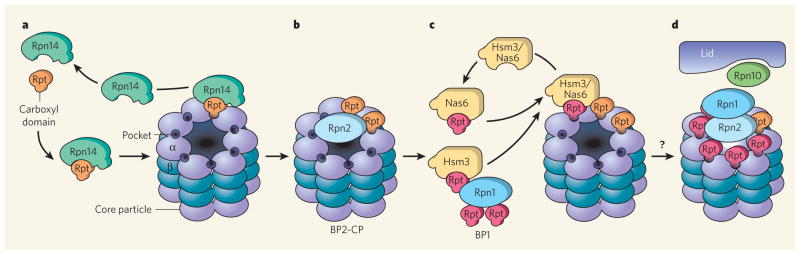
a, ‘Templating’ Rpt4 and Rpt6 proteins (orange) bind
the Rpn14 chaperone and connect to the core particle. Rpn14 and the core
particle α-subunit compete for binding to the carboxy-terminal domain of
Rpt, and the chaperone is displaced following Rpt–α-subunit
interaction. b, The non-ATPase subunit Rpn2 might stabilize this
complex, termed BP2–CP. c, Other Rpt ATPases (red) are
transferred to the core particle by chaperones Hsm3 and Nas6. Hsm3 is found in
the intermediate complex BP1, which also contains Rpt1, 2 and 5 and Rpn1. The
specific interactions among these proteins and their order of addition to the
emerging Rpt ring are not known. For clarity, Rpn1 and Rpn2 are not shown on the
core particle. d, Completion of the ATPase ring fully activates the
proteasome. Formation of the base–core-particle complex is presumably
followed by assembly of the intact proteasome. The interaction between the base
and the lid is predicted to require Rpn10. Only one regulatory particle is
shown.
Comment on
-
Chaperone-mediated pathway of proteasome regulatory particle assembly.Nature. 2009 Jun 11;459(7248):861-5. doi: 10.1038/nature08063. Nature. 2009. PMID: 19412159 Free PMC article.
-
Hexameric assembly of the proteasomal ATPases is templated through their C termini.Nature. 2009 Jun 11;459(7248):866-70. doi: 10.1038/nature08065. Nature. 2009. PMID: 19412160 Free PMC article.
References
-
- Ramos CP, Dohmen RJ. Structure. 2008;16:1296–1304. - PubMed
Publication types
MeSH terms
Substances
Grants and funding
LinkOut - more resources
Full Text Sources
Other Literature Sources
Molecular Biology Databases
