. 2009 Jun 11;4(6):e5886.
doi: 10.1371/journal.pone.0005886.

Exercise-training in young Drosophila melanogaster reduces age-related decline in mobility and cardiac performance

Affiliations

Exercise-training in young Drosophila melanogaster reduces age-related decline in mobility and cardiac performance

Nicole Piazza et al. PLoS One. .

Abstract

Declining mobility is a major concern, as well as a major source of health care costs, among the elderly population. Lack of mobility is a primary cause of entry into managed care facilities, and a contributing factor to the frequency of damaging falls. Exercise-based therapies have shown great promise in sustaining mobility in elderly patients, as well as in rodent models. However, the genetic basis of the changing physiological responses to exercise during aging is not well understood. Here, we describe the first exercise-training paradigm in an invertebrate genetic model system. Flies are exercised by a mechanized platform, known as the Power Tower, that rapidly, repeatedly, induces their innate instinct for negative geotaxis. When young flies are subjected to a carefully controlled, ramped paradigm of exercise-training, they display significant reduction in age-related decline in mobility and cardiac performance. Fly lines with improved mitochondrial efficiency display some of the phenotypes observed in wild-type exercised flies. The exercise response in flies is influenced by the amount of protein and lipid, but not carbohydrate, in the diet. The development of an exercise-training model in Drosophila melanogaster opens the way to direct testing of single-gene based genetic therapies for improved mobility in aged animals, as well as unbiased genetic screens for loci involved in the changing response to exercise during aging.


Conflict of interest statement

Competing Interests: The authors have declared that no competing interests exist.

Figures

Figure 1
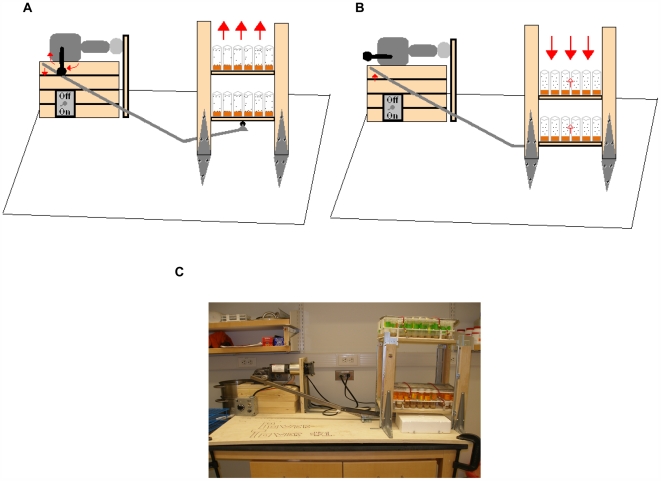
Figure 1. Schematic representation of the Power Tower, a motor-operated enforced climbing apparatus that exercise-trains Drosophila.
(A): As the rotating arm circles around in a clockwise direction, the lever pushes down and the two platforms of vial holders rise up. (B): As the rotating arm rolls off, the lever lifts and the platform of vial holders drops down. The flies drop to the bottom of the vial, inducing their negative geotaxis instinct. The flies continue to repeat this process until the motor is shut off. Exercise-training thus occurs through continuous climbing. (C): An image of the Power Tower.
Figure 2
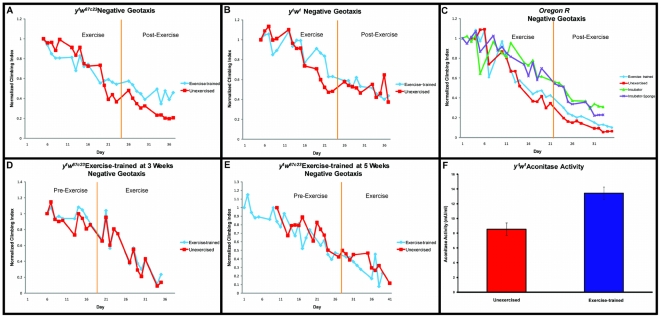
Figure 2. Negative geotaxis in aging, exercise-trained flies.
(A): y1w67c23 exercise-trained flies (blue diamonds) improve their negative geotaxis ability over their unexercised controls (red squares) by day 21 of the exercise-training regimen. This difference persists two weeks after cessation of exercise (multivariate regression, treatment-by-age (days 21–37): p = 0.0747; treatment effect (days 21–37) p<0.001). (B): y1w1 exercise-trained flies (blue diamonds) demonstrate improvement in negative geotaxis from day 19 to 37 of the training regimen (multivariate regression, treatment effect: p<0.0001). (C): Oregon R exercised-trained flies (blue diamonds) improve their negative geotaxis ability over unexercised controls (red squares). A difference in climbing ability becomes apparent at day 17 of the time-course and this improvement over controls persists for at least two weeks after cessation of exercise (multivariate regression, treatment effect (days 17–33): p<0.001). Untreated flies (green triangles) and untreated flies with restricted movement (purple X) show no significant difference in negative geotaxis ability (multivariate regression, treatment effect: p = 0.3018). (D): y1w67c23 flies that began exercise-training at 3 weeks of age (blue diamonds) show no significant difference in climbing ability over unexercised flies (red squares) (multivariate regression, treatment-by-age: p = 0.9893). (E): y1w67c23 flies that began exercise-training at 5 weeks of age (blue diamonds) show no significant differences in climbing ability over control flies (red squares) (multivariate regression, treatment-by-age: p = 0.9545). (F): Aconitase activity in total protein extract from whole flies is increased following three weeks of exercise (red) as compared to isogenic, age-matched controls (blue) (t-test, p = .037).
Figure 3
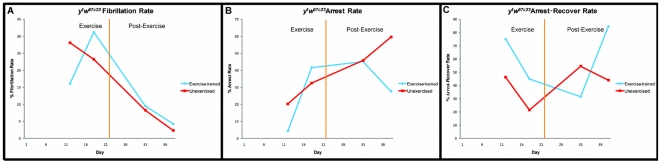
Figure 3. Cardiac stress resistance tests for exercise-trained and unexercised flies.
(A): There is no significant difference in fibrillation rate of y1w67c23 flies after cardiac electrical pacing between exercised (blue diamonds) and unexercised flies (red squares) (multivariate regression, treatment-by-age: p = 0.1947, chi-square = 1.682). (B): y1w67c23 cardiac arrest rate in response to electrical pacing is shown for exercise and unexercised flies across five weeks. Exercise-trained flies (blue diamonds) display a lower arrest rate than unexercised flies (red squares) by five weeks (t-test, p = 0.001). (C): y1w67c23 exercise-trained flies (blue diamonds) have a higher arrest-recovery rate at five weeks than unexercised flies (red squares) (t-test, p = 0.008). All lines represent straight connective lines between data points, and are not fitted to a best-fit model.
Figure 4
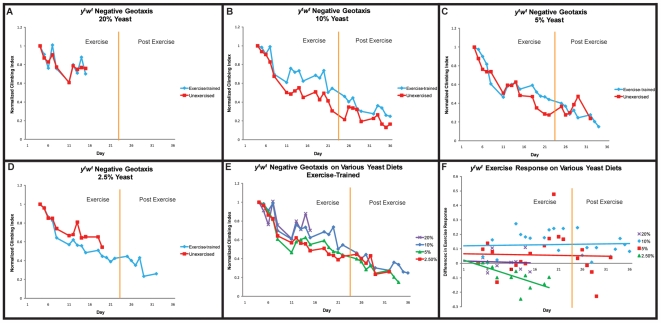
Figure 4. Influence of dietary yeast on negative geotaxis of aging, exercise-trained flies.
(A): On a 20% yeast, 10% sucrose diet, both exercise-trained flies (blue diamonds) and unexercised y1w1 flies (red squares) exhibit high climbing ability. (B): On the standard 10% yeast, 10% sucrose diet, y1w1 exercise-trained flies (blue diamonds) improve their negative geotaxis ability over unexercised controls (red squares) by day 11 of the regimen and this difference persists two weeks after cessation of exercise-training (multivariate regression, treatment effect (days 11–36): p<0.0001). (C): On a 5% yeast, 10% sucrose diet, exercise-trained flies (blue diamonds) show a smaller, yet still significant improvement in negative geotaxis ability over unexercised controls (red squares) (multivariate regression, treatment effect (days 15–29): p = 0.0575). (D): On a 2.5% yeast, 10% sucrose diet, exercise-trained flies (blue diamonds) have a reduction in their negative geotaxis ability compared to unexercised flies (red squares) (multivariate regression, treatment effect: p<0.0001). (E): Negative geotaxis ability of exercise-trained y1w1 flies are re-graphed by diet (purple Xs: 20% yeast; blue diamonds: 10% yeast; green triangles: 5% yeast; red squares: 2.5% yeast). Slope of decline in negative geotaxis ability is dependent upon the amounts of yeast in the diet (multivariate regression, diet-by-age: p = 0.0573). (F): Difference in climbing index score between exercise-trained and unexercised flies on various yeast diets.
Figure 5
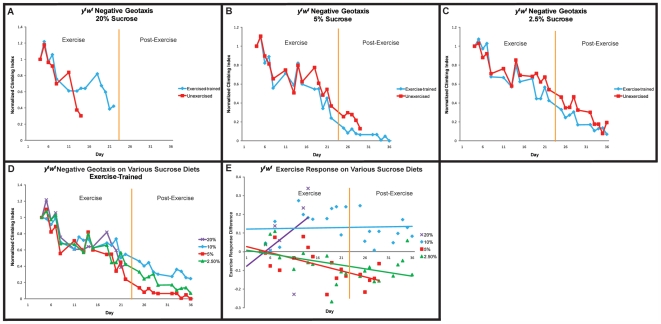
Figure 5. Negative geotaxis is shown for y1w1 while changing the amount of sucrose in the diet and keeping yeast levels constant.
(A): On a 20% sucrose, 10% yeast diet, no apparent difference is seen early on in the time-course of exercise-training. Lifespan was greatly reduced on this diet, therefore too small of a sample size was available for statistical analysis. (B): On a 5% sucrose, 10% yeast diet, exercise-trained flies (blue diamonds) have a reduction in negative geotaxis ability compared to unexercised controls (red squares) (Treatment (days 19–29): p<0.0001). (C) On a 2.5%, 10% yeast diet, exercise-trained flies (blue diamonds) have a decline in negative geotaxis ability compared to unexercised controls (red squares) (Treatment (days 19–36): p = 0.0088). (D): Negative geotaxis ability of exercise-trained y1w1 flies are graphed by diet (purple Xs: 20% sucrose; blue diamonds: 10% sucrose; green triangles: 5% sucrose; red squares: 2.5% sucrose). (E): A difference plot between exercise-trained and unexercised flies on various sucrose diets. Data for 10% yeast, 10% sucrose diet is derived from the experiment shown in Figure 4B and is reused for comparative purposes.
Figure 6
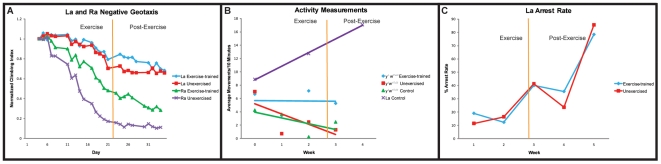
Figure 6. Mito-efficient flies display improved mobility.
(A): Negative geotaxis of aging, exercise-trained, La flies. Ra exercise-trained flies (green triangles) display improvement in climbing index at day 7 of the exercise-training regimen and this difference persists two weeks after cessation of exercise-training compared to the unexercised controls (purple Xs) (multivariate regression, treatment, p<0.0001; treatment-by-age: p = 0.0023). In contrast, La flies show a slower age-related decline in mobility compared to Ra flies (La exercise-trained (blue diamonds) versus Ra exercise-trained (green triangles): (multivariate regression, genotype-by-age: p<0.0001). (B): Activity rate is measured as number of times crossing a beam threshold per 10 minutes during 2-hour intervals. y1w67c23 exercise-trained flies (blue diamonds) have higher activity rates over 4 weeks compared to y1w67c23 unexercised flies (red squares) (multivariate regression, treatment-by-age: p = 0.0365) and y1w67c23 control flies (green triangles) not placed on the Power Tower. Unexercised flies placed on the machine and control flies not placed on the machine are not significantly different from each other (multivariate regression, treatment-by-age: p = 0.2237). La flies (purple Xs) not placed on the machine have a much higher activity rate throughout 4 weeks compared to the wildtype. (C): Arrest rate for La exercise-trained flies (blue diamonds) is not significantly different from La unexercised flies (red squares) across 5 weeks (multivariate regression, treatment: p = 0.8688, treatment-by-age: p = 0.3784).

References

    1. Cohen-Mansfield J, Frank J. Relationship between perceived needs and assessed needs for services in community-dwelling older persons. Gerontologist. 2008;48:505–516. - PubMed
    1. Espeland MA, Gill TM, Guralnik J, Miller ME, Fielding R, et al. Designing clinical trials of interventions for mobility disability: results from the lifestyle interventions and independence for elders pilot (LIFE-P) trial. J Gerontol A Biol Sci Med Sci. 2007;62:1237–1243. - PMC - PubMed
    1. Englander F, Hodson TJ, Terregrossa RA. Economic dimensions of slip and fall injuries. J Forensic Sci. 1996;41:733–746. - PubMed
    1. Gaebler S. Predicting which patient will fall again … and again. J Adv Nurs. 1993;18:1895–1902. - PubMed
    1. Sattin RW. Falls among older persons: a public health perspective. Annu Rev Public Health. 1992;13:489–508. - PubMed

Publication types

LinkOut - more resources