


REDIRECT: cluster randomised controlled trial of GP training in first-episode psychosis
- PMID: 19520016
- PMCID: PMC2688067
- DOI: 10.3399/bjgp09X420851
REDIRECT: cluster randomised controlled trial of GP training in first-episode psychosis
Abstract
Background: Delays in accessing care for young people with a first episode of psychosis are significantly associated with poorer treatment response and higher relapse rates.
Aim: To assess the effect of an educational intervention for GPs on referral rates to early-intervention services and the duration of untreated psychosis for young people with first-episode psychosis.
Design of study: Stratified cluster randomised controlled trial, clustered at practice level.
Setting: Birmingham, England.
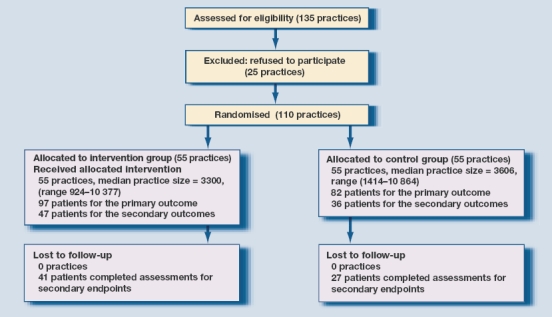
Method: Practices with access to the three early-intervention services in three inner-city primary care trusts in Birmingham were eligible for inclusion. Intervention practices received an educational intervention addressing GP knowledge, skills, and attitudes about first-episode psychosis. The primary outcome was the difference in the number of referrals to early-intervention services between practices. Secondary outcomes were duration of untreated psychosis, time to recovery, use of the Mental Health Act, and GP consultation rate during the developing illness.
Results: A total of 110 of 135 eligible practices (81%) were recruited; 179 young people were referred, 97 from intervention and 82 from control practices. The relative risk of referral was not significant: 1.20 (95% confidence interval [CI] = 0.74 to 1.95; P = 0.48). No effect was observed on secondary outcomes except for 'delay in reaching early-intervention services', which was statistically significantly shorter in patients registered in intervention practices (95% CI = 83.5 to 360.5; P = 0.002).
Conclusion: GP training on first-episode psychosis is insufficient to alter referral rates to early-intervention services or reduce the duration of untreated psychosis; however, there is a suggestion that training facilitates access to the new specialist teams for early psychosis.
Comment in
-
Early intervention in psychosis: keeping the body in mind.Br J Gen Pract. 2009 Jun;59(563):395-6. doi: 10.3399/bjgp09X420888. Br J Gen Pract. 2009. PMID: 19520021 Free PMC article. No abstract available.
References
-
- Drake RJ, Haley CJ, Akhtar S, Lewis SW. Causes and consequences of duration of untreated psychosis in schizophrenia. Br J Psychiatr. 2000;177:511–515. - PubMed
-
- Lincoln C, McGorry P. Who cares? Pathways to psychiatric care for young people experiencing a first episode of psychosis. Psychiatr Serv. 1995;46(11):1166–1171. - PubMed
-
- Larsen T, Friis S, Haahr U, et al. Early detection and intervention in first-episode schizophrenia: a critical review. Acta Psychiatr Scand. 2001;103(5):323–334. - PubMed
-
- Marshall M, Lewis S, Lockwood A. Association between duration of untreated psychosis and outcome in cohorts of first episode psychosis. Arch Gen Psychiatry. 2005;62(9):975–983. - PubMed
-
- Cole E, Leavey G, King M, et al. Pathways to care for patients with a first episode of psychosis: a comparison of ethnic groups. Br J Psychiatr. 1995;167(6):770–776. - PubMed
Publication types
MeSH terms
Associated data
LinkOut - more resources
Full Text Sources
Medical
Research Materials
