. 2009 Aug;107(2):429-37.
doi: 10.1152/japplphysiol.00331.2009. Epub 2009 Jun 11.

Skeletal muscle blood flow responses to hypoperfusion at rest and during rhythmic exercise in humans

Affiliations

Skeletal muscle blood flow responses to hypoperfusion at rest and during rhythmic exercise in humans

Darren P Casey et al. J Appl Physiol (1985). 2009 Aug.

Abstract

We evaluated the contribution of changes in systemic arterial pressure and local vasodilation to blood flow restoration in contracting human muscles during acute hypoperfusion. Healthy subjects (n=10) performed rhythmic forearm exercise (10% and 20% of maximum) while a balloon in the brachial artery located above the elbow was inflated. Each trial included 3 min of rest, exercise, exercise with balloon inflation, and exercise after balloon deflation. Forearm blood flow (FBF) was measured using Doppler ultrasound. Blood pressure on both sides of the balloon was measured using a brachial artery catheter (distal pressure), and Finometer for proximal (systemic) arterial pressure. Balloon inflation during exercise reduced distal arterial pressure, and FBF fell 37-41%. There was also a surprising acute increase in forearm vascular resistance (distal pressure/FBF). This was followed by recovery of distal arterial pressure and forearm vasodilation that caused a marked (approximately 75%) restoration of flow that was not associated with significant changes in systemic arterial pressure. During validation trials (n=6) at rest and with exercise both balloon and brachial artery diameters were stable when the balloon was inflated. Our findings indicate that at these exercise intensities 1) the restoration of FBF during exercise with hypoperfusion relied primarily on local dilator responses in conjunction with restoration of distal perfusion pressure likely as a result of increased collateral flow around the elbow, and 2) a loss of pulsatile flow and elastic recoil in the forearm may have contributed to the acute increase in vascular resistance seen at the onset of hypoperfusion.


Figures
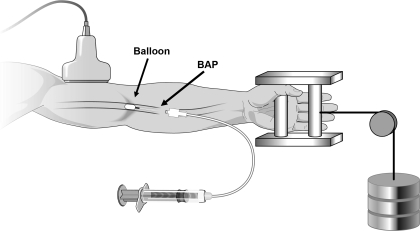
Fig. 1.
Fig. 1.
Schematic of forearm exercise model. Brachial artery blood velocity was measured (via Doppler ultrasound) proximal to the balloon. The configuration of the balloon upstream from the lumen of the introducer allowed measurement of the brachial arterial pressure (BAP) distal to the balloon that was perfusing the contracting forearm muscles. Rhythmic forearm exercise was performed with a hand grip device by lifting a weight (10% and 20% of maximal voluntary contraction) 4–5 cm over a pulley system at a duty cycle of 1-s contraction and 2-s relaxation (20 contractions/min).
Fig. 2.
Fig. 2.
Schematic diagram of experimental protocol. Subjects completed 1 resting and 4 exercise trials. The resting trial consisted of baseline, inflation, and recovery measurements (3 min each). Each exercise trial consisted of baseline, exercise (control), exercise during inflation, exercise following deflation, and recovery measurements (3 min each). Each trial was separated by at least 20 min of rest to allow forearm blood flow (FBF) to return to baseline values. MVC, maximal voluntary contraction.
Fig. 3.
Fig. 3.
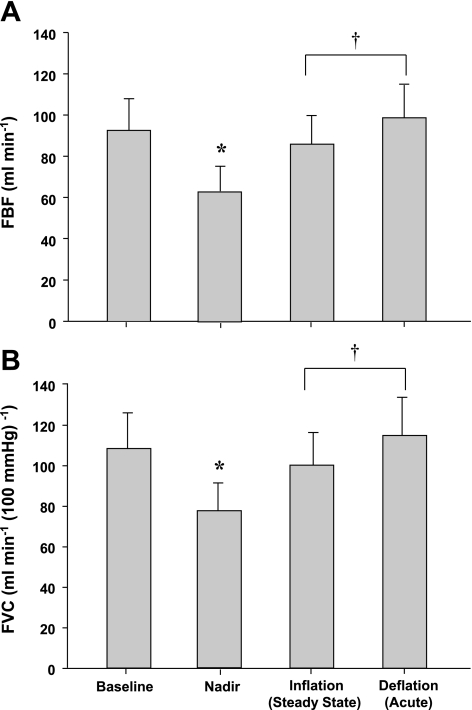
Effect of balloon-induced hypoperfusion on FBF (A) and forearm vascular conductance (FVC; B) at rest. Balloon inflation resulted in an acute reduction in FBF and FVC (nadir), which were partially restored. *P < 0.001 vs. baseline. †P < 0.001 vs. nadir.
Fig. 4.
Fig. 4.
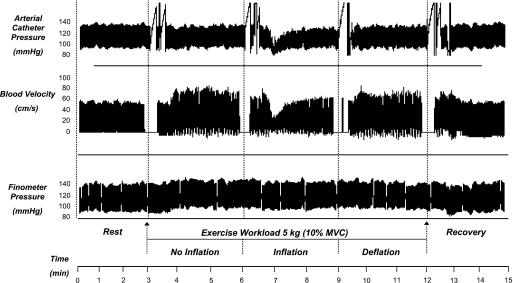
Documentation of fall in blood velocity with balloon inflation. Individual record (compressed) of arterial catheter pressure, brachial artery velocity, and Finometer blood pressure during mild rhythmic hand gripping. Exercise caused a rapid increase in blood velocity. Balloon inflation caused a fall in blood velocity that recovered with no obvious increase in systemic pressure. With balloon deflation there was a modest reactive hyperemia. Breaks in velocity signal indicate times of image acquisition for diameter measurements and breaks in arterial pressure tracing indicate times for blood sampling.
Fig. 5.
Fig. 5.
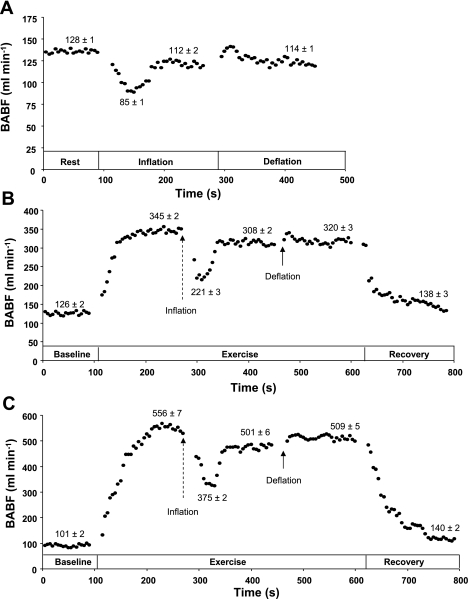
Typical blood flow response. A sample tracing of FBF [i.e., brachial artery blood flow (BABF)] in 5-s averages (•) under resting conditions (A) and during exercise at 10% (B) and 20% (C) of maximal voluntary contraction. Arrows indicate start of balloon inflation (dashed) and deflation (solid).
Fig. 6.
Fig. 6.
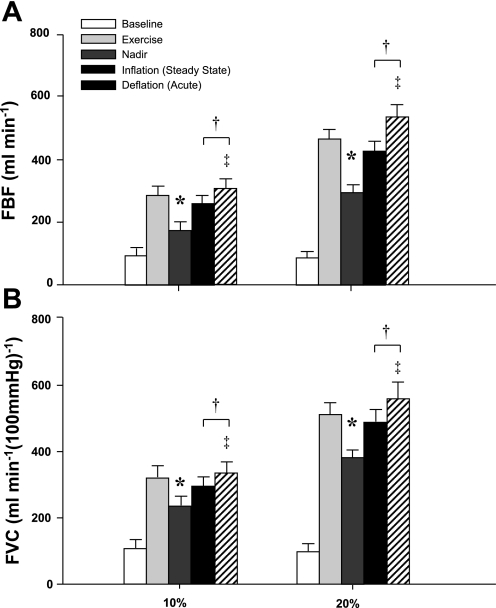
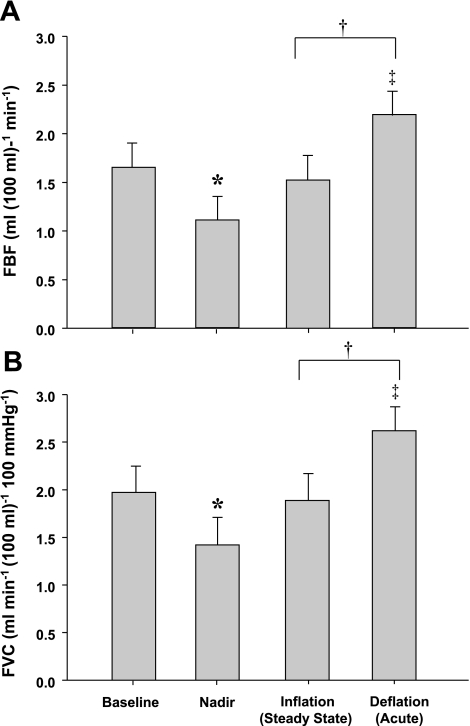
Effect of balloon-induced hypoperfusion on FBF (A) and (FVC; B) during exercise. Balloon inflation resulted in an acute reduction in FBF and FVC (nadir), which were partially restored in both trials. *P < 0.001 vs. exercise. †P < 0.001 vs. nadir. ‡P < 0.05 vs. inflation (steady state).
Fig. 7.
Fig. 7.
Effect of balloon-induced hypoperfusion on downstream FBF (A) and FVC (B) at rest measured by plethysmography. Balloon inflation resulted in an acute reduction in FBF and FVC (nadir), which were partially restored. *P < 0.01 vs. baseline. †P < 0.05 vs. nadir. ‡P < 0.05 vs. baseline.

References

    1. Bell JW Treatment of post-catheterization arterial injuries: use of survey plethysmography. Ann Surg 155: 591–598, 1962. - PMC - PubMed
    1. Britton SL, Metting PJ, Ronau TF, Strader JR, Weldy DL. Autoregulation of hind-limb blood flow in conscious dogs. J Physiol 368: 409–422, 1985. - PMC - PubMed
    1. Daley JC, Khan MH, Hogeman CS, Sinoway LI. Autonomic and vascular responses to reduced limb perfusion. J Appl Physiol 95: 1493–1498, 2003. - PubMed
    1. Ellsworth ML, Forrester T, Ellis CG, Dietrich HH. The erythrocyte as a regulator of vascular tone. Am J Physiol Heart Circ Physiol 269: H2155–H2161, 1995. - PubMed
    1. Faber JE, Meininger GA. Selective interaction of alpha-adrenoceptors with myogenic regulation of microvascular smooth muscle. Am J Physiol Heart Circ Physiol 259: H1126–H1133, 1990. - PubMed

Publication types

MeSH terms