


Successful weight loss with self-help: a stepped-care approach
- PMID: 19521759
- PMCID: PMC3533369
- DOI: 10.1007/s10865-009-9221-8
Successful weight loss with self-help: a stepped-care approach
Abstract
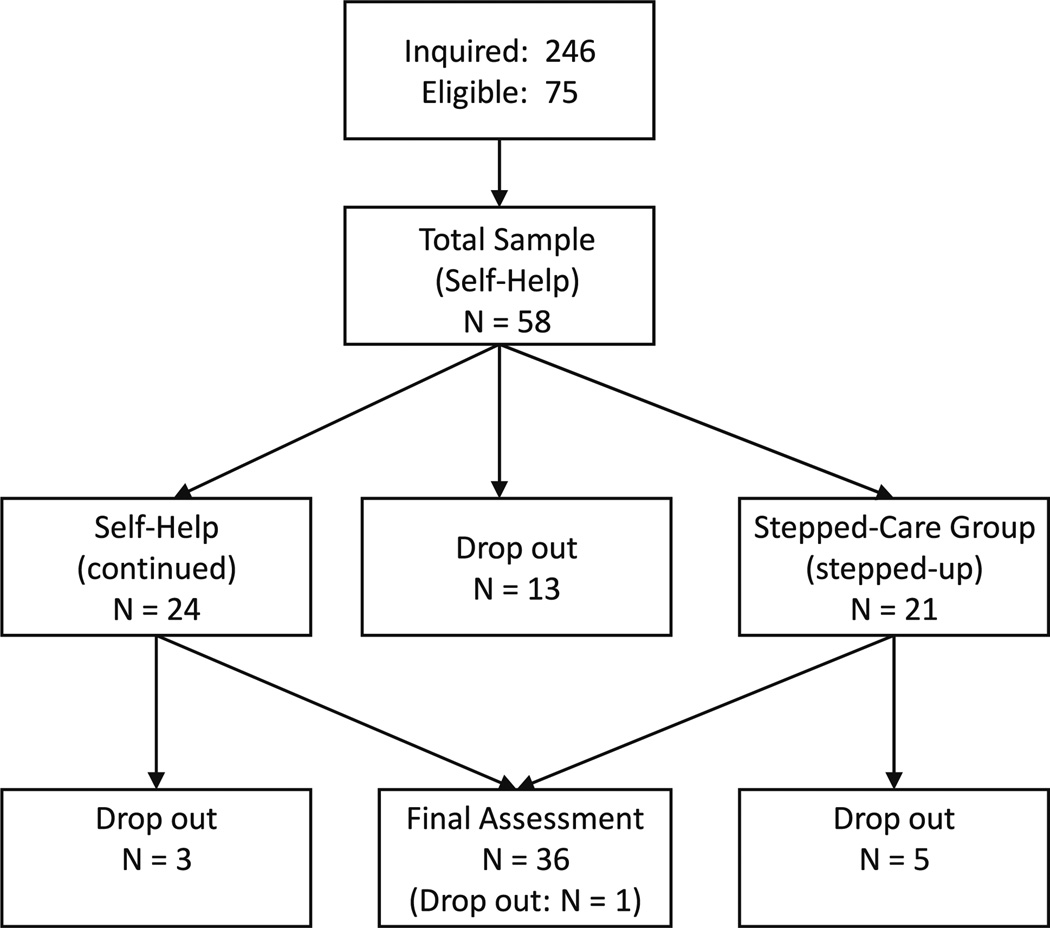
In a stepped-care approach to treatment, patients are transitioned to more intensive treatments when less intensive treatments fail to meet treatment goals. Self-help programs are recommended as an initial, low intensity treatment phase in stepped-care models. This investigation examined the effectiveness of a self-help, stepped-care weight loss program. Fifty-eight overweight/obese adults (BMI ≥27 kg/m(2)) participated in a weight loss program. Participants were predominately Caucasian (93.1%) and female (89.7%) with a mean BMI of 36.6 (SD=7.1). Of those completing the program, 57% of participants (N=21) who remained in self-help maintained an 8% weight loss at follow-up. Participants who were stepped-up self-monitored fewer days and reported higher daily caloric intake than self-help participants. Once stepped-up, weight loss outcomes were equivalent between individuals who remained in self-help compared to those who were stepped-up. Individuals who were stepped-up benefited from early intensive intervention when unsuccessful at losing weight with self-help.
© Springer Science+Business Media, LLC 2009
Figures

References
-
- Abrams DB. Treatment issues in tobacco dependence: Towards a stepped-care model. Tobacco Control. 1993;2:s17–s37.
-
- Andersen R, Wadden T, Bartlett S, Zemel B, Verde T, Franckowiak S. Effects of lifestyle activity vs. structured aerobic exercise in obese women. JAMA. 1999;281:335–340. - PubMed
-
- Baker RC, Kirschenbaum DS. Weight control during the holidays: Highly consistent self-monitoring as a potentially useful coping mechanism. Health Psychology. 1998;17:367–370. - PubMed
-
- Balogun J, Martin D, Clendenin M. Calometric validation of the Caltrac Accelerometer during level walking. Physical Therapy. 1989;89:501–509. - PubMed
-
- Bell EA, Roe LS, Rolls BJ. Sensory-specific satiety is affected more by volume than by energy content of liquid food. Physiology & Behavior. 2003;78:593–600. - PubMed
