Review
. 2009 Sep;13(9B):3006-18.
doi: 10.1111/j.1582-4934.2009.00824.x. Epub 2009 Jun 11.

The ubiquitin-proteasome system in cancer, a major player in DNA repair. Part 1: post-translational regulation

Affiliations
Review

The ubiquitin-proteasome system in cancer, a major player in DNA repair. Part 1: post-translational regulation

Panagiotis J Vlachostergios et al. J Cell Mol Med. 2009 Sep.

Abstract

DNA repair is a fundamental cellular function, indispensable for cell survival, especially in conditions of exposure to environmental or pharmacological effectors of DNA damage. The regulation of this function requires a flexible machinery to orchestrate the reversal of harmful DNA lesions by making use of existing proteins as well as inducible gene products. The accumulation of evidence for the involvement of ubiquitin-proteasome system (UPS) in DNA repair pathways, that is reviewed here, has expanded its role from a cellular waste disposal basket to a multi-dimensional regulatory system. This review is the first of two that attempt to illustrate the nature and interactions of all different DNA repair pathways where UPS is demonstrated to be involved, with special focus on cancer- and chemotherapy-related DNA-damage repair. In this first review, we will be presenting the proteolytic and non-proteolytic roles of UPS in the post-translational regulation of DNA repair proteins, while the second review will focus on the UPS-dependent transcriptional response of DNA repair after DNA damage and stress.


Figures
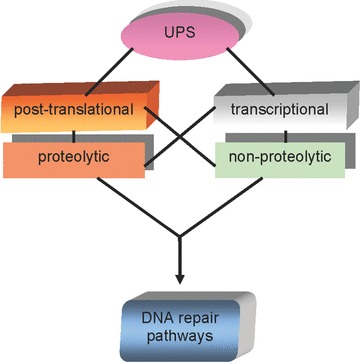
Figure 1
Figure 1
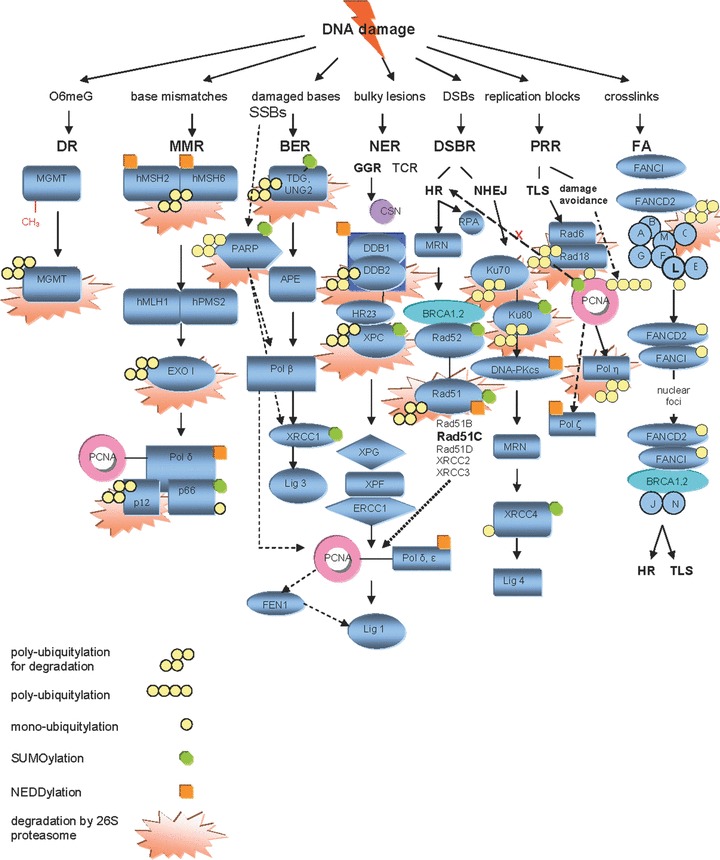
Modes of UPS involvement in regulation of DNA repair. *Abbreviations: O6meG, O6-methylated guanine; MGMT, O6-methylguanine-DNA methyltransferase; DR, direct repair; hMSH2, human MutS homologue 2; hMSH6, human MutS homologue 6; hMLH1, human MutL homologue 1; hPMS2, human post-meiotic segregation increased 2 protein; MMR, mismatch-repair; NEDD8, neural precursor cell expressed, developmentally down-regulated 8; EXO I, human exonuclease 1; SSBs, single-strand breaks; DSBs, double-strand breaks; TDG, thymine-DNA glycosylase; APE, apurinic endonuclease; Lig 3, DNA-ligase 3; FEN1, flap structure-specific endonuclease 1; BER, base-excision repair; NER, nucleotide-excision repair; GGR, global genomic repair; TCR, transcription-coupled repair; CSN, COP9 signalosome; SUMO, small ubiquitin-like modifier; UNG2, uracil-DNA glycosylase 2; PARP-1, poly-ADP-ribose polymerase; XRCC1, X-ray repair complementing defective repair in Chinese hamster cells 1; XPC, Xeroderma pigmentosum complementation group C; HR23, homologue of Rad23; DDB1, damage-specific DNA binding protein 1; DDB2, damage-specific DNA binding protein 2; NEDD8, neural precursor cell expressed developmentally down-regulated 8; XPG, Xeroderma pigmentosum complementation group G; XPF, Xeroderma pigmentosum complementation group F; ERCC1, excision repair cross-complementing rodent repair deficiency complementation group 1; Lig 1, DNA-ligase 1; HR, homologous recombination; NHEJ, non-homologous end joining; XRCC4, X-ray repair complementing defective repair in Chinese hamster cells 4; Lig 4, DNA-ligase 4; DNA-PKcs, DNA-dependent protein kinase catalytic subunit; PCNA, proliferating cell nuclear antigen protein; DSBR, double-strand break repair; MRN, Mre11-Rad50-Nbs1 complex; RPA, replication protein A; BRCA 1,2, breast cancer 1,2 genes; XRCC2, X-ray repair complementing defective repair in Chinese hamster cells 2; XRCC3; X-ray repair complementing defective repair in Chinese hamster cells 3; XRCC4, X-ray repair complementing defective repair in Chinese hamster cells 4; PRR, post-replication repair; TLS, translesion DNA synthesis; Pol η, DNA polymerase η; Pol ζ, DNA polymerase ζ; Pol γ, ɛ, DNA polymerases γ, ɛ; FANCC, Fanconi anaemia, complementation group C; FANCD2, Fanconi anaemia complementation group D2; FANCI, Fanconi anaemia complementation group I.
Figure 2
Figure 2
Post-translational modifications of DNA repair by UPS. The regulatory roles of UPS exerted on DNA repair on the post-translational level include (A) signalling for chromatin recruitment (FANCD2-FANCI, XRCC4 mono-ubiquitylation), (B) stabilisation and sustain of activity (XPC, Rad52 SUMOylation), (C) facilitation of DNA unbinding and turnover (TDG, XPC SUMOylation), (D) choice of sub-pathway (PCNA mono-, poly-ubiquitination, SUMOylation) and (E) degradation of DNA repair proteins considered to be proteolytic targets of the proteasome, in a way that both their levels and availability in DNA repair complexes are modified after completion of repair (MGMT, hMutSa complex, hEXO1b, TDG, UNG2, PARP-1, XPC, Rad51, Ku70, Ku80, Rad18, FANCC). There is both proteolytic and non-proteolytic contribution of UPS to this regulation of DNA repair proteins. The first is affected via the attachment of several Ub molecules and subsequent recognition and degradation by the proteasome, while the second is orchestrated through conjugation of the repair protein with a single Ub or Ub-like modifier (mainly SUMO and NEDD8).

References

    1. Hansen WK, Kelley MR. Review of mammalian DNA repair and translational implications. J Pharmacol Exp Ther. 2000;295:1–9. - PubMed
    1. Christmann M, Tomicic MT, Roos WP, et al. Mechanisms of human DNA repair: an update. Toxicology. 2003;193:3–34. - PubMed
    1. Wood RD, Mitchell M, Lindahl T. Human DNA repair genes. Mutat Res. 2005;577:275–83. - PubMed
    1. Pourquier P. La réparation de l’ ADN, cible potentielle d’un développement thérapeutique en cancérologie. Bull Cancer. 2006:124–44. ; hors série:
    1. Sánchez-Pérez I. DNA inhibitors in cancer treatment. Clin Transl Oncol. 2006;8:642–6. - PubMed