. 2009 Jun 12:9:55.
doi: 10.1186/1472-6750-9-55.

High-titer preparation of Bombyx mori nucleopolyhedrovirus (BmNPV) displaying recombinant protein in silkworm larvae by size exclusion chromatography and its characterization

Affiliations

High-titer preparation of Bombyx mori nucleopolyhedrovirus (BmNPV) displaying recombinant protein in silkworm larvae by size exclusion chromatography and its characterization

Tatsuya Kato et al. BMC Biotechnol. .

Abstract

Background: Budded baculoviruses are utilized for vaccine, the production of antibody and functional analysis of transmembrane proteins. In this study, we tried to produce and purify the recombinant Bombyx mori nucleopolyhedrovirus (rBmNPV-hPRR) that displayed human (pro)renin receptor (hPRR) connected with FLAG peptide sequence on its own surface. These particles were used for further binding analysis of hPRR to human prorenin. The rBmNPV-hPRR was produced in silkworm larvae and purified from its hemolymph using size exclusion chromatography (SEC).

Results: A rapid method of BmNPV titer determination in hemolymph was performed using quantitative real-time PCR (Q-PCR). A correlation coefficient of BmNPV determination between end-point dilution and Q-PCR methods was found to be 0.99. rBmNPV-hPRR bacmid-injected silkworm larvae produced recombinant baculovirus of 1.31 x 10(8) plaque forming unit (pfu) in hemolymph, which was 2.8 x 10(4) times higher than transfection solution in Bm5 cells. Its purification yield by Sephacryl S-1000 SF column chromatography was 264 fold from larval hemolymph at 4 days post-injection (p.i.), but 35 or 39 fold at 4.5 or 5 days p.i., respectively. Protein patterns of rBmNPV-hPRR purified at 4 and 5 days were the same and ratio of envelope proteins (76, 45 and 35 kDa) to VP39, one of nucleocapsid proteins, increased at 5 days p.i. hPRR was detected in only purified rBmNPV-hPRR at 5 days p.i..

Conclusion: The successful purification of rBmNPV-hPRR indicates that baculovirus production using silkworm larvae and its purification from hemolymph by Sephacryl S-1000 SF column chromatography can provide an economical approach in obtaining the purified BmNPV stocks with high titer for large-scale production of hPRR. Also, it can be utilized for further binding analysis and screening of inhibitors of hPRR.


Figures
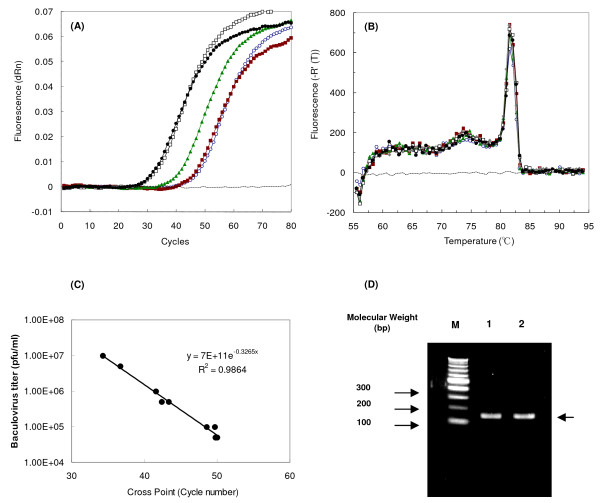
Figure 1
Figure 1
Q-PCR analysis of BmNPV-CP--/bx-GGT2. (A) The graph of fluorescent signals during Q-PCR cycles using various baculovirus stocks. (B) Melting curve analysis of Q-PCR products. Symbols in A and B: dotted lines, water; open circles, 4.9 × 10⁴ pfu/ml; closed squares, 9.8 × 10⁴ pfu/ml: closed triangles, 4.9 × 10⁵ pfu/ml; closed circles, 4.9 × 10⁵ pfu/ml; open squares, 9 × 10⁵ pfu/ml. (C) Standard calibration curve of cross point vs. log (BmNPV-CP-/bx-GGT2 titer). (D) Analysis of Q-PCR products using BmNPV-CP-/bx-GGT2 stock solution by 2% agarose gel. Lane M: 100-bp ladder DNA marker, lane 1: stock solution of 9.80 × 10⁵ pfu/ml, lane 2: stock solution of 9.80 × 10⁶ pfu/ml.
Figure 2
Figure 2
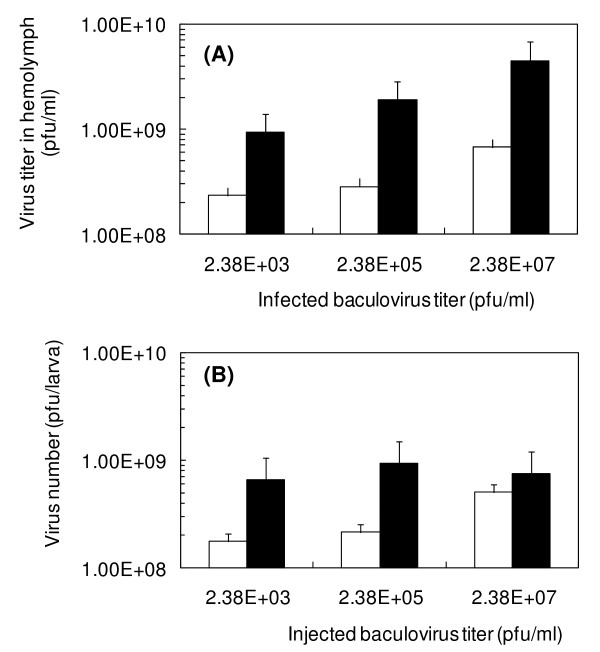
Virus titer (A) and virus number (B) of hemolymph from silkworm larvae infected with various titers of baculovirus. Before injection into silkworm larvae, 2.38 × 10³, 2.38 × 10⁵, 2.38 × 10⁷ pfu/ml of baculovirus solution was prepared by dilution of hemolymph from rBmNPV-hPRR bacmid-injected silkworm larvae with PBS (pH 6.2). White and black bars in (A) and (B) indicate 4 and 5 days p.i., respectively.
Figure 3
Figure 3
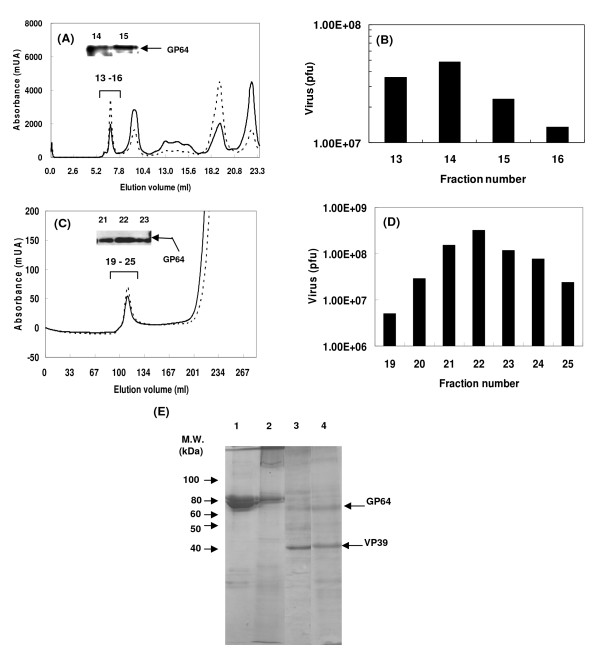
Purification of rBmNPV-hPRR from hemolymph by Superdex 200 10/300 GL column chromatography and Sephacryl S-1000 SF column chromatography. (A) and (C) Chromatogram of Superdex 200 10/300 GL and Sephacryl S-1000 SF column chromatography and GP64 detection by Western blot using anti-Bmgp64 antibody. Solid and dotted lines indicate absorbance at 280 and 254 nm, respectively. Numbers on GP64 bands indicate fraction numbers. (B) and (D) Baculovirus number as present in each fraction of Superdex 200 10/300 GL and Sephacryl S-1000 SF column chromatography. (E) SDS-PAGE analysis of proteins of each purified rBmNPV-hPRR fraction stained with CBB. Lane 1, hemolymph; lane 2, rBmNPV-hPRR purified by Superdex 200 10/300 GL column chromatography; lane 3, rBmNPV-hPRR purified by Sephacryl S-1000 column chromatography; lane 4, rBmNPV-hPRR purified from Bm5 cell culture supernatant.
Figure 4
Figure 4
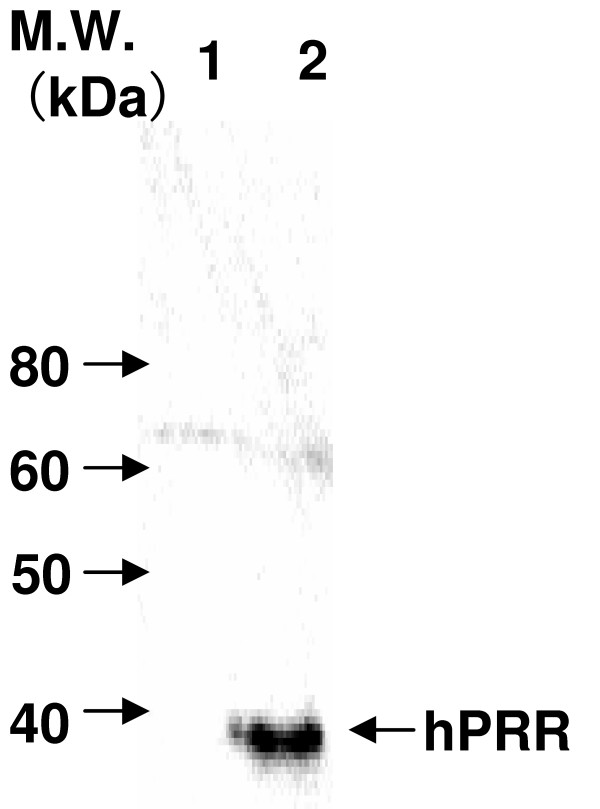
Western blot analysis of hPRR in each purified rBmNPV-hPRR from hemolymph by Sephacryl S-1000 column chromatography. hPRR of purified rBmNPV-hPRR was detected on reduced condition in Western blotting with mouse anti-FLAG M2 antibody, because the hPRR is a native form with FLAG peptide sequence. Lane 1, purified rBmNPV-hPRR at 4 days p.i.; lane 2, purified rBmNPV-hPRR at 5 days p.i..
Figure 5
Figure 5
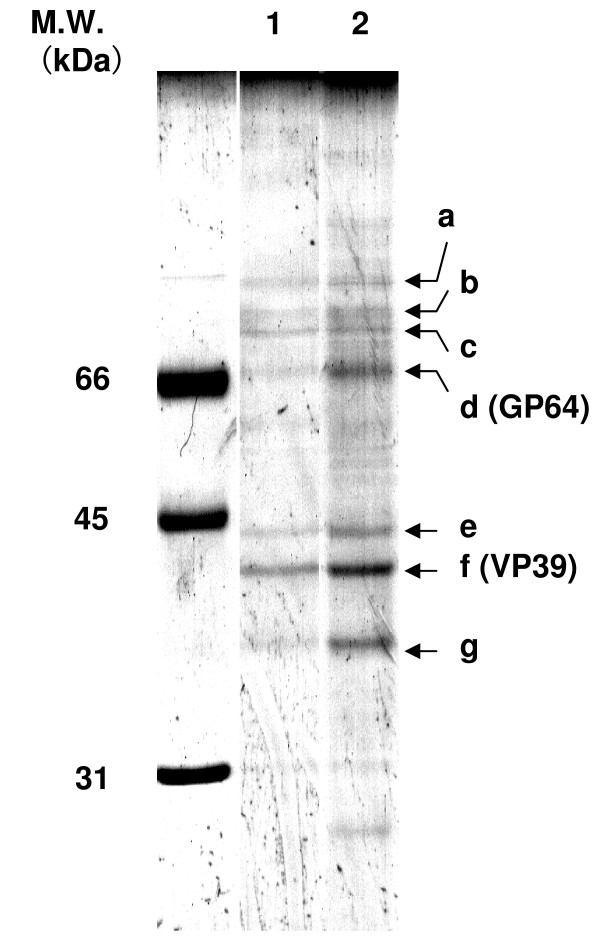
SDS-PAGE analysis of proteins in purified rBmNPV-hPRR at 4 and 5 days by CBB stain. Envelope and nucleocapsid proteins of purified rBmNPV-hPRR were separated by SDS-PAGE using 12% polyacrylamide. Lane 1, purified rBmNPV-hPRR at 4 days (1.1 μg of protein); lane 2, purified rBmNPV-hPRR at 5 days (1.6 μg of protein). a-g denotes main protein bands of rBmNPV-hPRR.
Figure 6
Figure 6
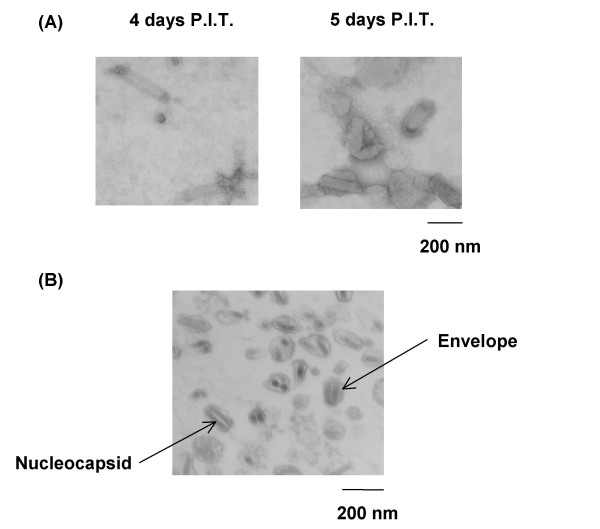
Shapes of purified rBmNPV-hPRR from larval hemolymph at 4 and 5 days p.i. (A) TEMs of purified rBmNPV-hPRR from hemolymph at 4 and 5 days p.i.. (B) Thin-section TEM of purified rBmNPV-hPRR from hemolymph at 5 days p.i..

References

    1. Sanghani PC, Moran RC. Purification and characterization of recombinant human folylpoly-γ-glutamate synthase expressed at high levels in insect cells. Protein Expr Purif. 2000;18:36–45. doi: 10.1006/prep.1999.1173. - DOI - PubMed
    1. Maranga L, Rueda P, Antonis AGF, Vela C, Langeveld JPM, Casal JI, Carrondo MJT. Large scale production and downstream processing of a recombinant porcine parvovirus vaccine. Appl Microbiol Biotechnol. 2002;59:45–50. doi: 10.1007/s00253-002-0976-x. - DOI - PubMed
    1. Fipaldini C, Bellei B, La Monica N. Expression of hepatitis C virus cDNA in human hepatoma cell line mediated by a hybrid baculovirus-HCV Vector. Virology. 1999;255:320–311. doi: 10.1006/viro.1998.9565. - DOI - PubMed
    1. Tani H, Limn CK, Yap CC, Onishi M, Nozaki M, Nishimune Y, Okahashi N, Kitagawa Y, Watanabe R, Mochizuki R, Moriishi K, Matsura Y. In vitro and in vivo gene delivery by recombinant baculoviruses. J Virol. 2003;77:9799–9808. doi: 10.1128/JVI.77.18.9799-9808.2003. - DOI - PMC - PubMed
    1. Hu Y. Baculovirus as a highly efficient expression vector in insect and mammalian cells. Acta Pharmacol Sin. 2005;26:405–416. doi: 10.1111/j.1745-7254.2005.00078.x. - DOI - PMC - PubMed

Publication types

LinkOut - more resources