


Developing competencies for training practitioners in evidence-based cancer control
- PMID: 19526405
- PMCID: PMC3877239
- DOI: 10.1080/08858190902876395
Developing competencies for training practitioners in evidence-based cancer control
Abstract
Background: Competency-based education allows public health departments to better develop a workforce aimed at conducting evidence-based control cancer.
Methods: A 2-phased competency development process was conducted that systematically obtained input from practitioners in health departments and trainers in academe and community agencies (n = 60).
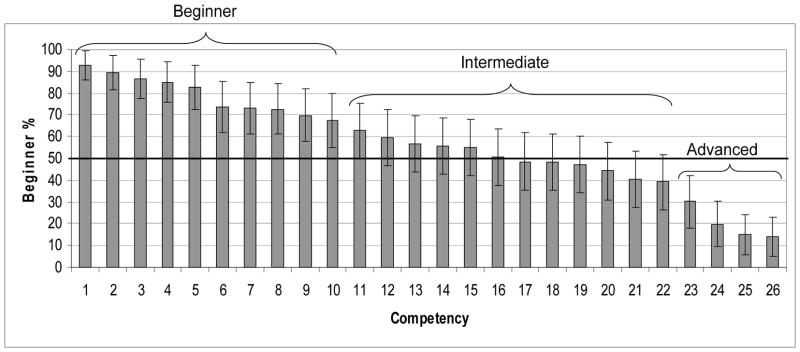
Results: Among the 26 competencies developed, 10 were rated at the beginner level, 12 were intermediate, and 4 were advanced. Community-level input competencies were seen as beginner level, whereas policy-related competencies were rated as advanced.
Conclusion: Although adaptation to various audiences is needed, these competencies provide a foundation on which to build practitioner-focused training programs.
Figures

References
-
- National Cancer Institute. To Eliminate the Suffering and Death Due to Cancer. Vol. 2006 Bethesda, MD: National Cancer Institute, US Department of Health and Human Services; Jan, 2006. The NCI Strategic Plan for Leading the Nation.
-
- Curry S, Byers T, Hewitt M, editors. Fulfilling the Potential of Cancer Prevention and Early Detection. Washington, DC: National Academies Press; 2003. - PubMed
-
- Brownson RC, Baker EA, Leet TL, Gillespie KN. Evidence-Based Public Health. New York: Oxford University Press; 2003.
-
- Black BL, Cowens-Alvarado R, Gershman S, Weir HK. Using data to motivate action: the need for high quality, an effective presentation, and an action context for decision-making. Cancer Causes Control. 2005 Oct;16( Suppl 1):15–25. - PubMed
-
- Zaza S, Briss PA, Harris KW, editors. The Guide to Community Preventive Services: What Works to Promote Health? New York: Oxford University Press; 2005.
Publication types
MeSH terms
Grants and funding
LinkOut - more resources
Full Text Sources