


Our plastic age
- PMID: 19528049
- PMCID: PMC2874019
- DOI: 10.1098/rstb.2009.0054
Our plastic age
Abstract
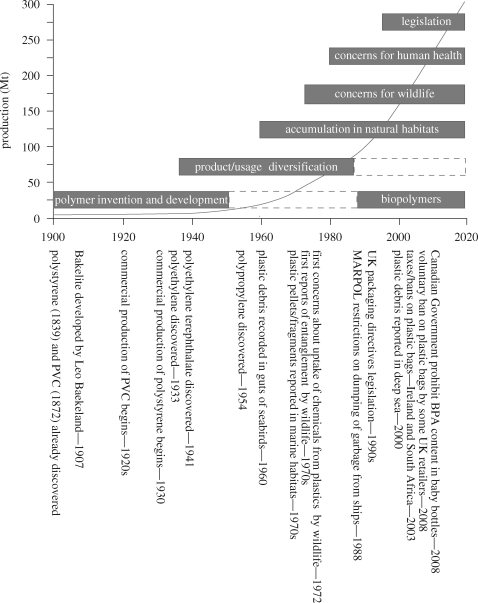
Within the last few decades, plastics have revolutionized our daily lives. Globally we use in excess of 260 million tonnes of plastic per annum, accounting for approximately 8 per cent of world oil production. In this Theme Issue of Philosophical Transactions of the Royal Society, we describe current and future trends in usage, together with the many benefits that plastics bring to society. At the same time, we examine the environmental consequences resulting from the accumulation of waste plastic, the effects of plastic debris on wildlife and concerns for human health that arise from the production, usage and disposal of plastics. Finally, we consider some possible solutions to these problems together with the research and policy priorities necessary for their implementation.
Figures
References
-
- Andrady A. L., Neal M. A.2009Applications and societal benefits of plastics. Phil. Trans. R. Soc. B 364, 1977–1984 (doi:10.1098/rstb.2008.0304) - DOI - PMC - PubMed
-
- APME 2006An analysis of plastics production, demand and recovery in Europe Brussels: Association of Plastics Manufacturers
-
- Arthur C., Baker J., Bamford H.2009. In Proc. Int. Res. Workshop on the Occurrence, Effects and Fate of Microplastic Marine Debris, 9–11 September 2008 NOAA Technical Memorandum NOS-OR&R30
-
- Barnes D. K. A., Galgani F., Thompson R. C., Barlaz M.2009Accumulation and fragmentation of plastic debris in global environments. Phil. Trans. R. Soc. B 364, 1985–1998 (doi:10.1098/rstb.2008.0205) - DOI - PMC - PubMed
-
- Gregory M. R.2009Environmental implications of plastic debris in marine settings—entanglement, ingestion, smothering, hangers-on, hitch-hiking and alien invasions. Phil. Trans. R. Soc. B 364, 2013–2025 (doi:10.1098/rstb.2008.0265) - DOI - PMC - PubMed
Publication types
MeSH terms
Substances
LinkOut - more resources
Full Text Sources
