. 2009 Jun 30;106(26):10847-52.
doi: 10.1073/pnas.0901800106. Epub 2009 Jun 15.

Mouse model of OPRM1 (A118G) polymorphism has sex-specific effects on drug-mediated behavior

Affiliations

Mouse model of OPRM1 (A118G) polymorphism has sex-specific effects on drug-mediated behavior

Stephen D Mague et al. Proc Natl Acad Sci U S A. .

Abstract

A single nucleotide polymorphism (SNP) in the human mu-opioid receptor gene (OPRM1 A118G) has been widely studied for its association in a variety of drug addiction and pain sensitivity phenotypes; however, the extent of these adaptations and the mechanisms underlying these associations remain elusive. To clarify the functional mechanisms linking the OPRM1 A118G SNP to addiction and analgesia phenotypes, we derived a mouse model possessing the equivalent nucleotide/amino acid substitution in the Oprm1 gene. Mice harboring this SNP (A112G) demonstrated several phenotypic similarities to humans carrying the A118G SNP, including reduced mRNA expression and morphine-mediated antinociception. We found additional phenotypes associated with this SNP including significant reductions of receptor protein levels, morphine-mediated hyperactivity, and the development of locomotor sensitization in mice harboring the G112 allele. In addition, we found sex-specific reductions in the rewarding properties of morphine and the aversive components of naloxone-precipitated morphine withdrawal. Further cross-species analysis will allow us to investigate mechanisms and adaptations present in humans carrying this SNP.


Conflict of interest statement

The authors declare no conflict of interest.

Figures
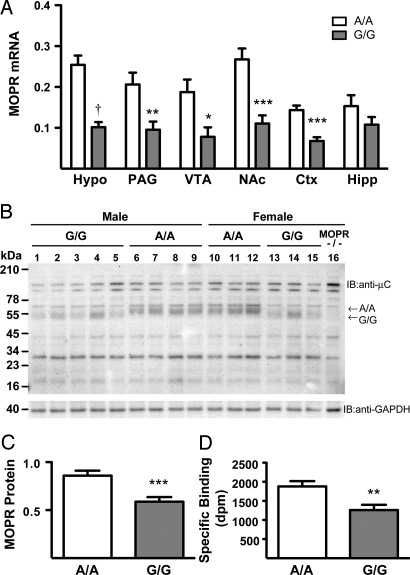
Fig. 1.
Fig. 1.
MOPR expression is decreased in A112G knock-in mice. (A) MOPR mRNA, as measured by real-time RT-PCR and normalized against TATA binding protein (TBP), in the periaqueductal gray (PAG), hypothalamus (Hypo), ventral tegmental area (VTA), nucleus accumbens (NAc), and cortex (Ctx) (mean ± SEM, n = 7–8; *, P < 0.05; **, P < 0.01; ***, P < 0.001; , P < 0.0001 compared to A/A, Bonferroni/Dunn). (B) A representative immunoblot of MOPR in membranes prepared from thalami of A/A mice, G/G mice, and MOPR−/− mice and probed with the MOPR antibody shows decreased molecular weight of MOPR protein in G/G mice. (C) Quantification of MOPR immunoreactivities, normalized against GAPDH (mean ± SEM, n = 11; ***, P < 0.001 compared to A/A). (D) Binding of [3H]DAMGO (3 nM) in thalamus membranes (0.1 mg/tube). Data are presented as specific binding/tube (dpm) for each sample run in duplicate (mean ± SEM, n = 11; **, P < 0.01 compared to A/A).
Fig. 2.
Fig. 2.
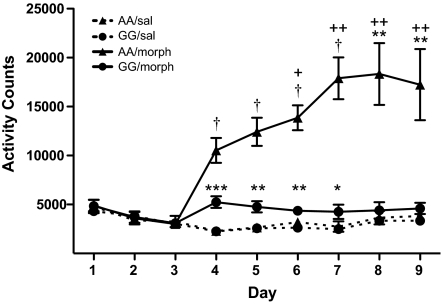
Morphine-mediated hyperlocomotion is blunted in G/G mice. Saline was administered to all groups on days 1–3 and morphine (10 mg/kg) was administered on days 4–9 (saline control groups received saline injections on all 9 days). Results are presented as total activity counts for the 120-min postinjection test (mean ± SEM, n = 6–7; *, P < 0.05; **, P < 0.01; ***, P < 0.001; , P < 0.0001 compared to saline-injected controls; +, P < 0.01; ++, P < 0.0001 compared to the average of days 1–3, Bonferroni/Dunn).
Fig. 3.
Fig. 3.
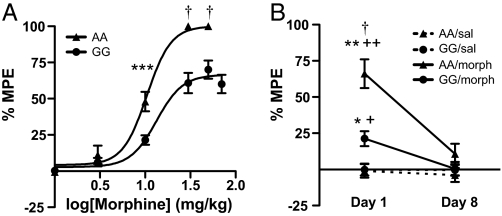
Morphine-mediated antinociception is decreased in G/G mice while tolerance to repeated exposure remains intact. (A) Morphine-mediated antinociception, as measured by hind-paw lick latency on a 55 °C hot-plate assay using a cumulative-dosing paradigm, was significantly reduced in G/G mice. Results are presented as percentage of maximal possible effect (MPE) [(morph jump latency − saline jump latency)/(total time − saline jump latency) × 100] (mean ± SEM, n = 18; ***, P < 0.001; , P < 0.0001 compared to G/G mice). (B) Tolerance to morphine-mediated (10 mg/kg) hot-plate antinociception was present in both A/A and G/G mice. Results are presented as percentage of maximal possible effect (MPE) [(morph jump latency − baseline jump latency)/(total time − baseline jump latency) × 100] (mean ± SEM, n = 12–14; *, P < 0.05; **, P < 0.01 compared to saline-treated controls; +, P < 0.05; ++, P < 0.01 compared to day 8; , P < 0.0001 compared to G/G mice treated with morphine, Bonferroni/Dunn).
Fig. 4.
Fig. 4.
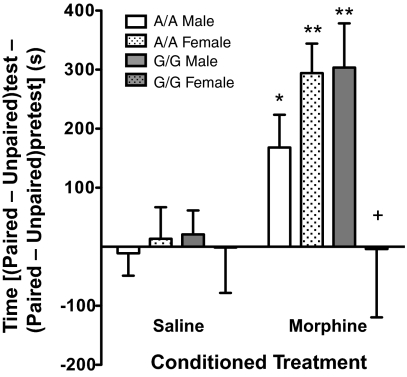
Female G/G mice failed to show a conditioned place preference to morphine-paired environments (10 mg/kg). Results are presented as the difference in time spent in drug-paired environments compared to nondrug-paired environments on the test day minus the difference in time from the preconditioning day (mean ± SEM, n = 6–8; *, P < 0.05; **, P < 0.01 compared to saline-treated controls; +, P < 0.05 compared to morphine-treated A/A females and G/G males, Bonferroni/Dunn).
Fig. 5.
Fig. 5.
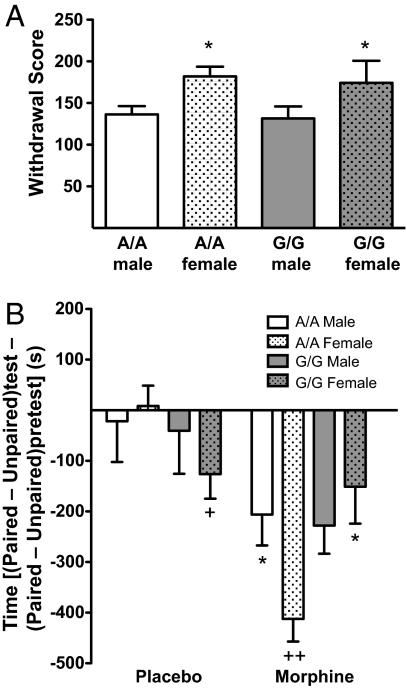
Disassociation of the physical and affective components of naloxone-precipitated morphine withdrawal. (A) A/A and G/G mice displayed similar somatic signs of naloxone-precipitated (0.1 mg/kg) withdrawal. Results are presented as the withdrawal score calculated by summing the total number of occurrences of jumping, paw tremor, genital licking, backing up, gnawing, ptosis, resting tremor, diarrhea, and teeth chatter (mean ± SEM, n = 5–6; *, P < 0.05 compared to male A/A and G/G). (B) Naloxone-precipitated morphine withdrawal-induced place aversions were reduced in G/G females. Additionally, placebo-treated G/G females displayed aversion to naloxone-paired environments compared to A/A females. Results are presented as the difference in time spent in drug-paired environments compared to nondrug-paired environments on the test day minus the difference in time from the preconditioning day (mean ± SEM, n = 8–12; *, P < 0.05 compared to morphine-treated A/A females; +, P < 0.05; ++, P < 0.0001 compared to placebo-treated A/A females, Bonferroni/Dunn).

References

    1. Gelernter J, Kranzler H, Cubells J. Genetics of two mu opioid receptor gene (OPRM1) exon I polymorphisms: Population studies and allele frequencies in alcohol- and drug-dependent subjects. Mol Psychiatry. 1999;4(5):476–483. - PubMed
    1. Bergen AW, et al. Mu opioid receptor gene variants: Lack of association with alcohol dependence. Mol Psychiatry. 1997;2(6):490–494. - PubMed
    1. Tan EC, Tan CH, Karupathivan U, Yap EP. Mu opioid receptor gene polymorphisms and heroin dependence in Asian populations. Neuroreport. 2003;14(4):569–572. - PubMed
    1. Ray LA, Hutchison KE. A polymorphism of the mu-opioid receptor gene (OPRM1) and sensitivity to the effects of alcohol in humans. Alcohol Clin Exp Res. 2004;28(12):1789–1795. - PubMed
    1. Drakenberg K, et al. Mu opioid receptor A118G polymorphism in association with striatal opioid neuropeptide gene expression in heroin abusers. Proc Natl Acad Sci USA. 2006;103(20):7883–7888. - PMC - PubMed

Publication types

MeSH terms