. 2009;10(6):R66.
doi: 10.1186/gb-2009-10-6-r66. Epub 2009 Jun 16.

Global expression analysis of the brown alga Ectocarpus siliculosus (Phaeophyceae) reveals large-scale reprogramming of the transcriptome in response to abiotic stress

Affiliations

Global expression analysis of the brown alga Ectocarpus siliculosus (Phaeophyceae) reveals large-scale reprogramming of the transcriptome in response to abiotic stress

Simon M Dittami et al. Genome Biol. 2009.

Abstract

Background: Brown algae (Phaeophyceae) are phylogenetically distant from red and green algae and an important component of the coastal ecosystem. They have developed unique mechanisms that allow them to inhabit the intertidal zone, an environment with high levels of abiotic stress. Ectocarpus siliculosus is being established as a genetic and genomic model for the brown algal lineage, but little is known about its response to abiotic stress.

Results: Here we examine the transcriptomic changes that occur during the short-term acclimation of E. siliculosus to three different abiotic stress conditions (hyposaline, hypersaline and oxidative stress). Our results show that almost 70% of the expressed genes are regulated in response to at least one of these stressors. Although there are several common elements with terrestrial plants, such as repression of growth-related genes, switching from primary production to protein and nutrient recycling processes, and induction of genes involved in vesicular trafficking, many of the stress-regulated genes are either not known to respond to stress in other organisms or are have been found exclusively in E. siliculosus.

Conclusions: This first large-scale transcriptomic study of a brown alga demonstrates that, unlike terrestrial plants, E. siliculosus undergoes extensive reprogramming of its transcriptome during the acclimation to mild abiotic stress. We identify several new genes and pathways with a putative function in the stress response and thus pave the way for more detailed investigations of the mechanisms underlying the stress tolerance of brown algae.


Figures

Figure 1
Figure 1
Effects of saline and oxidative stress of different intensities on the photosynthetic efficiency (quantum yield) of E. siliculosus. The conditions in red (1,470 mM NaCl, 12.5% seawater, and 1 mM H2O2) were the conditions chosen for the microarray analysis.
Figure 2
Figure 2
Intracellular versus extracellular osmolarity and Na+ concentration under saline stress. Oxidative stress samples are not shown as they did not differ significantly from the control sample. Every point represents the mean of five biological replicates ± standard deviation.
Figure 3
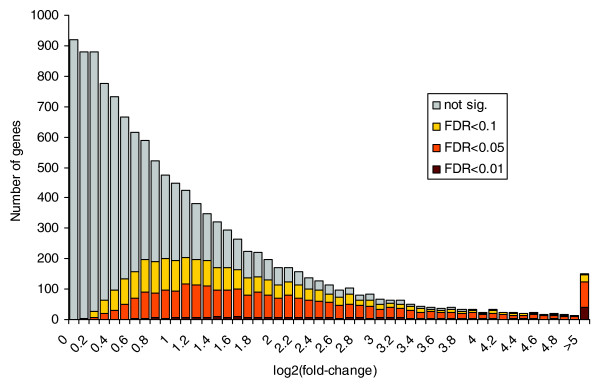
Figure 3
Distribution of observed fold-changes (log2-ratios of stress and control samples). All three comparisons between stress and control treatments were considered and the observed frequencies averaged. The color coding shows how many transcripts were labeled as differentially expressed at different FDRs. Not sig., not significant.
Figure 4
Figure 4
Venn diagram of KEGG pathways identified as over-represented among the transcripts significantly up- or down-regulated (FDR <0.1) in the different stress conditions. Only KEGG pathways with q-values < 0.1 in at least two conditions or for both datasets (FDR of 0.05 and FDR of 0.1) were considered. The general category 'other enzymes' was not included. Further 'SNARE interactions in vesicular transport' includes the category 'SNARE', and 'photosynthesis' includes 'photosynthesis proteins' and 'porphyrin and chlorophyll metabolism'. No pathways were found to be common only to hyposaline and hypersaline stress. SNARE, soluble N-ethylmaleimide-sensitive factor attachment receptor.
Figure 5
Figure 5
Expression graphs of clusters identified by the k-means algorithm. The graphs display the log2-ratio of all stress conditions (hypo = green, hyper = red, oxi = blue) with the control condition. GO terms and KEGG pathways (KO) identified as over-represented in these clusters (FDR = 10%) are shown next to the graph.
Figure 6
Figure 6
Major transcriptomic changes in E. siliculosus under short-term oxidative and saline stress. This schema summarizes the most important transcriptomic changes discussed in the text. Processes on the left (blue) were repressed, while processes on the right (yellow) were activated. Please note that this graph displays only the general trends; some of the pathways are not regulated in all stress conditions and not all genes of one pathway are always regulated in the same way (see text for details).

References

    1. Boyen C, Oudot MP, Loiseaux-De Goër S. Origin and evolution of plastids and mitochondria: the phylogenetic diversity of algae. Cah Biol Mar. 2001;42:11–24.
    1. Baldauf SL. The deep roots of eukaryotes. Science. 2003;300:1703–1706. - PubMed
    1. Graham MH, Kinlan BP, Druehl LD, Garske LE, Banks S. Deep-water kelp refugia as potential hotspots of tropical marine diversity and productivity. Proc Natl Acad Sci USA. 2007;104:16576–16580. - PMC - PubMed
    1. Santelices B. The discovery of kelp forests in deep-water habitats of tropical regions. Proc Natl Acad Sci USA. 2007;104:19163–19164. - PMC - PubMed
    1. Küpper FC, Carpenter LJ, McFiggans GB, Palmer CJ, Waite TJ, Boneberg E-M, Woitsch S, Weiller M, Abela R, Grolimund D, Potin P, Butler A, Luther GW, Kroneck PMH, Meyer-Klaucke W, Feiters MC. Iodide accumulation provides kelp with an inorganic antioxidant impacting atmospheric chemistry. Proc Natl Acad Sci USA. 2008;105:6954–6958. - PMC - PubMed

Publication types

MeSH terms