Review
. 2009;27(3):163-79.
doi: 10.3233/RNN-2009-0467.

Mechanisms of gender-linked ischemic brain injury

Affiliations
Review

Mechanisms of gender-linked ischemic brain injury

Mingyue Liu et al. Restor Neurol Neurosci. 2009.

Abstract

Biological sex is an important determinant of stroke risk and outcome. Women are protected from cerebrovascular disease relative to men, an observation commonly attributed to the protective effect of female sex hormones, estrogen and progesterone. However, sex differences in brain injury persist well beyond the menopause and can be found in the pediatric population, suggesting that the effects of reproductive steroids may not completely explain sexual dimorphism in stroke. We review recent advances in our understanding of sex steroids (estradiol, progesterone and testosterone) in the context of ischemic cell death and neuroprotection. Understanding the molecular and cell-based mechanisms underlying sex differences in ischemic brain injury will lead to a better understanding of basic mechanisms of brain cell death and is an important step toward designing more effective therapeutic interventions in stroke.


Figures
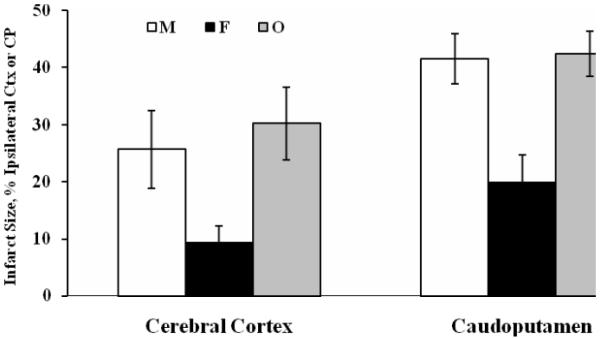
Fig. 1
Fig. 1
Sex Differences in Ischemic Brain Injury. Ischemia was induced by MCA occlusion for 2 hours in age-matched male (M), female (F) and ovariectomized (O) female rats. Infarct size was measured in brain sections by TTC staining at 22 hours of reperfusion and expressed as a percentage of ipsilateral cerebral cortex (CTX) or caudoputamen (CP). * Different from M and O (P < 0.05) (Alkayed et al., 1998).
Fig. 2
Fig. 2
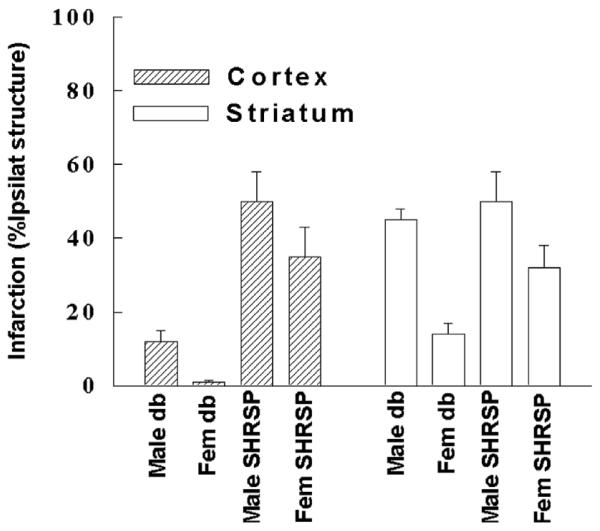
Sex differences in Ischemic Brain Injury are Unaffected by Diabetes and Hypertension. Hypoxia-ischemia (HI) was induced in male and female db/db mice, a genetic model of Type II diabetes, by combined common carotid artery ligation and hypoxia, and tissue damage assessed by hematoxylin and eosin staining. Focal cerebral ischemia was induced in age-matched male and female stroke prone spontaneously hypertensive rats (SHR-SP) rats by MCA occlusion for 2 hours, and infarct size was measured at 24 hours by triphenyl-tetrazolium chloride (TTC).
Fig. 3
Fig. 3
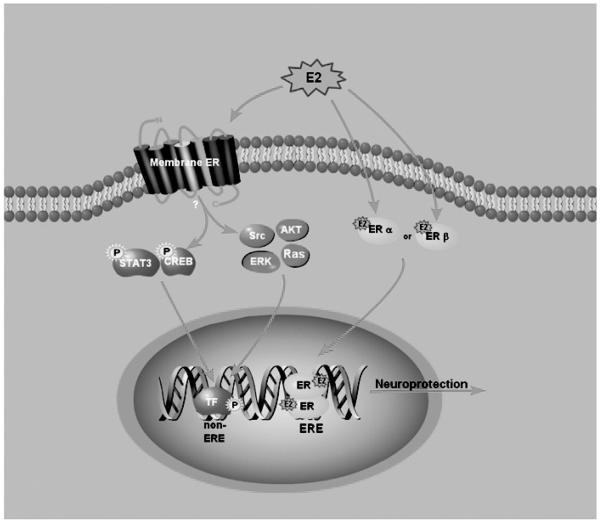
E2 induces neuroprotective genes after ischemia by classical and non-classical mechanisms. In the classical mechanism, E2 binds to either ERα or ERβ receptor and acts as a transcription factor that directly binds to estrogen response elements (EREs) in neuroprotective gene promoters. In the non-classical mechanism, E2 binds to a putative membrane estrogen receptor, resulting in rapid activation of signaling cascades (shown in pink). Activation of signaling cascades leads to the phosphorylation and activation of transcription factors, including STAT3 or Creb (shown in blue), which bind to their cognate response elements (non-ERE sites) in neuroprotective gene promoters.
Fig. 4
Fig. 4
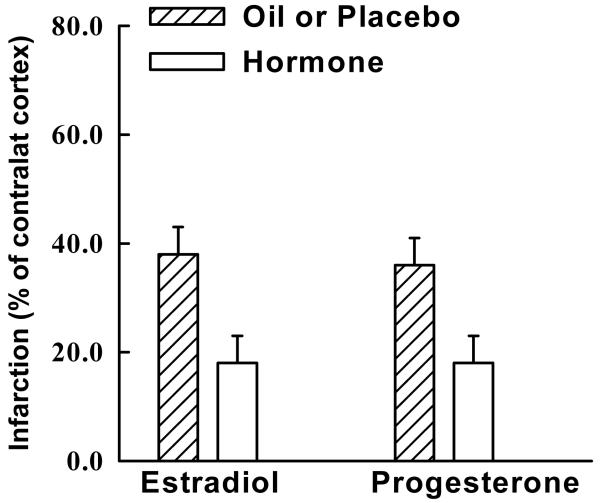
Female Sex Hormones 17β-Estradiol and Progesterone are Protective against Ischemic Brain Injury. Ischemia was induced in ovariectomized female rats with and without hormone replacement for two hours by MCA occlusion, and infarct size was measured in the cerebral cortex at 24 hours by triphenyl tetrazolium chloride (TTC) and expressed as a percentage of contralateral cortex to account for edema.
Fig. 5
Fig. 5
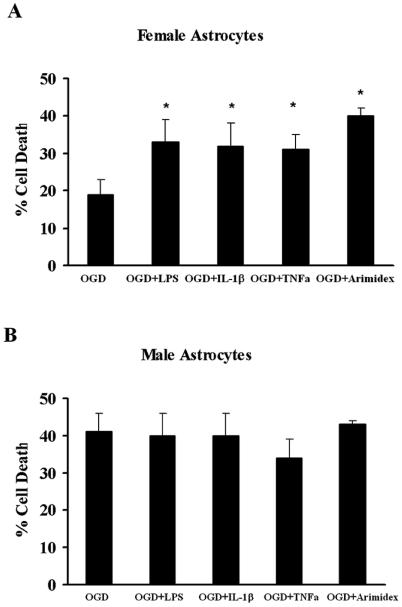
Sex-specific astrocytic cell death. A. Female astrocytes are more resistant to cell death induced by oxygen-glucose deprivation. LPS, interleukin-1β (IL-1β), tissue necrosis factor (TNF)-1α and Arimidex exacerbate OGD-induced cell death in female astrocytes compared to OGD alone. * p < 0.05. B. Male astrocytes are more susceptible to cell death induced by oxygen-glucose deprivation. LPS, interleukin-1β (IL-1β), tissue necrosis factor (TNF)-1α and Arimidex did not alter OGD-induced cell death in male astrocytes. Adapted from Liu et al., 2007.
Fig. 6
Fig. 6
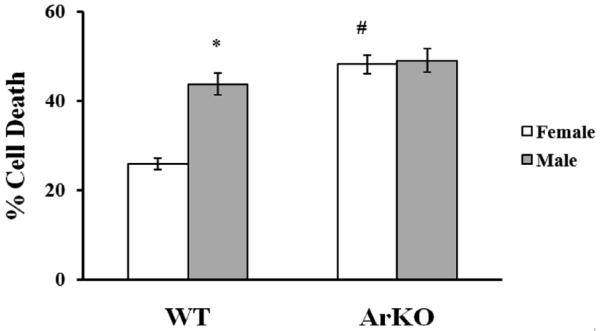
Sex differences in OGD-induced cell death in mouse astrocytes. WT female astrocytes are less susceptible to cell death compared to WT male astrocytes after OGD (#p < 0.05). Cell death markedly increased in ArKO female astrocytes compared to WT female cells (*p < 0.05), but there was no significant difference in cell death between ArKO male astrocytes compared to WT male cells. Sex-specific responses to OGD were abolished in ArKO astrocyte cultures. Adapted from Liu et al., 2008.

References

    1. Abraham IM, Todman MG, Korach KS, Herbison AE. Critical in vivo roles for classical estrogen receptors in rapid estrogen actions on intracellular signaling in mouse brain. Endocrinology. 2004;145:3055–3061. - PubMed
    1. Ahlbom E, Grandison L, Bonfoco E, Zhivotovsky B, Ceccatelli S. Androgen treatment of neonatal rats decreases susceptibility of cerebellar granule neurons to oxidative stress in vitro. Eur J Neurosci. 1999;11:1285–1291. - PubMed
    1. Ahlbom E, Prins GS, Ceccatelli S. Testosterone protects cerebellar granule cells from oxidative stress-induced cell death through a receptor mediated mechanism. Brain Res. 2001;892:255–262. - PubMed
    1. Alkayed NJ, Wang MM, Hurn PD. Clark R, editor. Reproductive hormones as neuroprotectants in brain injury. Brain injury molecular and cellular biology of critical care medicines series Kluwer-Lippincott. 2001a
    1. Alkayed NJ, Goto S, Sugo N, Joh HD, Klaus J, Crain BJ, et al. Estrogen and bcl-2: Gene induction and effect of transgene in experimental stroke. J Neurosci. 2001b;21:7543–7550. - PMC - PubMed

Publication types

Substances

LinkOut - more resources