


Baseline articular contact stress levels predict incident symptomatic knee osteoarthritis development in the MOST cohort
- PMID: 19533741
- PMCID: PMC2981407
- DOI: 10.1002/jor.20936
Baseline articular contact stress levels predict incident symptomatic knee osteoarthritis development in the MOST cohort
Abstract
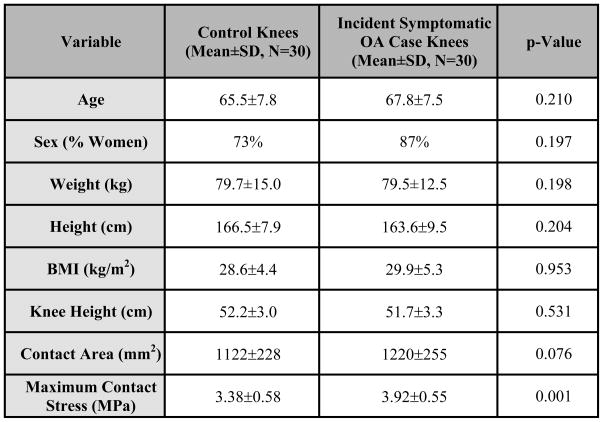
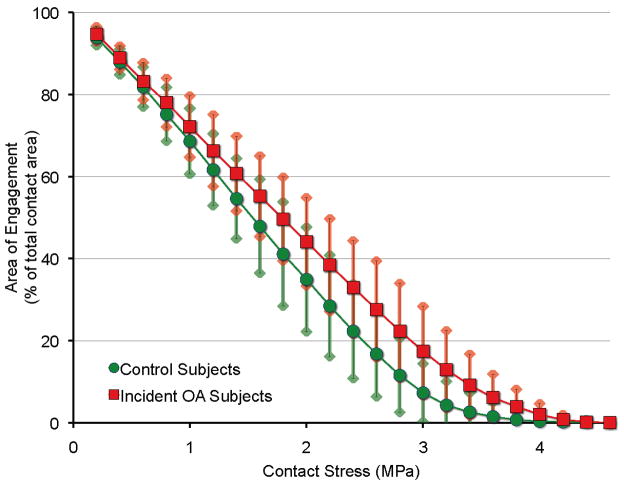
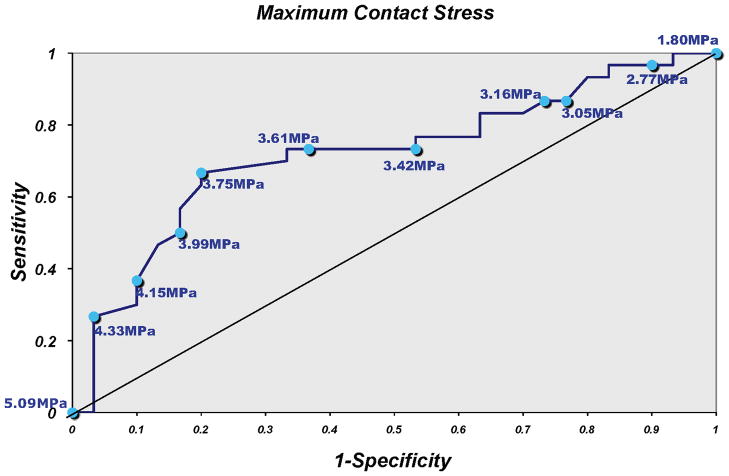
We studied whether contact stress estimates from knee magnetic resonance images (MRI) predict the development of incident symptomatic tibiofemoral osteoarthritis (OA) 15 months later in an at-risk cohort. This nested case-control study was conducted within a cohort of 3,026 adults, age 50 to 79 years. Thirty cases with incident symptomatic tibiofemoral OA by their 15 month follow-up visit were randomly selected and matched with 30 control subjects. Symptomatic tibiofemoral OA was defined as daily knee pain/stiffness and Kellgren-Lawrence Grade > or =2 on weight bearing, fixed-flexion radiographs. Tibiofemoral geometry was segmented on baseline knee MRI, and contact stresses were estimated using discrete element analysis. Linear mixed models for repeated measures were used to examine the association between articular contact stress and case/control status. No significant intergroup differences were found for age, sex, BMI, weight, height, or limb alignment. However, the maximum articular contact stress was 0.54 +/- 0.77 MPa (mean +/- SD) higher in incident OA cases compared to that in control knees (p = 0.0007). The interaction between case-control status and contact stress was significant above 3.20 MPa (p < 0.0001). The presence of differences in estimated contact stress 15 months prior to incidence suggests a biomechanical mechanism for symptomatic tibiofemoral OA and supports the ability to identify risk by subject-specific biomechanical modeling.
Conflict of interest statement
The authors have no conflict of interest with respect to any aspect of this study.
Figures
References
-
- Fried LP, Guralnik JM. Disability in older adults: evidence regarding significance, etiology, and risk. J Am Geriatr Soc. 1997;45:92–100. - PubMed
-
- Hochberg MC, Kasper J, Williamson J, Skinner A, Fried LP. The contribution of osteoarthritis to disability: preliminary data from the Women’s Health and Aging Study. J Rheumatol Suppl. 1995;43:16–18. - PubMed
-
- Felson DT. Risk factors for osteoarthritis: understanding joint vulnerability. Clinical Orthopaedics & Related Research. 2004:S16–21. - PubMed
Publication types
MeSH terms
Grants and funding
LinkOut - more resources
Full Text Sources
Other Literature Sources
