


Of mice and humans: how good are HLA transgenic mice as a model of human immune responses?
- PMID: 19534819
- PMCID: PMC2702351
- DOI: 10.1186/1745-7580-5-3
Of mice and humans: how good are HLA transgenic mice as a model of human immune responses?
Abstract
Background: Previous studies have defined vaccinia virus (VACV)-derived T cell epitopes in VACV-infected human leukocyte antigen-A*0201 (HLA-A2.1) transgenic (Tg) mice and A2.1-positive human Dryvax vaccinees. A total of 14 epitopes were detected in humans and 16 epitopes in A2.1 Tg mice; however, only two epitopes were independently reported in both systems. This limited overlap raised questions about the suitability of using HLA Tg mice as a model system to map human T cell responses to a complex viral pathogen. The present study was designed to investigate this issue in more detail.
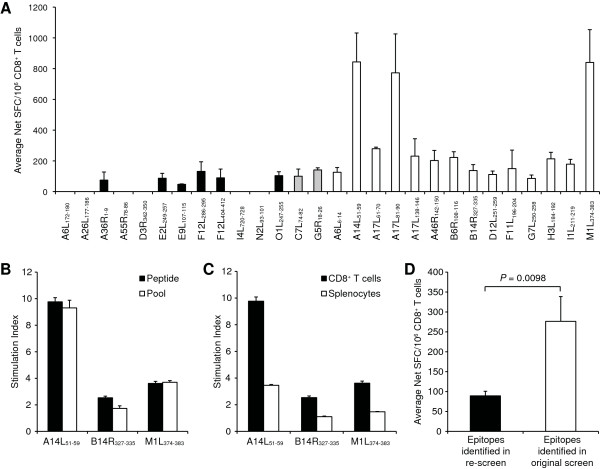
Results: Re-screening the panel of 28 A2.1-restricted epitopes in additional human vaccinees and in A2.1 Tg mice revealed that out of the 28 identified epitopes, 13 were detectable in both systems, corresponding to a 46% concordance rate. Interestingly, the magnitude of responses in Tg mice against epitopes originally identified in humans is lower than for epitopes originally detected in mice. Likewise, responses in humans against epitopes originally detected in Tg mice are of lower magnitude.
Conclusion: These data suggest that differences in immunodominance patterns might explain the incomplete response overlap, and that with limitations; HLA Tg mice represent a relevant and suitable model system to study immune responses against complex pathogens.
Figures
References
-
- Wu SJ, Hayes CG, Dubois DR, Windheuser MG, Kang YH, Watts DM, Sieckmann DG. Evaluation of the severe combined immunodeficient (SCID) mouse as an animal model for dengue viral infection. Am J Trop Med Hyg. 1995;52:468–476. - PubMed
-
- Shirai M, Arichi T, Nishioka M, Nomura T, Ikeda K, Kawanishi K, Engelhard VH, Feinstone SM, Berzofsky JA. CTL responses of HLA-A2.1-transgenic mice specific for hepatitis C viral peptides predict epitopes for CTL of humans carrying HLA-A2.1. J Immunol. 1995;154:2733–2742. - PubMed
-
- Pasquetto V, Bui HH, Giannino R, Banh C, Mirza F, Sidney J, Oseroff C, Tscharke DC, Irvine K, Bennink JR, Peters B, Southwood S, Cerundolo V, Grey H, Yewdell JW, Sette A. HLA-A*0201, HLA-A*1101, and HLA-B*0702 transgenic mice recognize numerous poxvirus determinants from a wide variety of viral gene products. J Immunol. 2005;175:5504–5515. - PubMed
LinkOut - more resources
Full Text Sources
Molecular Biology Databases
Research Materials
Miscellaneous