


Quantity matters: male sex pheromone signals mate quality in the parasitic wasp Nasonia vitripennis
- PMID: 19535374
- PMCID: PMC2817171
- DOI: 10.1098/rspb.2009.0738
Quantity matters: male sex pheromone signals mate quality in the parasitic wasp Nasonia vitripennis
Abstract
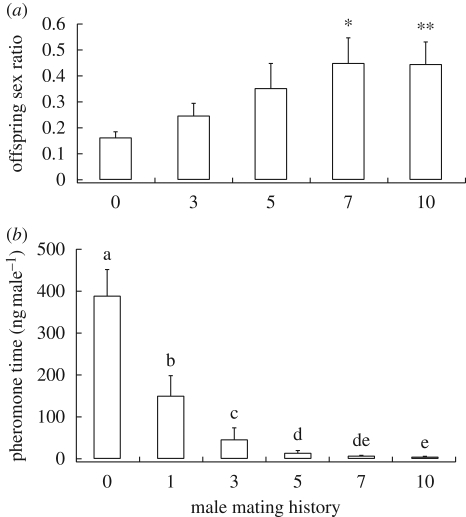
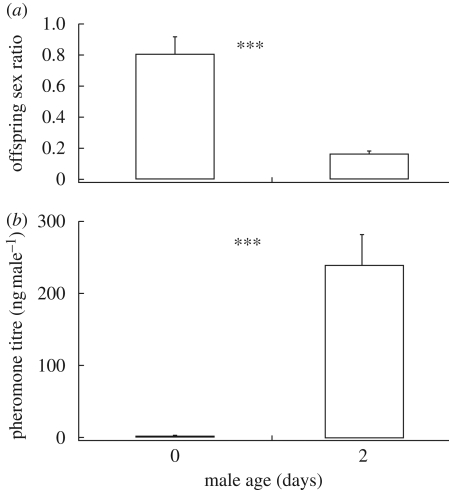
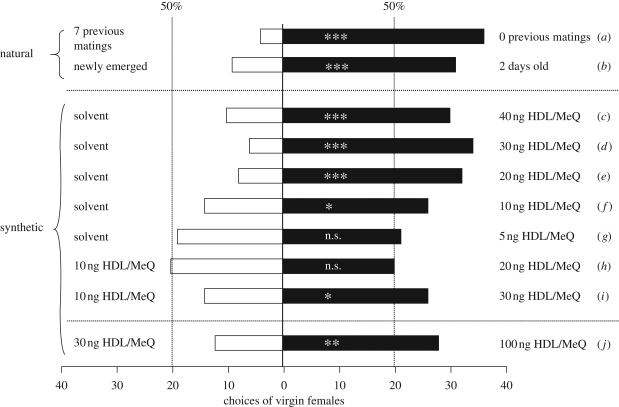
Sexual selection theory asserts that females are well adapted to sense signals indicating the quality of potential mates. One crucial male quality parameter is functional fertility (i.e. the success of ejaculates in fertilizing eggs). The phenotype-linked fertility hypothesis (PLFH) predicts that functional fertility of males is reflected by phenotypic traits that influence female mate choice. Here, we show for Nasonia vitripennis, a parasitic wasp with haplodiploid sex determination and female-biased sex ratios, that females use olfactory cues to discriminate against sperm-limited males. We found sperm limitation in newly emerged and multiply mated males (seven or more previous matings) as indicated by a higher proportion of sons in the offspring fathered by these males. Sperm limitation correlated with clearly reduced pheromone titres. In behavioural bioassays, females oriented towards higher doses of the synthetic pheromone and were attracted more often to scent marks of males with a full sperm load than to those of sperm-limited males. Our data support the PLFH and suggest that N. vitripennis females are able to decrease the risk of getting constrained to produce suboptimal offspring sex ratios by orienting towards gradients of the male sex pheromone.
Figures
References
-
- Abdel-latief M., Garbe L.-A., Koch M., Ruther J.2008An epoxide hydrolase involved in the biosynthesis of an insect sex attractant and its use to localize the production site. Proc. Natl Acad. Sci. USA 105, 8914–8919 (doi:10.1073/pnas.0801559105) - DOI - PMC - PubMed
-
- Andersson M.1994Sexual selection Princeton, NJ: Princeton University Press
-
- Andersson M., Simmons L. W.2006Sexual selection and mate choice. Trends Ecol. Evol. 21, 296–302 (doi:10.1016/j.tree.2006.03.015) - DOI - PubMed
-
- Barras R.1961A quantitative study of the behavior of the male Mormoniella vitripennis towards two constant stimulus situations. Behaviour 18, 288–312 (doi:10.1163/156853961X00178) - DOI
-
- Beeler A. E., Rauter C. M., Moore A. J.2002Mate discrimination by females in the burying beetle Nicrophorus orbicollis: the influence of male size on attractiveness to females. Ecol. Entomol. 27, 1–6 (doi:10.1046/j.1365-2311.2002.0371a.x) - DOI
Publication types
MeSH terms
Substances
LinkOut - more resources
Full Text Sources