


The long-term label retaining population of the renal papilla arises through divergent regional growth of the kidney
- PMID: 19535568
- PMCID: PMC2739716
- DOI: 10.1152/ajprenal.90650.2008
The long-term label retaining population of the renal papilla arises through divergent regional growth of the kidney
Abstract
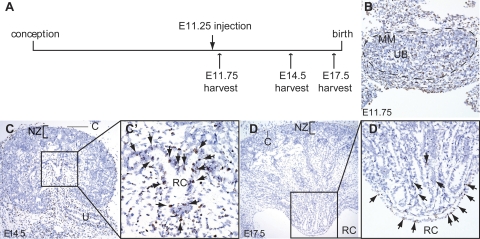
Long-term pulse chase experiments previously identified a sizable population of BrdU-retaining cells within the renal papilla. The origin of these cells has been unclear, and in this work we test the hypothesis that they become quiescent early during the course of kidney development and organ growth. Indeed, we find that BrdU-retaining cells of the papilla can be labeled only by pulsing with BrdU from embryonic (E) day 11.25 to postnatal (P) day 7, the approximate period of kidney development in the mouse. BrdU signal in the cortex and outer medulla is rapidly diluted by cellular proliferation during embryonic development and juvenile growth, whereas cells within the papilla differentiate and exit the cell cycle during organogenesis. Indeed, by E17.5, little or no active proliferation can be seen in the distal papilla, indicating maturation of this structure in a distal-to-proximal manner during organogenesis. We conclude that BrdU-retaining cells of the papilla represent a population of cells that quiesce during embryonic development and localize within a region of the kidney that matures early. We therefore propose that selective papillary retention of BrdU arises through a combination of regionalized slowing of, and exit from, the cell cycle within the papilla during the period of ongoing kidney development, and extensive proliferative growth of the juvenile kidney resulting in dilution of BrdU below the detection level in extra-papillary regions.
Figures



References
-
- Cha JH, Kim YH, Jung JY, Han KH, Madsen KM, Kim J. Cell proliferation in the loop of Henle in the developing rat kidney. J Am Soc Nephrol 12: 1410–1421, 2001. - PubMed
-
- Cotsarelis G, Cheng SZ, Dong G, Sun TT, Lavker RM. Existence of slow-cycling limbal epithelial basal cells that can be preferentially stimulated to proliferate: implications on epithelial stem cells. Cell 57: 201–209, 1989. - PubMed
-
- Fang TC, Alison MR, Cook HT, Jeffery R, Wright NA, Poulsom R. Proliferation of bone marrow-derived cells contributes to regeneration after folic acid-induced acute tubular injury. J Am Soc Nephrol 16: 1723–1732, 2005. - PubMed
-
- Fujigaki Y, Goto T, Sakakima M, Fukasawa H, Miyaji T, Yamamoto T, Hishida A. Kinetics and characterization of initially regenerating proximal tubules in S3 segment in response to various degrees of acute tubular injury. Nephrol Dial Transplant 21: 41–50, 2006. - PubMed
Publication types
MeSH terms
Substances
Grants and funding
LinkOut - more resources
Full Text Sources
