


Dissemination of Escherichia coli with CTX-M type ESBL between humans and yellow-legged gulls in the south of France
- PMID: 19536298
- PMCID: PMC2694269
- DOI: 10.1371/journal.pone.0005958
Dissemination of Escherichia coli with CTX-M type ESBL between humans and yellow-legged gulls in the south of France
Abstract
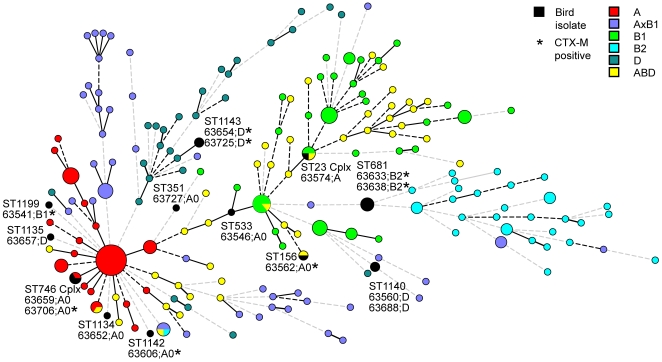
Extended Spectrum beta-Lactamase (ESBL) producing Enterobacteriaceae started to appear in the 1980s, and have since emerged as some of the most significant hospital-acquired infections with Escherichia coli and Klebsiella being main players. More than 100 different ESBL types have been described, the most widespread being the CTX-M beta-lactamase enzymes (bla(CTX-M) genes). This study focuses on the zoonotic dissemination of ESBL bacteria, mainly CTX-M type, in the southern coastal region of France. We found that the level of general antibiotic resistance in single randomly selected E. coli isolates from wild Yellow-legged Gulls in France was high. Nearly half the isolates (47.1%) carried resistance to one or more antibiotics (in a panel of six antibiotics), and resistance to tetracycline, ampicillin and streptomycin was most widespread. In an ESBL selective screen, 9.4% of the gulls carried ESBL producing bacteria and notably, 6% of the gulls carried bacteria harboring CTX-M-1 group of ESBL enzymes, a recently introduced and yet the most common clinical CTX-M group in France. Multi locus sequence type and phylogenetic group designations were established for the ESBL isolates, revealing that birds and humans share E. coli populations. Several ESBL producing E. coli isolated from birds were identical to or clustered with isolates with human origin. Hence, wild birds pick up E. coli of human origin, and with human resistance traits, and may accordingly also act as an environmental reservoir and melting pot of bacterial resistance with a potential to re-infect human populations.
Conflict of interest statement
Figures
References
-
- Sorum H, Sunde M. Resistance to antibiotics in the normal flora of animals. Vet Res. 2001;32:227–241. - PubMed
-
- Livermore DM, Canton R, Gniadkowski M, Nordmann P, Rossolini GM, et al. CTX-M: changing the face of ESBLs in Europe. J Antimicrob Chemother. 2007;59:165–174. - PubMed
-
- Gordon DM, Cowling A. The distribution and genetic structure of Escherichia coli in Australian vertebrates: host and geographic effects. Microbiology. 2003;149:3575–3586. - PubMed
-
- Österblad M, Norrdahl K, Korpimaki E, Huovinen P. Antibiotic resistance. How wild are wild mammals? Nature. 2001;409:37–38. - PubMed
Publication types
MeSH terms
Substances
LinkOut - more resources
Full Text Sources
Other Literature Sources
