


HER-2 positive breast cancer: decreasing proportion but stable incidence in Finnish population from 1982 to 2005
- PMID: 19538720
- PMCID: PMC2716505
- DOI: 10.1186/bcr2322
HER-2 positive breast cancer: decreasing proportion but stable incidence in Finnish population from 1982 to 2005
Abstract
Introduction: Classification of breast cancers according to the HER-2 oncogene status is of central importance in the selection of post-surgical therapies. A decrease in the proportion of HER-2-positive breast cancer has been suspected, but no data on the incidence trends at population level have been reported.
Methods: We studied the proportion of HER-2-positive breast cancers by chromogenic in situ hybridization (CISH) in three cohorts (years 1982 to 1986 (n = 310), 1989 to 1992 (n = 108), and 2004 to 2005 (n = 713)) in the population of the Pirkanmaa hospital district (approximately 220,000 women). Cancer incidence rates were age-adjusted to the world standard population.
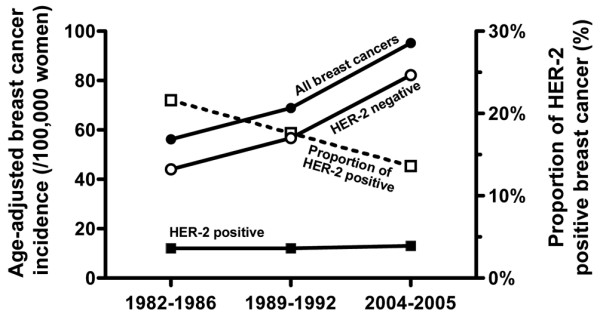
Results: The proportion of HER-2-positive breast cancer declined from 21.6% (average in 1982 to 1986) to 13.6% (average in 2004 to 2005). However, during the same time period the age-adjusted incidence of all invasive breast cancers had increased by 40%. These opposite trends balanced each other and indicated that the incidence of HER-2-positive breast cancer has remained unchanged (Poisson regression coefficient for time trend 1.000; 95% CI = 0.989 to 1.012). In contrast, the incidence of HER-2-negative cancer showed 2% annual increase (Poisson regression coefficient 1.021, 95% CI = 1.016 to 1.026). Although HER-2-negative cancers were more likely to be diagnosed by mammography screening, the changes were more likely to be explained by etiological risk factors favoring HER-2-negative (and hormone receptor-positive) disease such as menopausal hormone therapy.
Conclusions: These results document a significant decrease in the proportion of HER-2-positive breast cancer. However, the incidence of HER-2-positive cancer at the population level was found to be unchanged.
Figures
References
-
- Romond EH, Perez EA, Bryant J, Suman VJ, Geyer CE, Jr, Davidson NE, Tan-Chiu E, Martino S, Paik S, Kaufman PA, Swain SM, Pisansky TM, Fehrenbacher L, Kutteh LA, Vogel VG, Visscher DW, Yothers G, Jenkins RB, Brown AM, Dakhil SR, Mamounas EP, Lingle WL, Klein PM, Ingle JN, Wolmark N. Trastuzumab plus adjuvant chemotherapy for operable HER2-positive breast cancer. N Engl J Med. 2005;353:1673–1684. doi: 10.1056/NEJMoa052122. - DOI - PubMed
-
- Piccart-Gebhart MJ, Procter M, Leyland-Jones B, Goldhirsch A, Untch M, Smith I, Gianni L, Baselga J, Bell R, Jackisch C, Cameron D, Dowsett M, Barrios CH, Steger G, Huang CS, Andersson M, Inbar M, Lichinitser M, Láng I, Nitz U, Iwata H, Thomssen C, Lohrisch C, Suter TM, Rüschoff J, Suto T, Greatorex V, Ward C, Straehle C, McFadden E, Dolci MS, Gelber RD, Herceptin Adjuvant (HERA) Trial Study Team Trastuzumab after adjuvant chemotherapy in HER2-positive breast cancer. N Engl J Med. 2005;353:1659–1672. doi: 10.1056/NEJMoa052306. - DOI - PubMed
-
- Slamon D, Eiermann W, Robert N, Pienkowski T, Martin M, Pawlicki M, Chan A, Smylie M, Liu M, Falkson C, Pinter T, Fornander T, Shiftan T, Valero V, von Minckwitz G, Mackey J, Tabah-Fisch I, Buyse M, Lindsay MA, Riva A, Bee V, Pegram M, Press M, Crown J. BCIRG 006: 2nd interim analysis phase III randomized trial comparing doxorubicin and cyclophosphamide followed by docetaxel (AC T) with doxorubicin and cyclophosphamide followed by docetaxel and trastuzumab (AC TH) with docetaxel, carboplatin and trastuzumab (TCH) in Her2neu positive early breast cancer patients [abstract] Breast Cancer Res Treat. 2006;100(Suppl 1):52.
Publication types
MeSH terms
Substances
LinkOut - more resources
Full Text Sources
Medical
Research Materials
Miscellaneous
