. 2009 Jun 18:6:82.
doi: 10.1186/1743-422X-6-82.

The complete genome of klassevirus - a novel picornavirus in pediatric stool

Affiliations

The complete genome of klassevirus - a novel picornavirus in pediatric stool

Alexander L Greninger et al. Virol J. .

Abstract

Background: Diarrhea kills 2 million children worldwide each year, yet an etiological agent is not found in approximately 30-50% of cases. Picornaviral genera such as enterovirus, kobuvirus, cosavirus, parechovirus, hepatovirus, teschovirus, and cardiovirus have all been found in human and animal diarrhea. Modern technologies, especially deep sequencing, allow rapid, high-throughput screening of clinical samples such as stool for new infectious agents associated with human disease.

Results: A pool of 141 pediatric gastroenteritis samples that were previously found to be negative for known diarrheal viruses was subjected to pyrosequencing. From a total of 937,935 sequence reads, a collection of 849 reads distantly related to Aichi virus were assembled and found to comprise 75% of a novel picornavirus genome. The complete genome was subsequently cloned and found to share 52.3% nucleotide pairwise identity and 38.9% amino acid identity to Aichi virus. The low level of sequence identity suggests a novel picornavirus genus which we have designated klassevirus. Blinded screening of 751 stool specimens from both symptomatic and asymptomatic individuals revealed a second positive case of klassevirus infection, which was subsequently found to be from the index case's 11-month old twin.

Conclusion: We report the discovery of human klassevirus 1, a member of a novel picornavirus genus, in stool from two infants from Northern California. Further characterization and epidemiological studies will be required to establish whether klasseviruses are significant causes of human infection.


Figures

Figure 1
Figure 1
A. Genome organization of human klassevirus 1. Conserved picornaviral domains present in klassevirus are noted. Pyrosequencing contigs that align to Aichi virus by TBLASTX with an E-value of less than 10-6 covered more than 75% of the genome (light purple). Pyrosequncing contigs that align to the human klassevirus 1 genome by BLASTN with an E-value of less than 10-6 covered more than 95% of the full genome. B. Scanning nucleotide pairwise identity using a 100-bp window is depicted for Aichi virus, bovine kobuvirus, and porcine kobuvirus. C. Scanning amino acid pairwise identity using a 100-bp window versus Aichi virus.
Figure 2
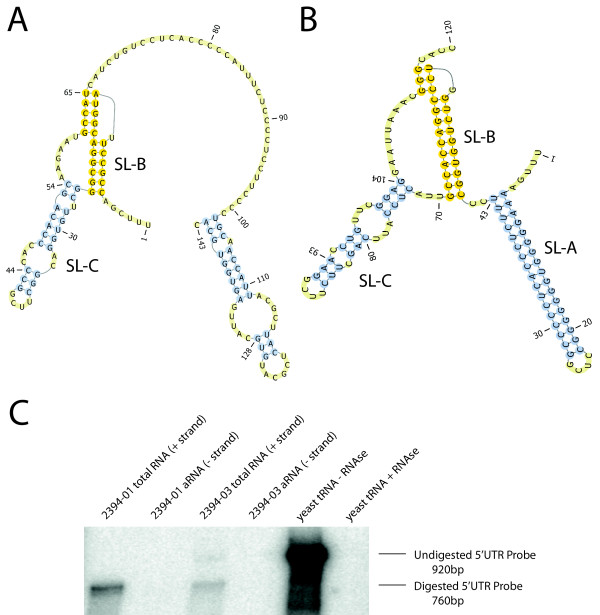
Figure 2
A. Predicted RNA secondary structure of first 143 bp of 5' UTR of klassevirus using pknotsRG from Bielefeld University. B. Predicted RNA secondary structure of first 120 bp of 5' UTR of Aichi virus using pknotsRG. The first 100 bp of Aichi virus, bovine kobuvirus, and porcine kobuvirus 5' UTRs are very conserved and have been shown to be critical for viral replication and encapsidation. C. RNAse protection experiment to show divergent klassevirus 5' UTR is contiguous. A 920-bp radiolabeled probe consisting of 760 bp of human kobuvirus 2 5' UTR flanked on each side by 80 bp of bacterial vector sequence was hybridized to stool total RNA, (-)-stranded kobuvirus, or nonsensical yeast tRNA, and digested by RNAse A/T1.
Figure 3
Figure 3
Alignment of klassevirus and kobuvirus 5' UTRs. The latter 500 bp of klasssevirus 5' UTR aligns with 69% identity to Aichi virus. We were unable to recover the conserved SL-A sequence found in kobuviruses from klassevirus, although the increasing sequence identity toward the 5' end of the genome is suggestive that the 5' end may not be complete.
Figure 4
Figure 4
Phylogenetic tree of klassevirus genome versus strains of other picornavirus genomes from genera based on coding region amino acid identity using clustalw.

References

    1. Racaniello VR. Picornaviridae: The Viruses and Their Replication. In: David M Knipe, Peter M, editor. Fields Virology. 5. Vol. 1. Howley: Lippincott Williams & Wilkins; 2007. pp. 795–838.
    1. Yamashita T, Kobayashi S, Sakae K, Nakata S, Chiba S, Ishihara Y, Isomura S. Isolation of cytopathic small round viruses with BS-C-1 cells from patients with gastroenteritis. J Infect Dis. 1991;164:954–7. - PubMed
    1. Yamashita T, Ito M, Kabashima Y, Tsuzuki H, Fujihara A, Sakae K. Isolation and characterization of a new species of kobuvirus associated with cattle. J Gen Virol. 2003;84:3069–77. doi: 10.1099/vir.0.19266-0. - DOI - PubMed
    1. Reuter G, Boldizsar A, Pankovics P. Complete nucleotide and amino acid sequences and genetic organization of porcine kobuvirus, a member of a new species in the genus Kobuvirus, family Picornaviridae. Arch Virol. 2009;154:101–8. doi: 10.1007/s00705-008-0288-2. - DOI - PubMed
    1. Yamashita T, Sakae K, Ishihara Y, Isomura S, Utagawa E. Prevalence of newly isolated, cytopathic small round virus (Aichi strain) in Japan. J Clin Microbiol . 1993;31:2938–2943. - PMC - PubMed

Publication types

Associated data