


Review
doi: 10.1016/j.it.2009.05.004.
Epub 2009 Jun 21.
Human innate immunosenescence: causes and consequences for immunity in old age
Affiliations
- PMID: 19541535
- PMCID: PMC4067971
- DOI: 10.1016/j.it.2009.05.004
Item in Clipboard
Review
Human innate immunosenescence: causes and consequences for immunity in old age
Trends Immunol.
2009 Jul.
Abstract
The past decade has seen an explosion in research focusing on innate immunity. Through a wide range of mechanisms including phagocytosis, intracellular killing and activation of proinflammatory or antiviral cytokine production, the cells of the innate immune system initiate and support adaptive immunity. The effects of aging on innate immune responses remain incompletely understood, particularly in humans. Here we review advances in the study of human immunosenescence in the diverse cells of the innate immune system, including neutrophils, monocytes, macrophages, natural killer and natural killer T (NKT) cells and dendritic cells-with a focus on consequences for the response to infection or vaccination in old age.
Figures
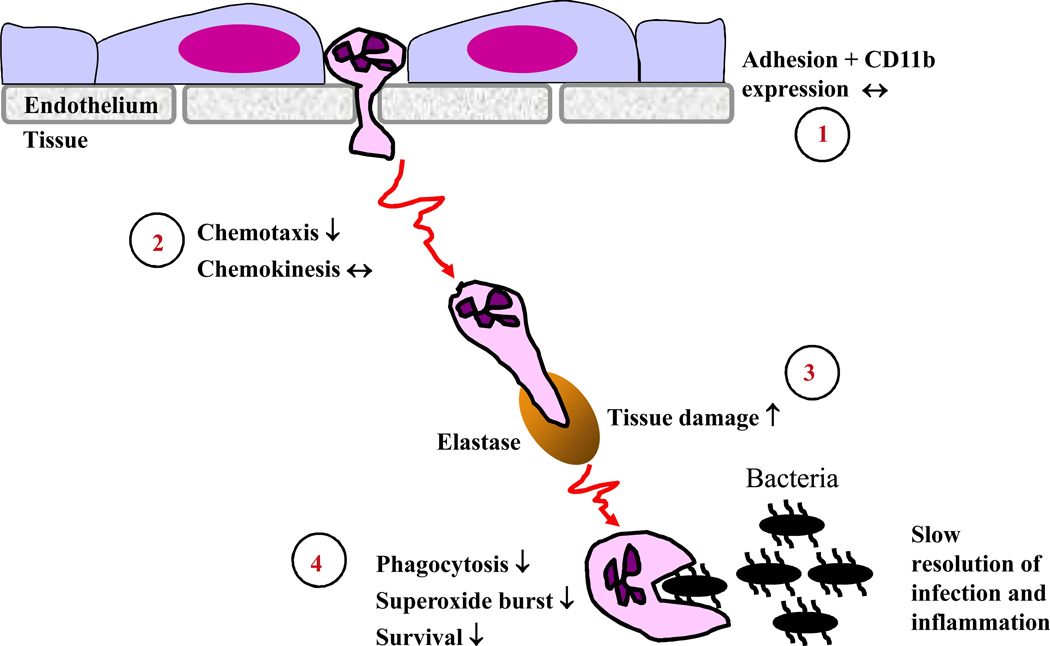
1) Neutrophil adhesion to vascular endothelium and initial extravasation
into tissue is unaffected by aging [89].
2) Chemotaxis appears to be compromised by aging whilst chemokinesis remains
intact [112], reducing the efficiency of
migration to the infected site. 3) Migration through tissue involves secretion
of proteases such as neutrophil elastase from azurophilic granules. Reduced
chemotactic activity would increase exposure of tissue to such proteases,
increasing collateral damage to healthy tissue. 4) At the site of infection
itself neutrophil uptake of microbes and subsequent killing involving generation
of superoxide are both reduced with age [76,77,112], due in part to reduced responsiveness to priming
agents such as GM-CSF [81]. GM-CSF also
extends neutrophil lifespan at sites of infection and thus reduced
responsiveness to this cytokine increases apoptosis. Each of these factors will
contribute to the reduced ability of aged adults to clear bacterial infections
and to resolve inflammation promptly.
References
-
- Auffray C, et al. Blood Monocytes: Development, Heterogeneity, and Relationship with Dendritic Cells. Annu Rev Immunol. 2009 - PubMed
-
- Sebastian C, et al. MacrophAging: a cellular and molecular review. Immunobiology. 2005;210:121–126. - PubMed
-
- Fietta A, et al. Influence of aging on some specific and nonspecific mechanisms of the host defense system in 146 healthy subjects. Gerontology. 1994;40:237–245. - PubMed
-
- Ogawa T, et al. Age-related changes of human bone marrow: a histometric estimation of proliferative cells, apoptotic cells, T cells, B cells and macrophages. Mech Ageing Dev. 2000;117:57–68. - PubMed
-
- Kawai T, Akira S. TLR signaling. Semin Immunol. 2007;19:24–32. - PubMed
Publication types
MeSH terms
Substances
Grants and funding
LinkOut - more resources
Full Text Sources
Other Literature Sources
Medical
Miscellaneous
