. 2009 Jun 30;106(26):10672-7.
doi: 10.1073/pnas.0902670106. Epub 2009 Jun 16.

Functional analysis of an Orc6 mutant in Drosophila

Affiliations

Functional analysis of an Orc6 mutant in Drosophila

Maxim Balasov et al. Proc Natl Acad Sci U S A. .

Abstract

The origin recognition complex (ORC) is a 6-subunit complex required for the initiation of DNA replication in eukaryotic organisms. ORC is also involved in other cell functions. The smallest Drosophila ORC subunit, Orc6, is important for both DNA replication and cytokinesis. To study the role of Orc6 in vivo, the orc6 gene was deleted by imprecise excision of P element. Lethal alleles of orc6 are defective in DNA replication and also show abnormal chromosome condensation and segregation. The analysis of cells containing the orc6 deletion revealed that they arrest in both the G(1) and mitotic stages of the cell cycle. Orc6 deletion can be rescued to viability by a full-length Orc6 transgene. The expression of mutant transgenes of Orc6 with deleted or mutated C-terminal domain results in a release of mutant cells from G(1) arrest and restoration of DNA replication, indicating that the DNA replication function of Orc6 is associated with its N-terminal domain. However, these mutant cells accumulate at mitosis, suggesting that the C-terminal domain of Orc6 is important for the passage through the M phase. In a cross-species complementation experiment, the expression of human Orc6 in Drosophila Orc6 mutant cells rescued DNA replication, suggesting that this function of the protein is conserved among metazoans.


Conflict of interest statement

The authors declare no conflict of interest.

Figures
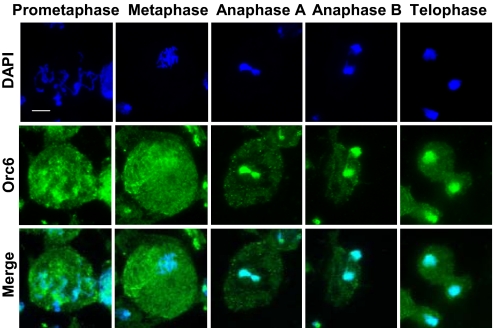
Fig. 1.
Fig. 1.
Drosophila Orc6 accumulates on chromosomes in anaphase through telophase. Immunofluorescence images of wild-type Drosophila neuroblasts stained with affinity-purified anti-Orc6 antibody (green) are shown in metaphase, anaphase, and telophase stages. DNA is stained with DAPI (blue). (Scale bar: 5 μm.)
Fig. 2.
Fig. 2.
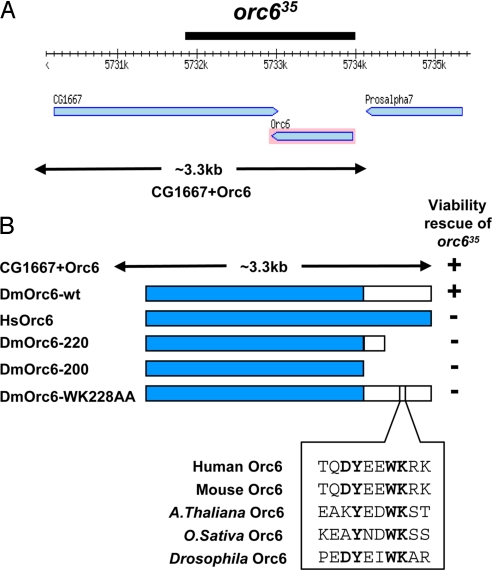
Generation and rescue of Orc6 mutant. Fragment of genomic map from Drosophila database and limits of the orc635 deletion are shown (A). Drosophila wild-type (DmOrc6), human (HsOrc6), truncated C terminus mutants (DmOrc6-220, DmOrc6-200), and substitution mutant (DmOrc6-WK228AA), all fused with GFP, were used in the rescue experiments (B). The predicted cytokinesis domain of Orc6 is shown in white. Conservative tryptophan (228) and lysine (229) amino acid residues of Drosophila Orc6 were replaced with alanines to create DmOrc6-WK228AA clone. An alignment of corresponding Orc6 sequences between different species is shown in the box.
Fig. 3.
Fig. 3.
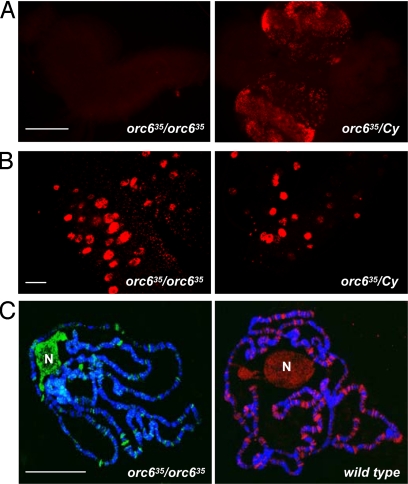
DNA replication in Orc6 mutant. BrdU incorporation level (red) in third-instar larval brains (A) and in salivary glands of orc635 mutant (B) compared with wild-type or orc635/Cy heterozygous animals. (C) Immunofluorescence experiments using affinity-purified anti-Orc6 antibody on polytene chromosomes isolated from wild-type animals (red) and from orc635 mutant (green) show the presence of Orc6 at specific loci along the chromosome length and in the nucleolus (N). (Scale bars: A and B, 100 μm; C, 50 μm.)
Fig. 4.
Fig. 4.
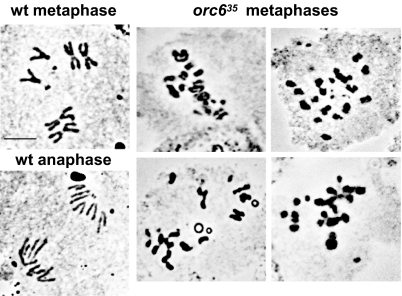
Aceto-Orcein squashes of orc635 brains. Metaphase-like chromosomes in orc635 mutant neuroblasts are abnormally condensed and fragmented compared with the wild-type chromosomes (wt). (Scale bar: 5 μm.)
Fig. 5.
Fig. 5.
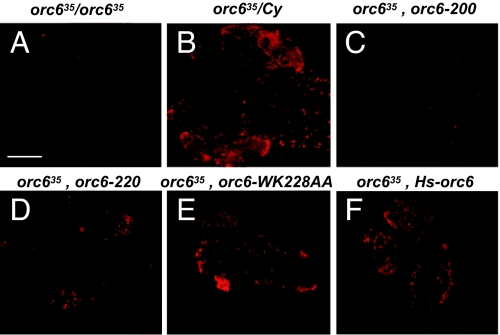
BrdU incorporation in Orc6 transgenic mutants. DNA replication in orc635 mutant neuroblasts (A) is rescued by the expression of Drosophila GFP-Orc6-220 (C terminus-truncated mutant; D), GFP-Orc6-WK228AA (amino acid substitution mutant; E), and human GFP-HsOrc6 (F), but not by the expression of Drosophila GFP-Orc6-200 (C). BrdU incorporation in heterozygous orc635/Cy neuroblasts is shown in B. (Scale bar: 100 μm.)
Fig. 6.
Fig. 6.
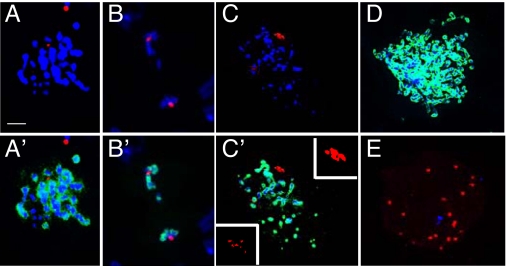
Cell cycle defects in Orc6 transgenic mutants. orc635 neuroblasts expressing GFP-Orc6-220 or GFP-Orc6-WK228AA are arrested in metaphase-like stage (A), but they also display anaphase-like figures (B) and proceed further in the cell cycle to form cells with multiple centrosomes and polyploid cells (C–E). Two clusters of multicentrosome bodies (enlarged 5× in CInsets) are shown on metaphase-like figures in C. DNA is stained with DAPI (blue); centrosomes are stained with anti-γ-tubulin antibody (red); mitotic chromosomes are stained with antibody raised against phosphohistone H3 (green). Merged images are shown in A′, B′, C′, D, and E. (Scale bar: 10 μm.)

References

    1. Bell SP. The origin recognition complex: From simple origins to complex functions. Genes Dev. 2002;16:659–672. - PubMed
    1. Machida YJ, Hamlin JL, Dutta A. Right place, right time, and only once: Replication initiation in metazoans. Cell. 2005;123:13–24. - PubMed
    1. Chesnokov IN. Multiple functions of the origin recognition complex. Int Rev Cytol. 2007;256:69–109. - PubMed
    1. Romanowski P, Madine MA, Rowles A, Blow JJ, Laskey RA. The Xenopus origin recognition complex is essential for DNA replication and MCM binding to chromatin. Curr Biol. 1996;6:1416–1425. - PubMed
    1. Rowles A, et al. Interaction between the origin recognition complex and the replication licensing system in Xenopus. Cell. 1996;87:287–296. - PubMed

Publication types

MeSH terms

LinkOut - more resources