


Top-down high-resolution mass spectrometry of cardiac myosin binding protein C revealed that truncation alters protein phosphorylation state
- PMID: 19541641
- PMCID: PMC2722289
- DOI: 10.1073/pnas.0813369106
Top-down high-resolution mass spectrometry of cardiac myosin binding protein C revealed that truncation alters protein phosphorylation state
Abstract
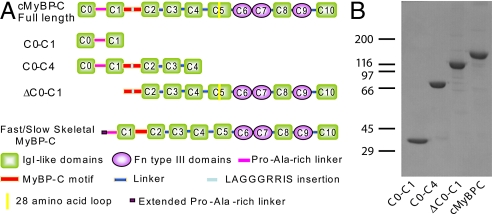
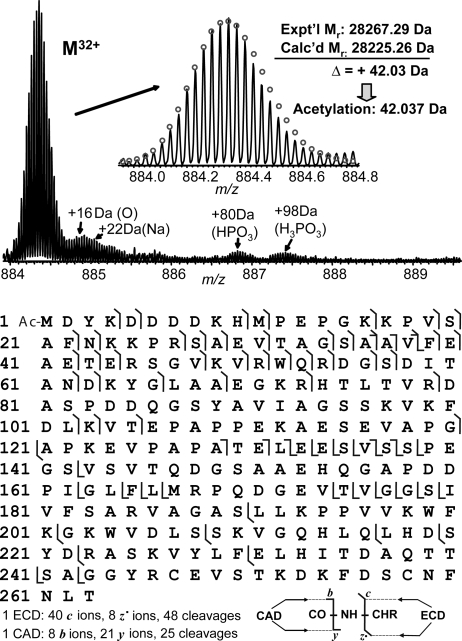
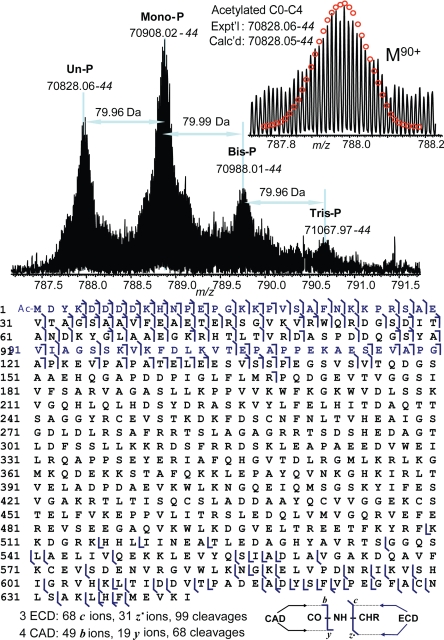
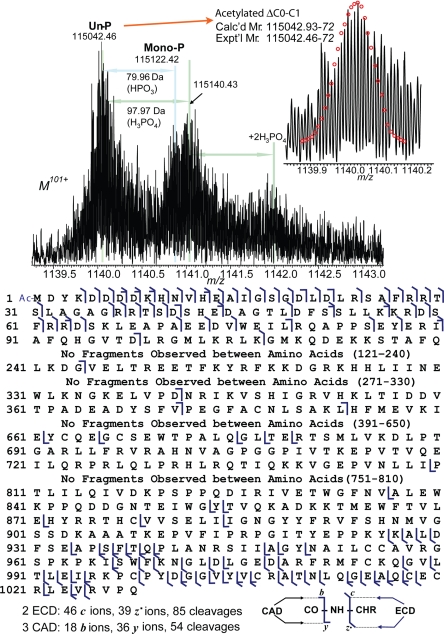
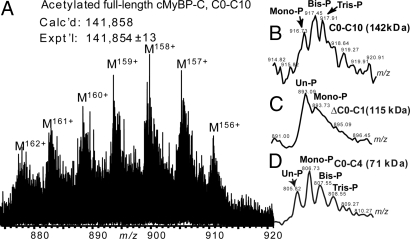
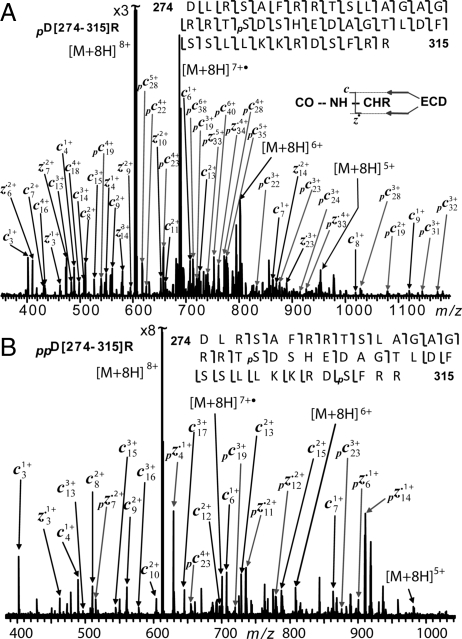
Cardiac myosin binding protein C (cMyBP-C), bound to the sarcomere's myosin thick filament, plays an important role in the regulation of muscle contraction. cMyBP-C is a large multidomain protein that interacts with myosin, titin, and possibly actin. Mutations in cMyBP-C are the most common known cause of heritable hypertrophic cardiomypathies. Phosphorylation of cMyBP-C plays an essential role in the normal cardiac function. cMyBP-C (142 kDa) has 81 serine and 73 threonine residues presenting a major challenge for unequivocal identification of specific phosphorylation sites. Top-down mass spectrometry, which directly analyzes intact proteins, is a powerful technique to universally observe and quantify protein posttranslational modifications without a priori knowledge. Here, we have extended top-down electron capture dissociation mass spectrometry to comprehensively characterize mouse cMyBP-C expressed in baculovirus. We have unambiguously identified all of the phosphorylation sites in the truncated (28-115 kDa) and full-length forms of cMyBP-C (142 kDa) and characterized the sequential phosphorylations, using a combination of top-down and middle-down (limited proteolysis) MS approach, which ensures full sequence coverage. Unit mass resolution and high mass accuracy (<5 ppm) have been achieved for a 115-kDa protein (the largest protein isotopically resolved to date). Remarkably, we discovered that truncations in recombinant proteins, even a seemingly minor one, can dramatically alter its phosphorylation state, which is significant because truncated recombinant proteins are routinely substituted for their full-length forms in crystal structure and functional studies. Our study provides direct evidence of alterations in the posttranslational state between the truncated and full-length recombinant proteins, which can lead to variations in structure and function.
Conflict of interest statement
The authors declare no conflict of interest.
Figures
References
-
- Winegrad S. Myosin binding protein C, a potential regulator of cardiac contractility. Circ Res. 2000;86:6–7. - PubMed
-
- Flashman E, Redwood C, Moolman-Smook J, Watkins H. Cardiac myosin binding protein C—Its role in physiology and disease. Circ Res. 2004;94:1279–1289. - PubMed
-
- de Tombe PP. Myosin binding protein C in the heart. Circ Res. 2006;98:1234–1236. - PubMed
-
- Moss RL, Razumova M, Fitzsimons DP. Myosin crossbridge activation of cardiac thin filaments-Implications for myocardial function in health and disease. Circ Res. 2004;94:1290–1300. - PubMed
Publication types
MeSH terms
Substances
Grants and funding
LinkOut - more resources
Full Text Sources
Other Literature Sources
Molecular Biology Databases
